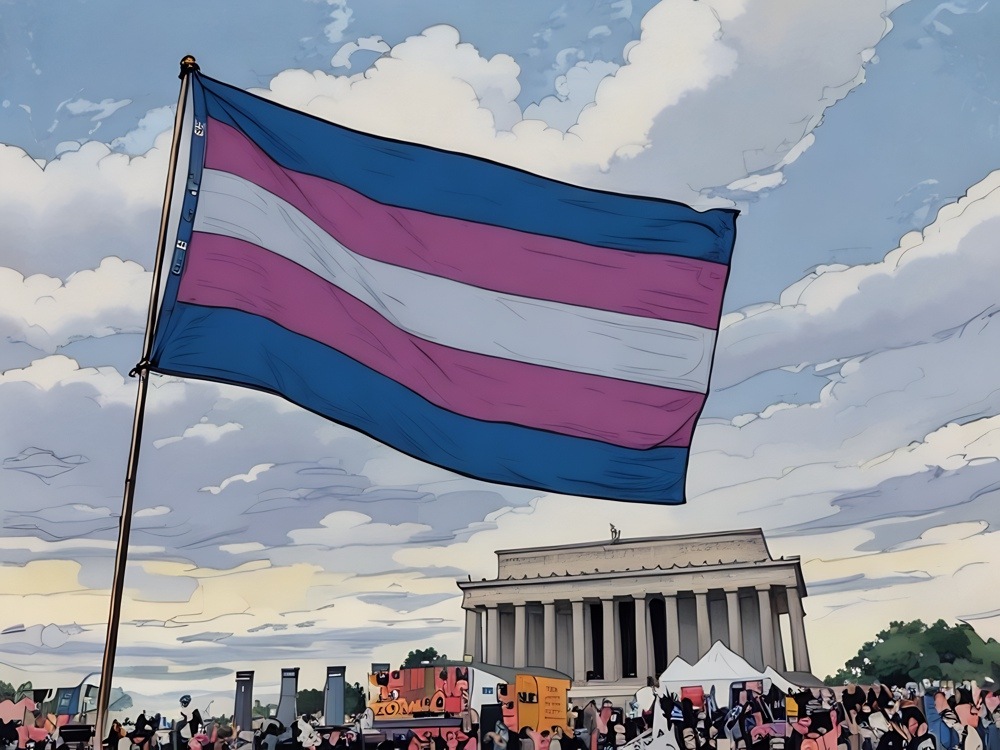
The US House of Representatives is set to vote on legislation that would impose a nationwide ban on gender-affirming healthcare for transgender people under 18, a move advocates warn could have devastating consequences.
The bill, HR 3492, known as the “Protect Children’s Innocence Act”, would make it a federal crime for medical professionals to provide puberty blockers, hormone therapy, or other forms of gender-affirming care to trans youth across every US state.
If passed, doctors and healthcare providers found guilty could face significant fines and prison sentences of up to 10 years.
A renewed push after repeated failures
The bill was introduced by Republican Representative Marjorie Taylor Greene, who unsuccessfully attempted to pass similar legislation in 2022 and 2023. After reintroducing the bill for a third time in May, it unexpectedly advanced through the House Judiciary Committee following a bipartisan vote.
With Republicans holding a majority in the House, lawmakers will now decide whether the bill moves to the US Senate.
Experts warn the bill could cost lives
LGBTQ+ advocates and medical experts have condemned the proposal, warning it could significantly increase suicide risk among trans and non-binary young people.
The Trevor Project, a leading LGBTQ+ suicide prevention organisation, said the bill would have “detrimental impacts” on a group already disproportionately at risk.
“The multitude of efforts we are seeing from federal legislators to strip transgender and non-binary youth of the health care they need is deeply troubling,” said Rodrigo Heng-Lehtinen, the organisation’s vice president of public engagement.
“The Trevor Project’s research shows that access to this care is associated with significantly lower rates of depression and suicide risk among transgender and non-binary young people who receive it.”
A 2022 study published in the Journal of Adolescent Health found trans youth prescribed puberty blockers were significantly less likely to experience depression or suicidal ideation.
Every major US medical body — including the American Medical Association, American Academy of Paediatrics, and American Psychological Association — supports gender-affirming healthcare, describing it as evidence-based and medically necessary for some patients.
“It’s no hyperbole to say that restricting this medically necessary care risks the lives of transgender and non-binary youth in communities all across the US,” The Trevor Project added.
What HR 3492 would do
The proposed law would ban medical professionals and healthcare organisations from providing gender-affirming treatment to trans minors, referring to such care as “chemical castration” — a term widely rejected by medical experts.
Under the bill:
- Puberty blockers, testosterone, oestrogen, and hormone suppressants would all be prohibited for trans youth
- Parents, guardians, or anyone assisting a minor in accessing care — even outside the US — could face criminal penalties
- Healthcare exceptions would apply only if treatment is deemed “necessary to the health of the minor,” explicitly excluding mental, behavioural, or emotional distress
The legislation also appears to conflate medication with gender-affirming surgeries, such as vaginoplasty or phalloplasty — procedures that are virtually never performed on minors.
Notably, the bill does not prevent:
- Non-consensual surgeries on intersex infants
- Cisgender children receiving puberty blockers for conditions like precocious puberty
Greene has repeatedly described puberty blockers as “mutilation”, despite failing to provide scientific evidence to support those claims.
Medical groups push back against misinformation
In May, the American Medical Association said bills like HR 3492 are driven by misinformation rather than science.
“These policies do not reflect the research landscape,” an AMA spokesperson said.
“More than 2,000 scientific studies have examined aspects of gender-affirming care since 1975.”
The AMA also stressed that medical intervention is not the first step for young children questioning their gender.
“When young children experience feelings that their gender identity does not match the sex recorded at birth, the first course of action is support and mental health care… medical intervention is reserved for older adolescents and adults.”