
Performer & choreographer Oli Mathiesen (one of contemporary dance’s hottest young talents) discusses his new work The Butterfly Who Flew Into the Rave, queer endurance, and the art of exhaustion.
By the time The Butterfly Who Flew Into the Rave reaches its final moments, something in the room has shifted. Sweat slicks the performers’ bodies. Breath is ragged. Muscles shake under the strain. The techno soundtrack does not soften. And the audience, seated safely in the dark, is left with a question that lingers long after the lights come up: what does it mean to watch someone endure?
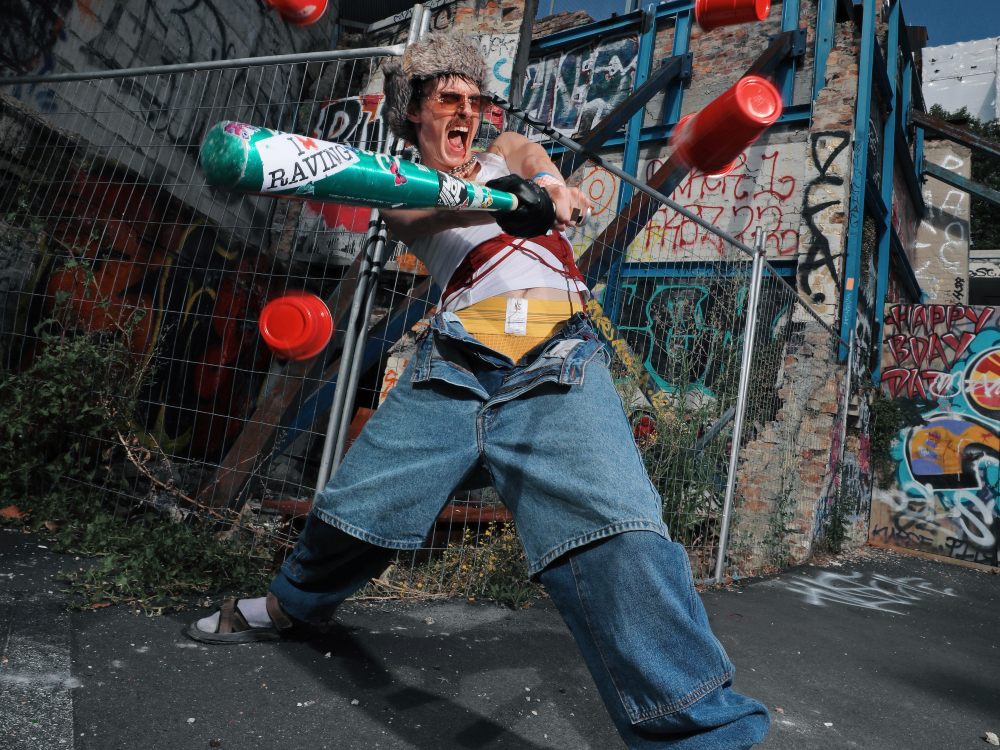
Created and performed by Oli Mathiesen (Ngāti Manu, Ngāti Hine, Ngāpuhi), alongside collaborators Sharvon Mortimer and Lucy Lynch, The Butterfly Who Flew Into the Rave condenses the atmosphere, culture, and psychological arc of a three-day rave into a single hour of continuous movement. Performed without pause to DJ Suburban Knight’s Nocturbulous Behaviour album, the work pushes endurance beyond spectacle and into something more unsettling — a meditation on ambition, escapism, and the cost of wanting more.
From the outset, Mathiesen was clear about the framing. The performers are ‘victims to music’.
“I knew it was going to be physically gruelling,” he explains. “And therefore, ‘a victim’.”
That idea of victimhood, however, is not simple. For Mathiesen, it opens up deeper questions about agency and choice — about who exactly is responsible when we push ourselves beyond our limits. “As queer people, as artists, we are often victims of our own ambition,” he says.
The bond between the three performers extends beyond the stage; their shared ethos, their kaupapa, is one of relentless drive. “We can be victims of that.”
In this way, Butterfly resists offering a clear perpetrator. Instead, it asks the audience to sit with discomfort — not just at what they’re watching, but at their own role in watching it. The performers’ labour is unavoidable. There is no illusion of ease, no hiding behind character. Bodies sweat, falter, and keep going.
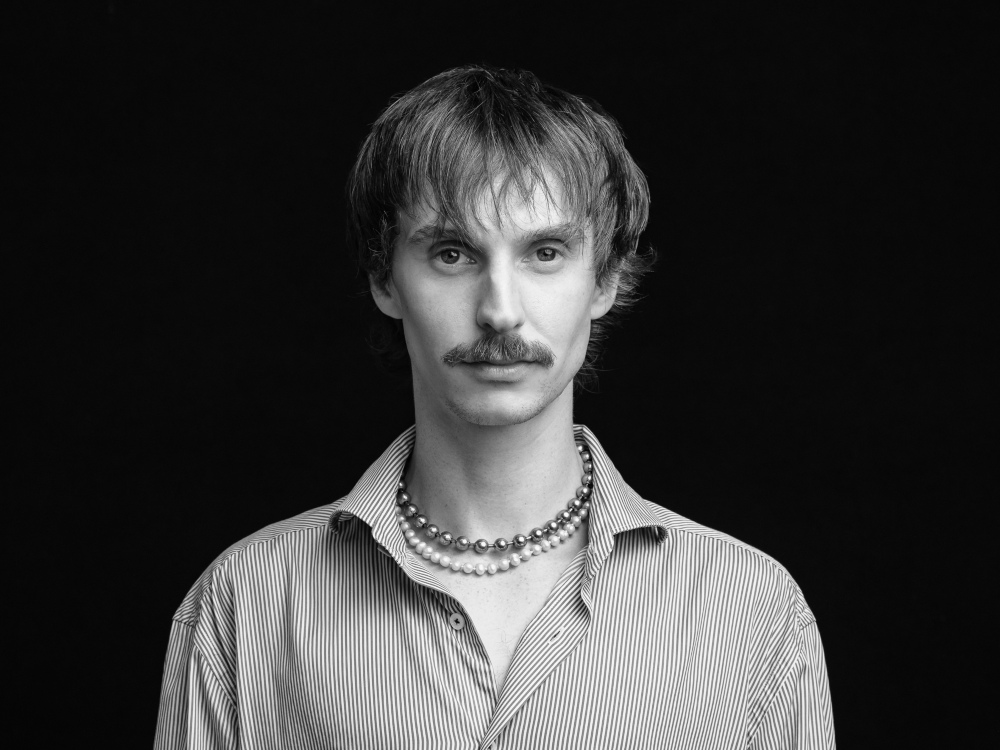
“I wanted the audience to be aware of the performers’ labour,” Mathiesen says. “And to feel complicit in witnessing it.”
That complicity is heightened by the work’s translation of rave culture — a space traditionally defined by communal energy and shared participation — into the rigid architecture of theatre. In a rave, the boundary between performer and audience dissolves. In Butterfly, it is sharply enforced. The audience is seated. The performers are not. The energy flows in one direction only.
“For lots of audiences, that’s a new experience,” Mathiesen reflects. “To not feel like they can contribute to the energy of the room the way you would in a rave space.”
Responses have varied widely. Some audience members feel concern, even distress, watching peers push themselves to the brink. Others — particularly older viewers — experience the work through nostalgia, reading it as a celebration rather than a warning. “They find it joyful,” Mathiesen says, “like being taken straight back to their rave heyday.”
That generational split is telling. For younger audiences, especially queer ones, Butterfly mirrors a far more precarious relationship with endurance — not as choice, but as expectation. The demand to keep going, to hustle, to win and win again, is no longer confined to the dance floor.
Endurance, for Mathiesen, became the conceptual engine of the work in the shadow of the pandemic.
“We’d just been through this globally shared experience of enduring something really difficult,” he says. “It was such a leveller.” Loss, boredom, fear — while experienced differently, were nonetheless collective.
He wanted to create an artefact of that endurance. Something that reflected not just survival, but the rat race that followed. “That pressure to keep going,” he explains.
In live theatre, performers often mask themselves with character. In Butterfly, the opposite occurs. The performers begin with a kind of cool detachment, and over the course of an hour, that façade is stripped away. What remains is vulnerability — the body pushed beyond pleasure and into compulsion.
That tension — between joy and self-destruction — feels unmistakably queer. Mathiesen agrees.
“We tend to put things like pleasure and pain on opposite ends of a spectrum,” he says. “But rave spaces really blur that line.”
Born from Black and queer communities, rave culture has long been a site of both transcendence and harm. Three-day raves fuelled by synthetic drugs sit alongside moments of profound connection, freedom, and ecstasy.
“You’re knowingly harming your body,” Mathiesen says, “to experience transcendence.”
For queer people, that extremity makes sense. In a world where queerness is policed, visibility is risky, and desire is surveilled, rave spaces historically offered safe spaces where limits can be tested.
“People take themselves to extremes to figure out what their bandwidth is,” Mathiesen says. “Within a bunker, within a community.”
That lineage is honoured carefully in Butterfly. Mathiesen is explicit about the responsibility he felt to acknowledge the Black queer origins of club culture — from voguing and waacking to popping, locking, and even a sly nod to Bob Fosse’s hyper-choreographed party scenes. Suburban Knight’s Detroit techno is not just a soundtrack, but a statement. “Detroit is the birthplace of techno,” Mathiesen notes. “Doing that justice mattered.”
The work’s intensity was tested to its limits during its run at the Edinburgh Fringe, where Butterfly was performed 23 times.
“It was a bit criminal,” Mathiesen admits. “We put ourselves and our bodies through something we maybe don’t completely agree with for ourselves.”
The contradiction is stark: a work critiquing endurance achieved through extreme endurance. As creator and performer, Mathiesen found himself negotiating not only his own exhaustion, but that of his closest collaborators. “You’re seeing your best friends struggling,” he says. “And as a human, you want to help. But as the lead, you’re also trying to uplift and maintain structure.”
What got him through was memory — not of the show itself, but of the labour behind it. Late nights writing funding applications. Community donations through Boosted. The invisible work that preceded the visible one. “When I wanted to stop,” he says, “I’d think about that. And I’d keep going.”
The show’s impact has been profound. Some audience members have been visibly shaken. One, Mathiesen recalls, left the theatre in Edinburgh and had a breakdown in the Meadows — only to return and see the show twice more. “I’m not after a specific response,” Mathiesen says. “Just a stirring.”
Art, for him, is meant to provoke — not comfort. If Butterfly lingers, if it shifts how someone understands contemporary dance, live performance, or even their own relationship to endurance, then it has done its job.
Performing the work has also reshaped Mathiesen’s relationship with his own body — a fraught terrain for many queer men. “It’s vulnerable,” he says. “And liberating.” As exhaustion takes over, aesthetic concerns fall away. Body image becomes irrelevant in the face of sheer physical demand.
“You forgive your body,” he says. “Because you’re doing the hardest thing you possibly can.”
By the end of a season, the performers calculated that each show was equivalent to running a half-marathon, without recovery time. Twenty-three shows meant twenty-three half marathons back to back.
Which brings us back to the central question of The Butterfly Who Flew Into the Rave: not whether endurance is impressive, but whether it is sustainable. Whether the spaces we create, the ambitions we chase, and the bodies we inhabit can withstand the cost of always pushing forward.
In asking that question, Butterfly doesn’t offer answers. It simply refuses to let us look away.