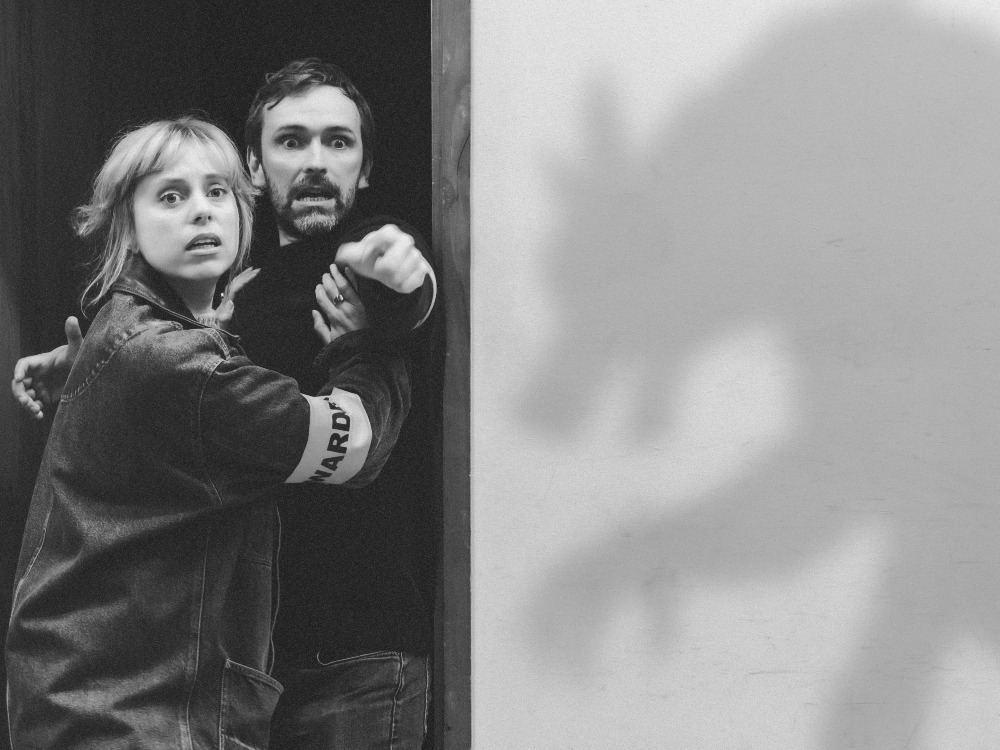
Creative Director Joel Baxendale and Theatre Designer Lucas Neal discuss making art on a budget, how sound and lighting can make the absurd feel possible, and why a new wave of theatre audiences are seeking interactive experiences.
There’s something deliciously revealing about Werewolf — the latest immersive work from Binge Culture Collective — being described as a show for people whose Halloween is their Christmas. Playful, slightly unhinged, and tapping into a shared appetite for risk and collective experience, it lands at a time when audiences increasingly want more than passive spectatorship.
Set to appear in both the Auckland Arts Festival and Aotearoa Festival of the Arts, Werewolf co-creator Joel Baxendale says festival backing brings visibility and credibility that independent companies can rarely achieve alone.
“It’s a huge step up in profile,” he says. “It gives you legitimacy. It can springboard people into international presentations. People take you more seriously once you’ve been in those festivals.”
It’s also a first. “This is the first time we’ve been in either of those major arts festivals — and we’ve been going for 15 years,” Baxendale adds. “It’s a milestone in itself, and hopefully we can continue to tour it further afield.”
Pressure Creates Diamonds
Werewolf arrives at a complex moment for live performance. While audiences are showing renewed hunger for in-person experiences, the conditions for creating work remain precarious.
“The work coming out right now is so exciting — especially the local stuff,” Baxendale says. “The industry’s just in a very tough spot. That’s not unique to the arts, but the arts have always been underfunded, and we’re really feeling that now.”
That pressure, he suggests, has pushed artists to reflect more deeply on why they do what they do.
“Not that we need tough conditions to make good art,” he says, “but it does influence people. It makes you question your motivations. If you’re not doing it for the money, what are you doing it for? What do you really get out of your art?”
“It pushes creatives to be more innovative — to make something that truly connects with audiences — to be intentional,” Baxendale continues, though he admits the stakes are high. “We need more resources, because fewer and fewer people can scrape by. The ones who are already established can just about manage, but there’s no space for anyone else. That’s the tragedy.”
Even for seasoned artists, survival is far from guaranteed. “We’d be considered pretty solidly mid-career at this point, and are just scraping by,” he says. “So what does that mean for emerging artists?”
Theatre for Risk-Takers
“One of the things we’ve deliberately tried to do with this work,” Baxendale says, “is to contrast something very naturalistic, like an emergency civil defence scenario, with something completely absurd — like werewolves.”
The format invites audiences into the world without requiring them to perform. Participation is structured, optional, and intentionally low-pressure.
“Instead of giving people a broad prompt — which can be intimidating — we let them have their little moment,” Baxendale explains. “That often opens them up to being more playful, depending on who they are.”
Crucially, the show accommodates different levels of comfort. “People who like contributing — it gives them permission to do that. And those who prefer to observe — they can do that too. There’s a lot of scope for people who enjoy playing games. It’s a show that welcomes that energy.”
While improvisation features, it’s never chaotic. “The story runs on its own tracks. But we do a kind of democratic performance — we won’t shut the audience down. We’ll take their offers and run with them,” Baxendale says.
Why Queer Audiences Will Recognise Themselves in It
For set and lighting designer Lucas Neal, whose creative lens shapes the work, Werewolf’s resonance with queer audiences is rooted in a broader cultural lineage.“There’s a pretty well-documented connection between queer audiences and horror,” Neal says. “It’s always been a genre where queer people could see themselves.”
In Werewolf, horror isn’t just about fear — it becomes a framework for transformation, secrecy, and social negotiation. These are long-standing themes in queer storytelling and community life.
The show’s audience, Baxendale adds, tends to sit slightly outside the mainstream. “It’s a bit of a cult thing,” he says. “There’s a crowd that really digs this show. They’re a little younger, maybe a bit more alternative — and they make great audiences!”
As Neal puts it, Werewolf has also landed at just the right cultural moment. “This kind of show is very zeitgeist,” he says, pointing to the popularity of social games and reality formats like The Traitors. “These kinds of games have been around forever, but in the past few years people have started to really embrace them and explore what other kinds of art can grow from them.”

Design as Storytelling
While Werewolf thrives on structure and interaction, Neal’s broader practice reveals how deeply he values design as a narrative tool — especially when it resists spectacle for its own sake.
Asked about recent influences, Neal points to Over and Out, a Wellington show at BATS Theatre.
“It was very simple,” he says, “written and performed by an actor called Jackson Burling. It was a verbatim piece — he interviewed a truck driver and performed that interview on stage.”
What struck Neal was how subtle design choices transformed the space. “The way they heightened it — brought you into that world of being in a truck — using lighting and projection was incredible,” he says, crediting lighting designer Jacob Banks, projection and set designer Rebekah de Roo, and sound designer Oli Devlin.
“It was transformative with very few elements — flickers of light suggesting passing streetlights, low rumbles of the truck. They created an amazing illusion with minimal set — basically a chair and a few props.”
For Neal, the power came from restraint, not excess. “You had to believe in the world to understand the character,” he says. “Making the audience feel like they were in that truck was key.”
The takeaway? Immersion doesn’t require high-tech bells and whistles. “It was a great example of how you don’t need flashy tech to make something powerful and beautiful. Every element was intentional — and essential to the storytelling.”
Choosing Experience Over Observation
If Werewolf speaks to a broader shift, it’s one that favours shared experience over passive consumption. Neal notes that audiences are increasingly drawn to work that feels social — something you attend with friends, talk about afterwards, and remember as an event, not just a product.
“These shows offer people a chance to have an experience. People are probably a bit starved of social connection — and immersive work answers that.”
That hunger, paired with Binge Culture Collective’s long-standing dedication to immersive theatre, makes Werewolf feel less like a novelty and more like a culmination — a show shaped by years of experimentation, landing at just the right time.
Whether you’re drawn in by the horror lineage, the collective decision-making, or simply because Halloween really is your Christmas, Werewolf extends an invitation: not to watch from the sidelines, but to step inside.