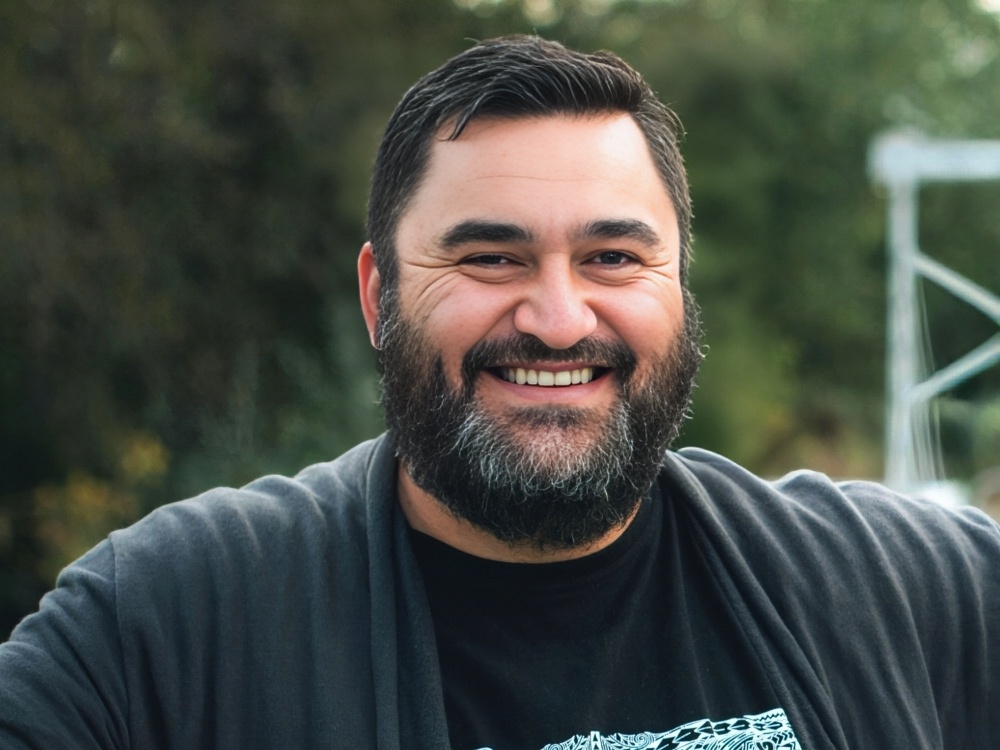

Aotearoa New Zealand Festival of the Arts Co-Director Tama Waipara discusses the Festival’s 40th anniversary, the pressures shaping this moment, and how we can all find identity and belonging in the arts.
“The urgency, I suppose, is really of our times,” he says.
For Tama, this anniversary doesn’t exist in isolation. It lands amid a charged political and social climate: the passing of the Regulatory Standards Bill, the anniversary of the hīkoi for Toitū Te Tiriti, and an ongoing reckoning around identity, nationhood, and belonging in Aotearoa.
That sense of interconnection underpins Tama’s approach to festival-making. He speaks about a layered backdrop — political, societal, emotional — and about the increasing marginalisation faced by communities already under strain. In that context, the arts aren’t an escape from reality so much as a place where reality can be spoken back to.
“The arts has always been a platform where those voices can be heard,” he says.
But 40 years isn’t only a moment for reflection. Tama is clear that legacy alone isn’t enough.
“There’s a need for us to remember to celebrate,” he says, “to be boldly provocative, and to be ourselves — and not be deterred by hatred or minimisation, oppression, prejudice, even policy.”
The anniversary, then, becomes both celebration and checkpoint.
“Forty years is a way of celebrating legacy, but it’s also a bookmark of where we are now,” Tama says. “Some of that can be quite shocking: have we really come that far? Where exactly are we?”
Rather than positioning himself as the one with answers, Tama redirects attention to the artists themselves.
“I don’t know the answers to any of those questions,” he says. “But I know our artists do.”
Creating space for those voices — rather than smoothing them into something palatable — has been central to how he and Dolina have approached the programme.
The challenge, of course, is that the arts landscape of 2026 looks vastly different from that of 1986. Funding pressures, audience behaviour, digital saturation, and the cost-of-living crisis have all reshaped how art is made and experienced. Tama doesn’t shy away from that reality.
“I always say festivals are the art of bringing people together,” he says, pointing to the origins of the modern festival model in post-World War Europe, where cultural gatherings emerged as a way to rebuild connection after devastation.
“But across the world, the model itself has shifted and started to frame what a festival looks and feels like — sometimes without being anchored in that original purpose,” he tells us.
For Tama, returning to purpose begins with self-knowledge.
“Part of the journey here at Tāwhiri, and at the Festival, is unpacking who we are,” he says. “Because if we don’t know that, how can we welcome anybody else, properly hold them, properly care for them while they do their thing?”
That inward gaze doesn’t mean narrowing focus. The 2026 Festival is built on collaboration — across organisations, across kaupapa, and across borders. Tama describes it as a “nexus” or “connection point”: a place where audiences are trusted to bring their own perspectives.
“Two people can see the same thing and take away an entirely different response,” he says. “That’s the beauty of a festival: everyone is welcome.”
Still, welcome doesn’t erase hardship. Tama acknowledges the financial strain felt across the arts sector, and the impact this has on artists already “punching above their weight”. Yet even here, he circles back to art’s deeper function.
“The job of an artist is to save the world,” he says — only half joking. “It is from our creative sources that we’re able to regenerate, recover, reimagine, reframe, rethink, refresh.”
That regenerative power is inseparable, for Tama, from takatāpui creativity. When asked about the prominence of queer artists across the programme, he doesn’t frame it as a curatorial strategy.
“I’ve never known it any other way,” he says. “The power of the arts is powered by queer arts.”
He speaks about queer storytelling as something forged through necessity — through the need to communicate across barriers.
“As queer people, we are fluent in the language of creative genius, because we have to be,” he says. “We have to find clever ways to tell our stories that can woo people, cuddle them, love them, shock them — but also allow them to hear us in a way that they otherwise wouldn’t.”
That philosophy feeds directly into what Tama hopes young takatāpui audiences might take from the Festival.
“I hope they have a moment where they can see or hear something that resonates with them and helps them continue to build who they aspire to be,” he says, remembering his own formative festival experiences.
Tama is quick to acknowledge that young people today carry a far more sophisticated vocabulary around identity than many earlier generations were allowed.
“We’ve built resilience over long periods of time — often through arduous and sometimes tragic paths,” he says. “I don’t think it’s any easier for young people, but I do think they have a more normalised vocabulary around what the questions are. The answers — no.”
On whether he thinks arts leaders fully understand a generation raised in a digital-first world, Tama is blunt.
“I do not,” he says, describing himself as something of an anachronism in the face of young people’s fluency with technology and new storytelling forms.
And yet, he remains convinced of the irreplaceable power of live performance. Pointing to works like Briefs, he tells us,
“It can wallop you with hilarity, but also turn that part of your stomach — your puku — where we hold anxiety, fear, longing, pain. Shows like that get in there and free something up — a pathway to acceptance.”
That physical, communal experience — laughing, crying, sitting together in the dark — is something no screen can replicate. It’s why festivals still matter.