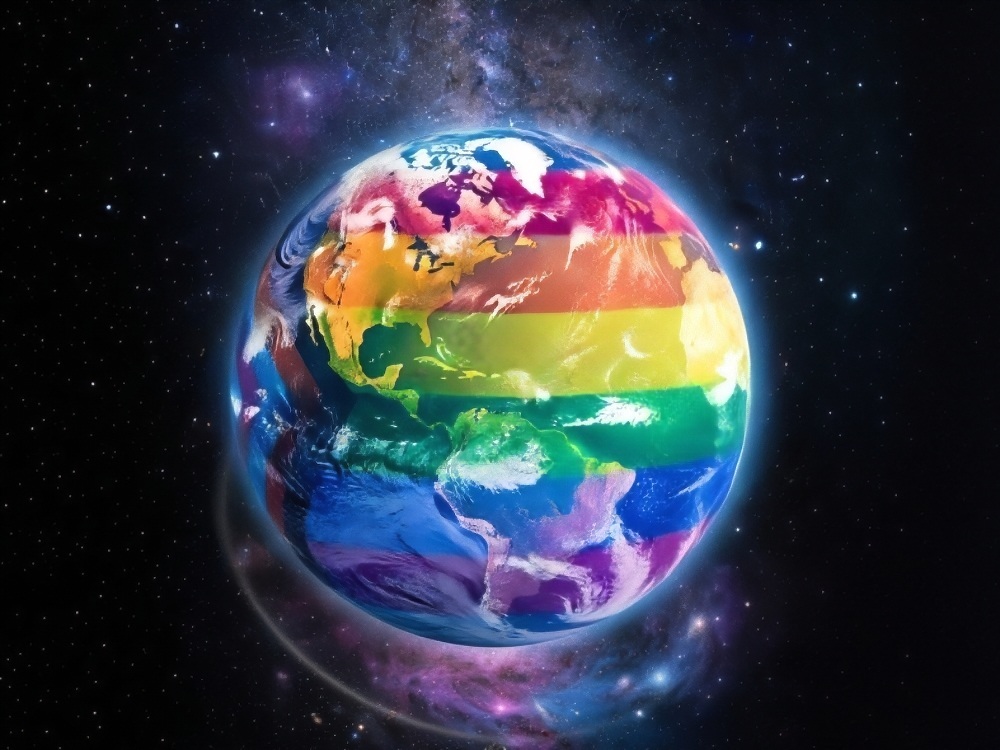
For many LGBTQ+ people, it can feel as though acceptance is steadily moving forward. Pride festivals continue to expand, marriage equality has spread to more countries, and younger generations often see sexuality as simply another part of human diversity.
Yet a major new international survey suggests the global reality is far more uneven.
A recent Pew Research Centre study covering 25 countries asked participants whether various behaviours – including drinking alcohol, divorce and homosexuality – were morally acceptable or morally wrong. When it came to homosexuality, the responses revealed some of the sharpest cultural divides in the entire survey.
The findings show a world where public attitudes toward LGBTQ+ people vary dramatically depending on geography. In parts of Europe, the belief that homosexuality is morally wrong has largely disappeared from mainstream thinking. In other regions, however, it remains a strongly held view shared by large majorities.
For LGBTQ+ communities around the world, the data highlights an important truth: progress does not happen everywhere at the same pace.
Where homosexuality is least likely to be seen as morally wrong
In several European and Western countries, only small minorities of people now say homosexuality is morally unacceptable.
- Sweden – 5%
- Germany – 5%
- France – 9%
- United Kingdom – 9%
- Canada – 10%
These countries tend to reflect societies where LGBTQ+ visibility, legal protections and social acceptance are well established. For many people in these places, sexuality is increasingly viewed not as a moral issue, but simply as part of a person’s identity.
Countries with more divided views
In many other countries, attitudes are more mixed. While notable portions of the population still believe homosexuality is morally wrong, those views are no longer dominant across society.
- Argentina – 15%
- Japan – 17%
- Italy – 18%
- Brazil – 24%
- Mexico – 25%
- Chile – 27%
- Israel – 29%
- Greece – 29%
These nations often represent cultural transition points. LGBTQ+ visibility is growing and legal reforms may be underway, but traditional or religious values continue to shape public opinion.
Where opposition remains significant
In some countries, sizeable portions of the population still consider homosexuality morally unacceptable.
- Peru – 36%
- Poland – 36%
- Hungary – 37%
- South Korea – 39%
- India – 47%
These figures illustrate the tension between increasing LGBTQ+ representation and long-standing cultural norms that can take much longer to shift.
Where homosexuality is overwhelmingly viewed as wrong
At the opposite end of the scale are countries where opposition remains extremely high.
- Kenya – 83%
- Indonesia – 93%
- Nigeria – 96%
In many of these places, homosexuality is still criminalised or highly stigmatised, and public opinion often reflects those legal and cultural realities.
A generational divide
One clear trend emerges across many of the surveyed countries: younger people are generally far less likely than older generations to view homosexuality as morally wrong.
While this does not immediately change the realities LGBTQ+ people face in many parts of the world, it suggests that attitudes continue to evolve over time.
Social views are rarely static. They shift gradually – sometimes unevenly – as societies change.
What it means for LGBTQ+ communities
In countries such as Aotearoa New Zealand, where acceptance has increased significantly over the past few decades, it can be easy to forget that experiences for LGBTQ+ people differ dramatically around the world.
The survey serves as a reminder that LGBTQ+ equality is part of a much broader global movement. Cultural traditions, political systems and religious beliefs all shape how quickly attitudes change in different places.
While some societies are now debating issues such as gender identity, inclusive education or healthcare access, others are still grappling with a more fundamental question:
Whether being gay should be seen as morally wrong in the first place.
Progress rarely happens everywhere at once. But shifts in public opinion, visibility and open conversation can gradually reshape attitudes – sometimes in ways that only become clear years later.