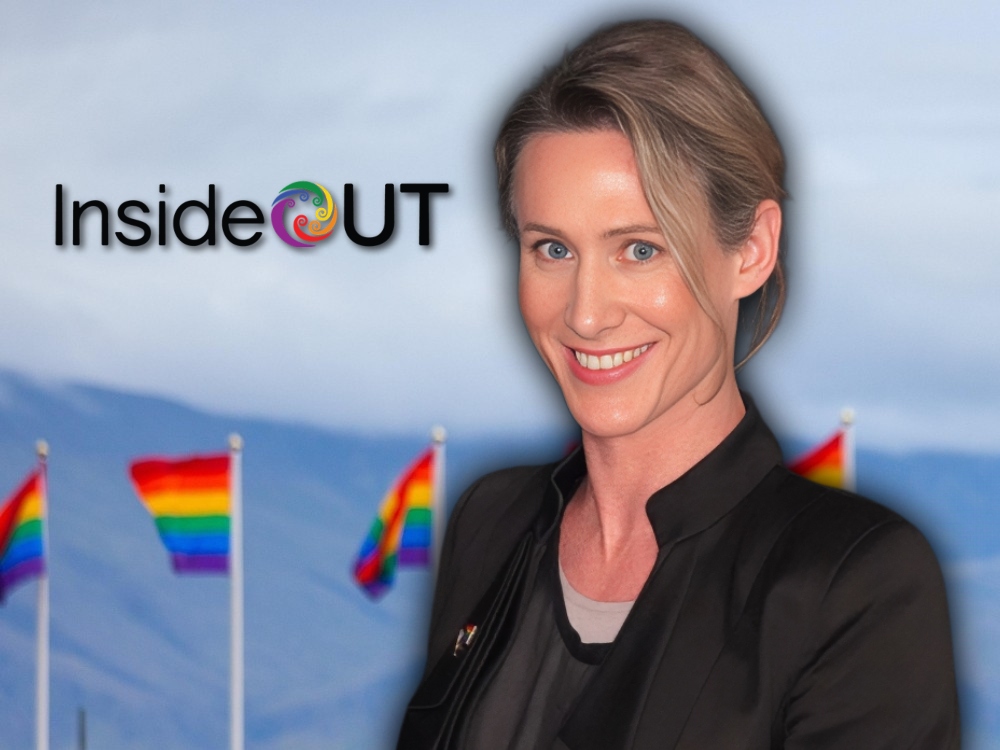

Judy O’Brien shares insights on allyship, online safety, youth advocacy, and hope for rainbow communities in Aotearoa.
When Judy O’Brien stepped into the CEO role at InsideOUT Kōaro, she did so at what many would describe as a difficult moment.
“This is not a time where people are standing up in support of particular communities,” she says. “They’re recognising that self-protection might be their priority at the moment.”
And yet, when she heard that outgoing CEO Tabby Besley was moving on, she felt something else: responsibility.
“I thought this was a really important organisation to continue. It provides an essential service to rainbow rangatahi in New Zealand and has impacted people’s lives really positively.”
InsideOUT Kōaro has spent years building support structures for queer and trans young people across Aotearoa — in schools, in communities, in policy spaces. For Judy, the move from NZ Rugby’s Head of Culture, Inclusion and Safeguarding into youth advocacy might look like a shift. But at heart, it’s the same work: protecting people, strengthening systems, and widening belonging.
Learning Allyship in the Masculine Mainstream
Before taking the helm at InsideOUT, Judy worked inside one of the most culturally powerful institutions in the country: NZ Rugby.
From the outside, rugby can represent Aotearoa at its most masculine and mainstream. But Judy’s experience complicates that stereotype.
“I benefited greatly from the allyship of men who worked across the rugby system,” she says. “It was often men who were the first people to step up to champion the kinds of initiatives I was promoting.”
Her portfolio wasn’t limited to rainbow inclusion — it included Māori, Pacific, and women as well. She tells us the groundwork had already been laid.
“A lot of great work had happened to build an appetite for inclusion. I got to build rainbow inclusion onto a number of years of work that had already been established.”
She tells us the key to making the work resonate was familiarity.
Instead of framing inclusion as an accusation — a call-out of homophobia or failure — Judy framed it as an extension of rugby’s existing values.
“Rainbow people have always been in rugby. The Black Ferns have been inclusive since day dot. This was about community.”
That approach unlocked personal connections. She heard countless stories from co-workers who had queer family members — people who simply wanted rugby to be safe for everyone.
“There were some really senior men who spoke up and said, ‘No matter who you love, rugby has your back.’”
By inviting people into a solution, rather than positioning them as the problem, she built allyship in spaces many assume could be hostile.
It’s a lesson she carries with her: change from the inside works best when people feel seen, not shamed.
The Double-Edged Sword of Online Life
Now leading an organisation that works directly with young queer and takatāpui people, Judy is deeply aware of the digital landscape they inhabit.
“It’s a nuanced conversation,” she says of social media.
For many rainbow rangatahi, online spaces are lifelines — places of connection, representation, and self-discovery. Youth-generated communities can ease isolation and provide validation.
“When they find others like themselves, it can be incredibly validating.”
But the same platforms also expose young people to rising hostility: misinformation, harassment, unmoderated hate speech, and targeted abuse.
“That kind of exposure to harmful content can really do damage to a young person.”
Rather than blanket bans, Judy is more interested in systemic accountability.
“What we need is greater moderation and greater safety for all online and digital spaces.”
She points to grooming, sexual violence, and conversion practices as serious online harms that demand attention. For her, the priority is equipping young people with media literacy and critical thinking skills — and holding platforms responsible for safety.
Anxiety by Design
Across queer communities, there’s a palpable sense of anxiety — a feeling that acceptance is being withdrawn or reversed. Judy doesn’t dismiss that fear. But she contextualises it.
“Our community has been used to generate anxiety — scapegoated to produce fear in other parts of society. And that’s by design.”
She describes intentional campaigns that fragment communities and drive division.
“They don’t want us working together and uniting against the real challenges we’re facing.”
That division fuels anxiety across the spectrum. Within rainbow communities, she sees that anxiety as understandable.
“It’s reasonable to feel anxious about the genuine harassment people are experiencing.”
And yet, perspective matters.
“If I look back 10 or 15 years, we’ve still made far greater progress than we had before. The infrastructure and support systems that have been built in aren’t being disintegrated. They may be challenged, but they still exist.”
When someone recently asked her if she still believes there’s light at the end of the tunnel, her answer was characteristically pragmatic.
“I think we’ve had a cave-in in the tunnel. We need to pick up shovels and get to work to clear that.”
What the Work Looks Like
For Judy, “the work” starts with young people.
“Ensuring we take care of our rangatahi so they can grow up to be tomorrow’s leaders.”
That means giving them the tools to self-regulate, to engage critically, to understand they have worth — political power, economic power, and inherent human value.
It also means safeguarding inclusive workplaces and advocating for policy that explicitly names rainbow communities.
“If we truly care about young people’s wellbeing outcomes, then we need policies that recognise them.”
She is concerned about proposed government changes to how rainbow identities are addressed in education.
“Where there is no explicit recognition of rainbow communities, there is a gap. And in that gap lies shame, fear, and misunderstanding.”
Without language and representation, young people are left “lost in that gap”. InsideOUT has strongly advocated for the inclusion of diverse genders and sexualities in the draft curriculum currently under consultation.
Hope in solidarity
Despite the challenges, Judy’s hope is grounded in lived experience.
“I know things can be better because they’ve been better before.”
Hailing from a Christian family, her self-acceptance of her gender identity, and her family’s acceptance of it, has been a journey — one that reached a milestone when she was married on New Year’s Eve.
She describes walking down the aisle surrounded by “Christians and queers and lads and dads and sisters and mothers. It was this wonderfully diverse community around me.”
That moment crystallised something simple and profound: people from different backgrounds, with different views, can love and support one another.
“Kindness isn’t necessarily cool anymore,” she says. “But it does exist.”
She speaks about family members who hold conservative Christian views, yet still show up in love and solidarity.
“They recognise that queer people exist and are worthy of love, and that gives me hope.”
In a time when division can feel amplified and anxiety weaponised, Judy O’Brien is choosing to stabilise and strengthen.
InsideOUT’s mahi continues — in schools, in policy submissions, and in conversations with young people who need to hear that they belong.
The tunnel may have caved in. But Judy is not standing still in the dark.
It’s time we all picked up a shovel.