








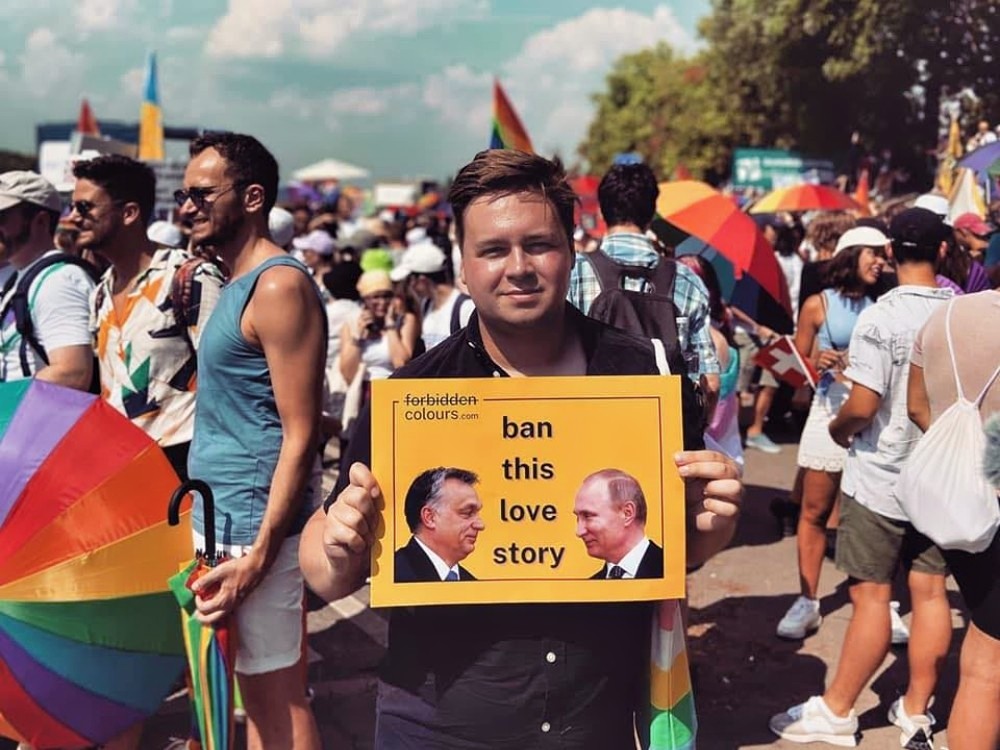

Rémy Bonny, the executive director of Brussels-based NGO Forbidden Colours, has spent years campaigning against democratic backsliding and anti-LGBTQ legislation in Europe. He is best known for his work challenging Hungary’s anti-LGBTQ “propaganda law”, and has become one of the most prominent voices in Brussels linking attacks on queer communities with wider attacks on democracy and the rule of law.
Now, with Orbán conceding defeat to Péter Magyar after 16 years in power, Bonny says Hungary has reached a historic turning point — but one that comes with serious risks as well as hope.
“This is a major political moment, not only for Hungary, but for Europe,” Bonny said. “For years, Hungary has been presented as a model by anti-rights and authoritarian forces across the region and beyond. So what happens next matters enormously.”
Bonny argues that Orbán’s loss is significant because Hungary has, under his leadership, become one of the clearest examples in Europe of how governments can roll back democratic standards while also targeting LGBTQ people as part of a broader political strategy.
“It’s important to understand that these attacks were never only about LGBTQ people,” he said. “They were also about reshaping the state, weakening institutions, controlling public debate and defining who belongs in the nation.”
During Orbán’s time in office, Hungary introduced a series of measures condemned by human rights groups and European institutions, including the so-called “propaganda law”, which restricts the depiction of LGBTQ identities in public life and education. Bonny also points to the ban on Pride, the blocking of legal gender recognition and restrictions on adoption as part of what he describes as a deliberate legal architecture of exclusion.
Asked why Hungary has drawn so much international attention, Bonny said the country became a testing ground for a style of politics that has spread far beyond its borders.
“Hungary showed how anti-LGBTQ politics can be used as a tool,” he said. “It was used to mobilise fear, to create cultural division, and to distract from corruption and democratic erosion. That model has influenced others in Eastern Europe, but also movements in Western Europe and the United States.”
For Bonny, that is what makes the current moment so significant for LGBTQ rights in Eastern Europe. If Hungary begins to reverse the laws and institutions built under Orbán, it could send a powerful signal across the region that authoritarian anti-LGBTQ politics is not inevitable and can be undone.
“There are many people in Eastern Europe who have been told for years that equality must wait, that democracy is fragile, that rights are negotiable,” he said. “A democratic reset in Hungary would show that rollback is not permanent.”
At the same time, he cautions against seeing the election result as a solution in itself.
“The real work starts now,” Bonny said. “You can change a government in one election. You cannot change an entrenched political system overnight.”
He says the new Hungarian leadership will face the challenge of dismantling not only hostile laws, but also the networks, institutions and power structures that helped sustain Orbán’s model of government. In Bonny’s view, organisations such as Mathias Corvinus Collegium and the Danube Institute became part of a wider ideological infrastructure that extended Hungarian influence into Brussels and international conservative circles.
“If those structures remain untouched, then Orbánism can survive Orbán,” he said.
Bonny also believes the European Union will play a crucial role in determining whether Hungary’s transition leads to meaningful democratic renewal. He warns Brussels against moving too quickly to normalise relations or release frozen funds without clear conditions.
“If the EU restores funding without demanding real structural change, then it risks financing the appearance of transition rather than the reality of it,” he said.
That change, he argues, should include repealing anti-LGBTQ laws, restoring legal protections, rebuilding independent institutions, strengthening civil society and supporting pluralist media.
Bonny says the stakes extend well beyond Hungary itself. Around the world, he argues, anti-LGBTQ narratives have increasingly been woven into broader authoritarian movements, making queer rights a frontline issue in the struggle over democracy.
“What happened in Hungary became part of a global story,” he said. “We’ve seen political actors in different countries borrow from the same playbook — targeting LGBTQ communities, attacking so-called gender ideology, undermining independent institutions and presenting equality as a threat.”
That is why he sees Hungary’s next chapter as globally significant.
“If Hungary can begin to undo that model, then it becomes more than a national political change,” Bonny said. “It becomes proof that authoritarian systems built on exclusion can be challenged — and that matters to LGBTQ communities everywhere.”
Even so, Bonny insists that symbolism will not be enough. The end of the Orbán era, he says, will only matter if it results in concrete protection for those whose rights were pushed back most aggressively.
“For LGBTQ people in Hungary, and for those watching across the region, this is about whether rights are restored in practice, not just promised in theory,” he said. “That is what will define whether this moment is truly historic.”