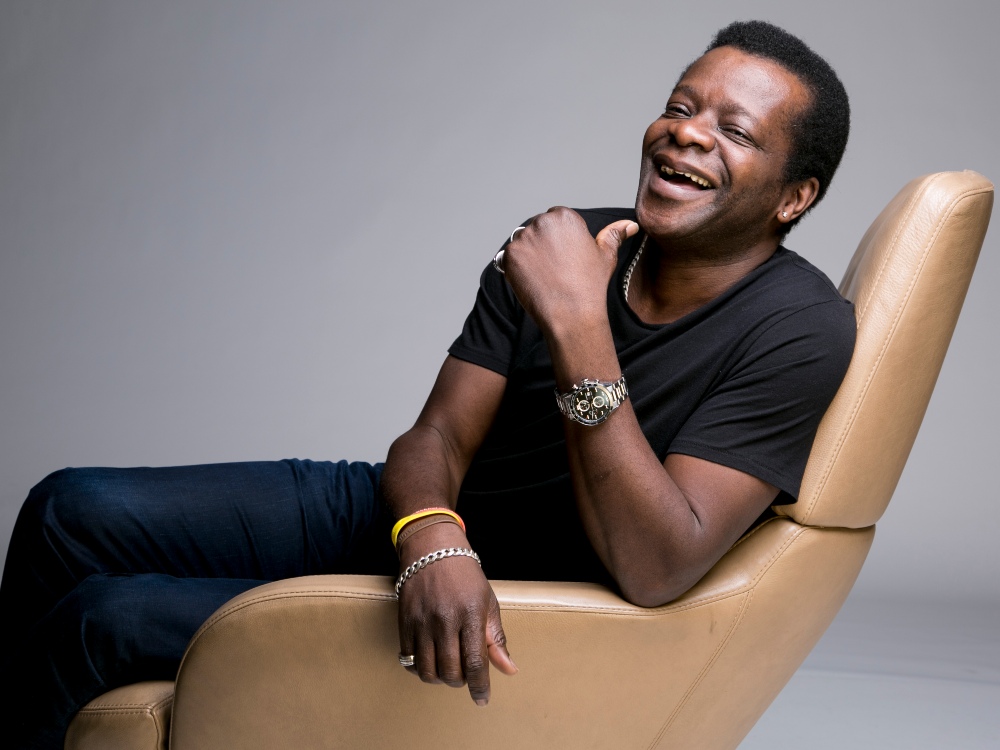

Comedian Stephen K Amos reflects on social media, race, representation, Prince Harry and Andrew, and the importance of context, in a world trying to balance progress with division.
Ahead of his return to New Zealand with Now We’re Talking, Stephen K Amos sounds energised by the idea of reconnecting with audiences — but also deeply preoccupied by the state of the world he’s stepping back into. The new tour is framed around what gives him “the ick” and what makes him “tick”, and when we speak, it quickly becomes clear that what most animates him in 2026 is not simply bad behaviour, but bad faith.
“The world at the moment, as we know it, is just a noisy place,” he says. With social media, and the endless churn of opinion and reaction, Amos sees a culture increasingly shaped by volume rather than understanding. “There’s a phrase going around the UK saying that we now live in a post-truth world, which I find absolutely terrifying.”
For Amos, the real issue is not that everyone is talking. It is that too few people are listening.
“We’re not asking enough questions,” he says. “There are a lot of big people with big mouths doing a lot of talking, but not listening. We need to make ourselves aware of context and nuance, and not necessarily believe everything you read.”
Asked whether this atmosphere has helped create conditions for the rise of figures like Nigel Farage, Amos does not hesitate. “It has led to extremism on both sides of the political spectrum, undoubtedly,” he says. He misses the smaller, quieter world he grew up in.
“We had three TV channels, and at certain points of the day the TV went off,” he says. “People weren’t telling you that other people are to blame for your lack of success. There wasn’t that sense of division that there is now. Sadly, it sits on both sides.”
What disturbs him most is the collapse of real dialogue. “Debating seems to have gone out of the window.” In its place, he argues, is a flattening of language and thought: “Disagree with someone on the right, and they are instantly branded a Nazi; disagree with someone on the left, and they are dismissed as a snowflake. What happened to discourse and dialogue and agreeing to disagree? It’s frightening.”
That commitment to context also shapes how Amos reflects on one of the moments for which he remains widely remembered: the time he publicly recounted Prince Harry saying he did not “sound like a black chap”. Nearly two decades later, and with Harry himself now outspoken about racism and media hostility, Amos is unwilling to reduce the story to a simplistic gotcha.
“I’m a huge fan of Harry and Meghan,” he says. The couple’s decision to leave the UK and raise their family elsewhere makes perfect sense. “The reaction to Meghan in the UK, anyway, by a lot of the right-wing press, was not very favourable. There was racism, and they’re only human.”
As for Harry’s comment? Amos insists that “context is key”. He explains that another comedian had been on before him and had been doing accent-based material, and that Harry was trying to join in the joke rather than make a malicious point. “So in all fairness, it was taken out of context. He was trying to be funny, and my comedy brain goes, yes, let’s go with that.”
He is similarly pragmatic when discussing the ongoing Prince Andrew (now Andrew Mountbatten) scandal and suggestions it could threaten the future of the monarchy. Amos doubts the institution itself is in real danger, at least in Britain. If anything, he suspects the future lies in a stripped-back version of the monarchy, centred only on senior working royals. But he is far more interested in the question of accountability than constitutional drama. “What I find more extraordinary about this whole Andrew saga is: where are the other heads? Where are they going to roll? When are you going to start seeing people being held accountable?”
If the monarchy reveals Amos’s instinct for separating noise from substance, his reflections on race and representation show just how much has changed during his own career. When he first went to the Edinburgh Fringe, he says, he was one of only a tiny number of Black comedians on the scene, and one of very few openly LGBTQ+ performers. The landscape now is unmistakably broader.
“One of the good things about social media is that there are so many voices out there now that can put out their own content,” he says. “You don’t have to wait for gatekeepers anymore.”
He remembers getting complaints when his Radio 4 series What Does the K Stand For? debuted in 2013, featuring actors using Nigerian accents to play his parents. “We still had people emailing and writing in saying, ‘We don’t like these voices on our radios.’” For Amos the lesson is straightforward: keep going. “My whole thing is comedy. I want to make people laugh. I don’t want to ostracise anybody. Everybody’s welcome to my shows.”
That generosity has had its own consequences. Over time, Amos found himself becoming something he had never consciously intended to be: a role model. When he first spoke openly about homosexuality in his Edinburgh show All of Me, the response was immediate and overwhelming. “I never thought I’d be a spokesperson or a representative of anybody,” he says. “But you find yourself in that position. Therefore, you really need to think about what you do, what you say, and how you present yourself.”
Still, he is adamant that progress must be acknowledged. “We should celebrate every victory,” he says. “Because they are there.”
Perhaps nowhere is Amos’s mix of candour, courage and curiosity clearer than in the extraordinary moment that unfolded during the BBC series Pilgrimage in 2019, when he told Pope Francis, “As a gay man, I don’t feel accepted.” Amos had joined the programme while grieving someone close to him, and despite not being religious, found himself unexpectedly open to the experience. When told the group would meet the Pope, his first instinct was to refuse. But after talking with fellow participants from other faith backgrounds, he reconsidered.
Then came the opportunity to ask questions. Amos knew he could not let the moment pass. “I cannot be a gay black man in front of the head of the Catholic Church and not ask important questions,” he says. “If I just sat there smiling and got a blessing, I probably would have kicked myself and reflected on it till the day I died.”
He had braced himself for a rejection dressed up as kindness. Instead, the Pope replied: “Giving more importance to the adjective rather than the noun, this is not good. We are all human beings and have dignity. It does not matter who you are or how you live your life, you do not lose your dignity. There are people that prefer to select or discard people because of the adjective – these people don’t have a human heart.” The answer moved him not because it solved anything, but because it did not condemn him. And yet seven years on, Amos is not naïve about how limited that moment’s practical legacy may have been. Since then, he says, the Church has often seemed to retreat towards the status quo. The hope the exchange briefly created has not necessarily translated into broader institutional courage.
Still, the moment matters. Not because it fixed the Catholic Church, and not because it made global headlines, but because Amos asked the question in the first place.
That, in a way, is the thread tying all of Amos’s ethos together: the insistence on asking, listening, probing, refusing easy narratives. Amos may be coming to New Zealand to make us laugh, but Now We’re Talking also arrives as a reminder that comedy can still make room for thought, complexity and truth.
And in a world full of noise, that feels worth hearing.