









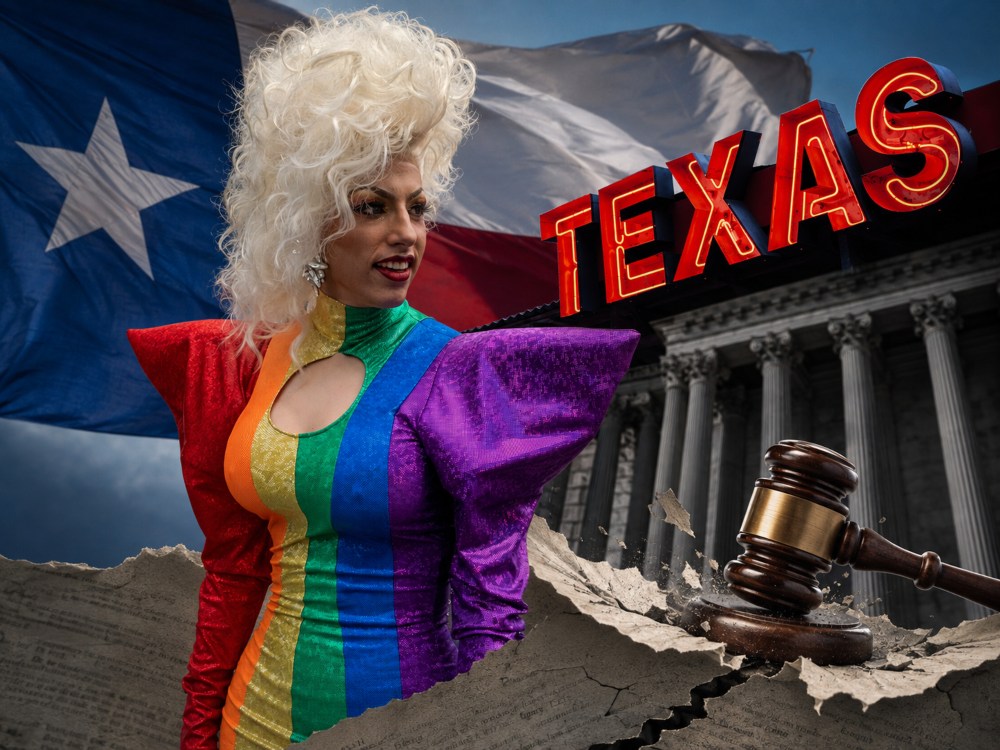

A federal judge has again struck down a Texas law restricting some drag performances, ruling that it violates the First Amendment.
US District Judge David Hittner found Senate Bill 12 unconstitutional for a second time on 25 August, blocking Texas Attorney General Ken Paxton from enforcing the measure.
The law was passed in 2023 and targeted “sexually oriented performances” on public property or in places where minors could be present. Although the final wording did not explicitly mention drag, earlier drafts did and supporters widely promoted it as a measure aimed at drag performances.
Judge Says Law Is Too Vague
Hittner ruled that the law was both overly broad and unconstitutionally vague, meaning it could potentially punish a wide range of performances beyond drag.
He noted that mainstream entertainers including Elvis Presley, Dolly Parton and Miley Cyrus had all faced criticism for supposedly sexual performances or appearances, arguing that similarly broad definitions could expose ordinary performers to penalties.
His message to people who find particular performances offensive was simple: they can choose not to attend.
The Law Had Already Been Blocked Once
Hittner first declared SB 12 unconstitutional in September 2023.
The Fifth US Circuit Court of Appeals later sent the case back to him for further review, and the law was allowed to take effect in March 2026 while the legal battle continued.
After reassessing the case under the appeals court’s instructions, Hittner again concluded that the law unlawfully restricted protected speech.
The latest ruling once again prevents the state from enforcing it.
Drag Performers Welcome The Decision
The ACLU of Texas, which challenged the law on behalf of drag performer Brigitte Bandit and other plaintiffs, welcomed the result.
Bandit said drag is a form of free expression and a source of “liberation, power, and joy” for LGBTQ+ communities.
The ruling is particularly significant because drag has increasingly become a political target in several US states, often through laws framed around protecting children or restricting sexualised performances.
For LGBTQ+ advocates, the Texas decision reinforces that drag itself is not inherently obscene and remains protected artistic expression.
Texas Could Appeal Again
Paxton has criticised the ruling and indicated that the state intends to appeal.
That means the legal fight may not be over.
For now, however, SB 12 cannot be enforced, and drag performers in Texas remain protected from penalties under the law.
The case is another reminder that attempts to restrict queer expression are still being tested against longstanding constitutional protections for free speech.