









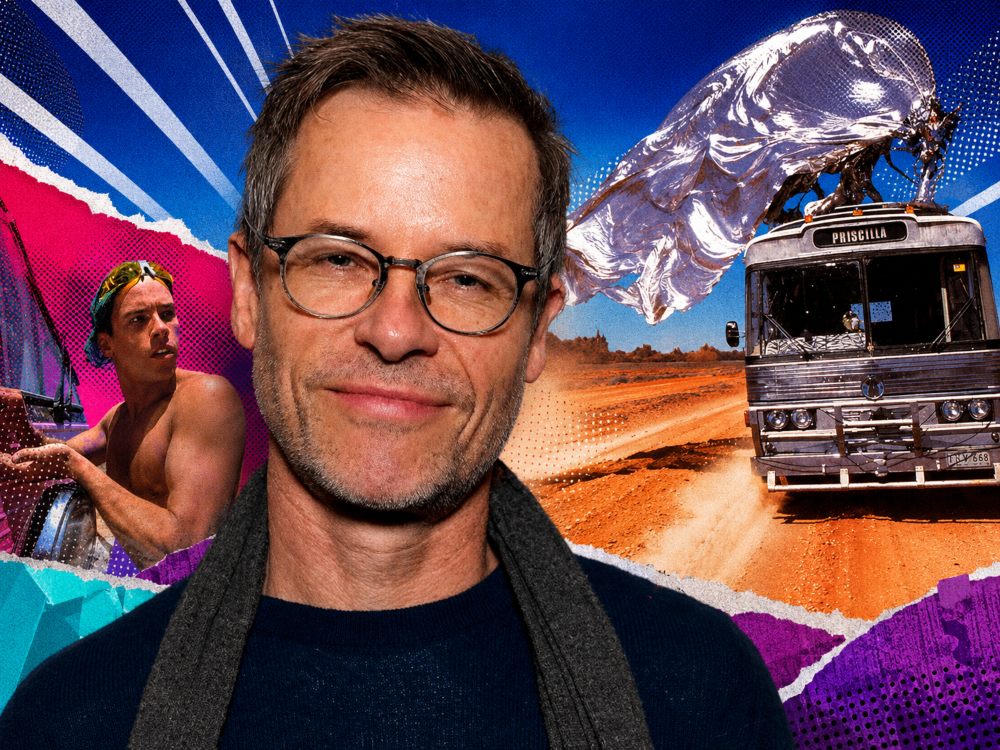
Guy Pearce has offered one of the clearest hints yet about when the long-awaited sequel to The Adventures of Priscilla, Queen of the Desert could finally arrive.
Speaking on Good Morning America, Pearce suggested the follow-up may shoot in 2027 and reach cinemas in 2028.
“Well, the sequel, right, which is going to be, what are we now, ’26?” he said.
“We’ll probably shoot it ’27. It’ll come out ’28.”
Nothing has been formally locked in yet, but for fans who have been waiting more than 30 years to see Priscilla return to the desert, even a tentative timeline is enough to get excited about.
The Sequel Has Been Years In The Making
Writer-director Stephan Elliott confirmed in 2024 that he was developing a sequel to his 1994 queer Australian classic.
At the time, original stars Hugo Weaving, Guy Pearce and Terence Stamp were all expected to return.
Pearce later described the production as being stuck in the “pre-production desert”, with the team still working through the script, locations and budget.
“I feel there’s enough love in the room to make it happen,” he said in 2025.
He also joked that returning to the wardrobe of drag performer Adam Whitely might be somewhat less forgiving three decades later.
“I’m not looking forward to putting on a dress again,” he said.
“I don’t think I’m going to look as good in a frock as I did in 1993 when I was 25.”
Judging by the latest update, however, he may need to start preparing.
Terence Stamp Filmed Bernadette’s Scenes Before His Death
One of the biggest questions surrounding the sequel was how it would handle the death of Terence Stamp, who played transgender performer Bernadette Bassenger in the original.
Stamp died in August 2025 aged 87.
But Elliott later revealed that Stamp had already filmed extensive material for the sequel before his death.
The decision came after Stamp made clear that he did not want a digital recreation of himself used to perform Bernadette.
According to Elliott, the actor wanted to personally complete the role in case he did not live to see principal photography begin.
With the blessing of Stamp, his family, Pearce, Weaving and the film’s financiers, Elliott arranged for Bernadette’s scenes to be pre-shot.
Stamp performed material from across the screenplay using a multi-camera set-up over several studio sessions.
A stand-in is expected to be used when the wider film is eventually shot, with Stamp’s pre-recorded performance incorporated during post-production.
The approach is intended to preserve Stamp’s actual final performance rather than generate a new AI version of him.
‘He Gave It Everything He Had’
Elliott has spoken emotionally about filming Stamp’s final scenes.
The director said preparing Bernadette’s appearance at an older age required extensive work on hair, makeup and character design.
Stamp may not have enjoyed every element of returning to drag, but Elliott said the actor threw himself into the performance.
“He hated putting the wig on again,” Elliott recalled.
But he described Stamp as having an enormous smile once he was back in character.
Elliott said calling “that’s a wrap” on Stamp was a moment that would stay with him for the rest of his life.
If the sequel reaches the screen, it will effectively give audiences one final opportunity to see Stamp as one of his most beloved characters.
The New Priscilla Will Explore Queer Ageing
Elliott has been clear that he has no interest in simply recreating the original film.
He says it took him decades to find a story strong enough to convince both himself and Stamp that a sequel was worthwhile.
The new film is expected to focus heavily on ageing, including what it means to grow older as a gay or transgender person.
Elliott has described the screenplay as touching and “very unusual”.
That direction could give the sequel a very different emotional centre from the original.
Rather than simply repeating the first film’s road-trip structure and camp spectacle, the follow-up appears set to revisit its characters later in life and explore how queer identity, friendship and family evolve with age.
For LGBTQ+ cinema, that alone makes the project noteworthy.
Older queer people remain significantly underrepresented on screen, particularly in major films where their sexuality or gender identity is treated as part of an ongoing life rather than a story that ended with youth.
A Queer Australian Classic
Released in 1994, The Adventures of Priscilla, Queen of the Desert follows drag performers Tick Belrose and Adam Whitely, played by Hugo Weaving and Guy Pearce, alongside transgender performer Bernadette, played by Stamp.
The trio travel across the Australian interior in a bus nicknamed Priscilla to perform a cabaret show in Alice Springs.
Along the way, the film mixes extravagant drag, comedy and ABBA with moments of homophobia, transphobia, friendship and resilience.
It became an international success and helped bring queer Australian characters into mainstream cinemas at a time when LGBTQ+ representation was far rarer than it is today.
The film also won the Academy Award for Best Costume Design.
Its influence spread well beyond cinema.
A stage musical premiered in Sydney in 2006 before travelling internationally, including to Aotearoa New Zealand, the United Kingdom, Canada and Broadway.
Why The Sequel Matters
A Priscilla sequel inevitably comes with expectations.
The original film occupies a complicated but important place in LGBTQ+ culture.
It was groundbreaking for its era, particularly in placing gay, drag and transgender characters at the centre of a mainstream Australian story.
At the same time, conversations about trans representation have evolved considerably since 1994.
That makes revisiting Bernadette, Tick and Adam more than a nostalgia exercise.
A sequel made more than three decades later has an opportunity to examine how queer life has changed — and how much has not.
Elliott’s focus on older LGBTQ+ characters could also move the story into territory rarely explored by mainstream queer films.
How do friendships change after decades?
What happens to queer community as people age?
And what does it mean for characters once defined by rebellion and youth to confront mortality, memory and an entirely different cultural landscape?
Those questions could give Priscilla a reason to return beyond simply putting the bus back on the road.
Could We Finally See It In 2028?
For now, fans should keep the champagne on ice.
Pearce’s suggestion of a 2027 shoot and 2028 release is not yet an official announcement.
The project has already spent years navigating scripts, financing, logistics and the death of one of its central stars.
But there is clearly still momentum.
Elliott has a story.
Pearce and Weaving remain involved.
Stamp completed his contribution before his death.
And Pearce is now publicly talking about a possible production window.
More than 30 years after Priscilla first rolled across the Australian desert, the old bus may finally be preparing for another journey.
And if Pearce’s prediction proves correct, we could be climbing aboard again in 2028.