










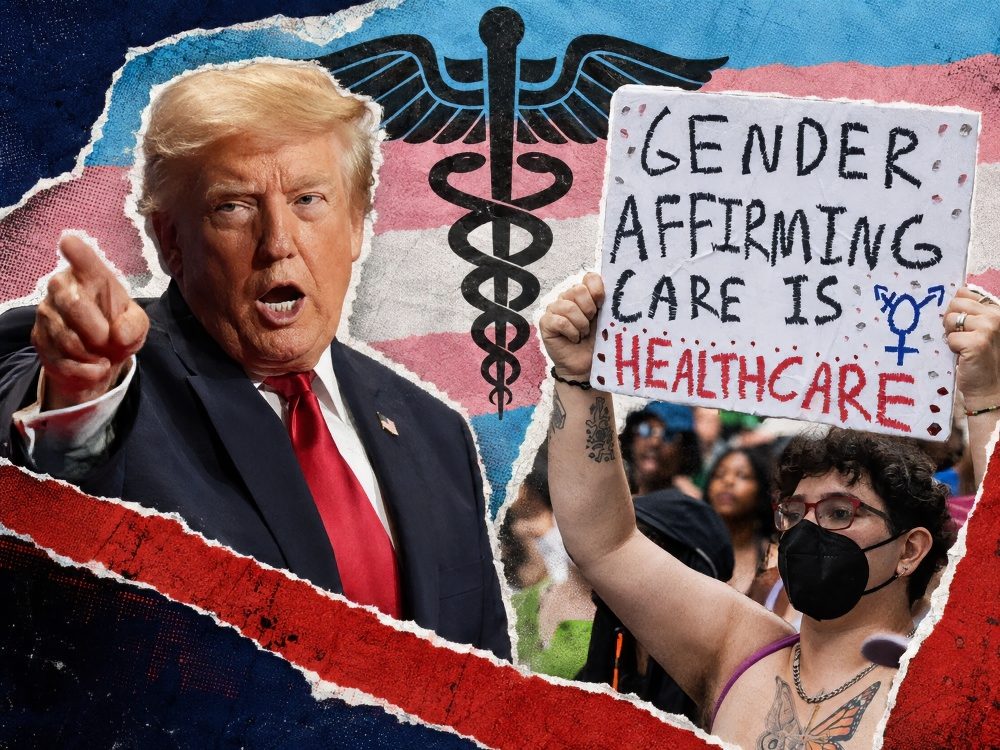
The Trump administration has finalised a sweeping new rule preventing two major US government health programmes from using federal funds for certain forms of gender-affirming healthcare for young people.
The rule affects Medicaid and the Children’s Health Insurance Program (CHIP), programmes that together provide health coverage to around 35.5 million children in the United States.
It is due to take effect in October.
Importantly, the rule does not make gender-affirming healthcare illegal across the US. Instead, it prevents federal Medicaid and CHIP money from being used to fund puberty blockers, hormone therapy and gender-affirming surgeries for patients covered by the rule.
States that want to continue providing this coverage will therefore need to fund it themselves.
The change could have a particular impact on trans and gender-diverse young people from lower-income families who rely on publicly funded healthcare.
Trump celebrates restrictions on trans healthcare
US President Donald Trump celebrated the decision on social media, using inflammatory language to describe gender-affirming healthcare and claiming the policy would protect children from potentially harmful procedures.
Administration officials have similarly argued that the treatments carry risks of irreversible harm and that the evidence supporting their use in young people is insufficient.
Centres for Medicare & Medicaid Services administrator Dr Mehmet Oz said the administration believed withdrawing federal funding would protect children and save taxpayer money.
However, CMS itself says the purpose of the rule is not primarily to achieve budget savings. The agency estimates approximately US$138 million in federal Medicaid and CHIP spending will be saved over a decade — a small fraction of overall federal spending on the programmes.
The administration’s position also conflicts with major US medical organisations, including the American Academy of Pediatrics and American Medical Association, which maintain that decisions about gender-affirming healthcare should be made according to individual clinical circumstances by patients, families and healthcare professionals.
What healthcare does the rule affect?
Gender-affirming healthcare is an umbrella term covering a wide range of services, and not every trans or gender-diverse person wants or receives medical treatment.
Care can include psychological and mental health support, puberty blockers, hormone treatment and, in some circumstances, surgery.
For young people, treatment depends on factors including age, development, individual needs and clinical assessment.
The new Medicaid and CHIP restrictions target specific medical interventions, including puberty blockers and gender-affirming hormones.
Young people already receiving hormone treatment through Medicaid or CHIP when the rule takes effect will receive six months of continued federal coverage to allow treatment to be tapered. That transitional provision does not apply in the same way to puberty blockers or surgery.
Gender-affirming surgery among trans minors is rare
Political debate over gender-affirming healthcare for young people frequently focuses on surgery, but research indicates such procedures among transgender minors are rare.
A 2024 study published in JAMA Network Open examined insured patients in the US in 2019.
Researchers found no gender-affirming surgical procedures associated with a transgender or gender-diverse diagnosis among children aged 12 or younger.
Among minors aged 13 to 14, the rate was 0.1 per 100,000, while among those aged 15 to 17 it was 2.1 per 100,000. Almost all of the procedures identified among transgender and gender-diverse minors were chest-related.
The study also compared breast reductions among transgender and gender-diverse people with those performed on cisgender males.
Among the 151 breast reductions identified across these groups in minors, 146 — or 97 per cent — were performed on cisgender boys rather than transgender or gender-diverse young people.
The researchers concluded that concerns about high rates of gender-affirming surgery among transgender minors may be unwarranted.
Research into youth healthcare remains politically contested
The evidence surrounding gender-affirming medical treatment for adolescents has become the subject of intense political and medical debate internationally.
Research has found associations between access to gender-affirming treatment and improved mental health outcomes for some transgender and non-binary young people.
For example, a prospective US study of 104 transgender and non-binary young people aged 13 to 20 found that receiving puberty blockers or gender-affirming hormones was associated with lower odds of depression and suicidality over 12 months.
That study was observational, however, meaning it demonstrates an association rather than proving that the treatment itself caused those outcomes.
International approaches to treating gender dysphoria in young people have also evolved, with different health systems taking different approaches to puberty blockers and hormone treatment.
That makes accurately distinguishing between the various forms of gender-affirming healthcare particularly important. Mental health support, puberty suppression, hormone treatment and surgery are separate interventions with different purposes, evidence bases, risks and eligibility criteria.
LGBTQ+ groups condemn the funding restriction
LGBTQ+ advocates have strongly criticised the Trump administration’s decision, arguing that politicians should not determine individual healthcare decisions for transgender young people.
Human Rights Campaign president Kelley Robinson said decisions should remain between young people, their families and healthcare providers.
Rodrigo Heng-Lehtinen of The Trevor Project similarly criticised a blanket federal approach to highly individual medical decisions.
Opposition extends beyond LGBTQ+ organisations.
More than 90 per cent of approximately 11,000 public comments submitted on the proposed funding change opposed it, according to Reuters.
Democratic state attorneys-general have also challenged the policy in court, arguing that the federal government is overstepping its authority and interfering with states’ ability to regulate healthcare.
The final rule creates a particular conflict for the 14 states and District of Columbia that have enacted so-called “shield laws” protecting access to gender-related healthcare.
Those jurisdictions could continue covering affected services, but without the federal contribution they previously received.
Part of a wider rollback of trans rights
The Medicaid and CHIP decision does not stand in isolation.
Since returning to the White House, Trump’s administration has pursued a range of policies affecting transgender Americans, including restrictions involving military service, passports, education, healthcare and the federal workforce.