









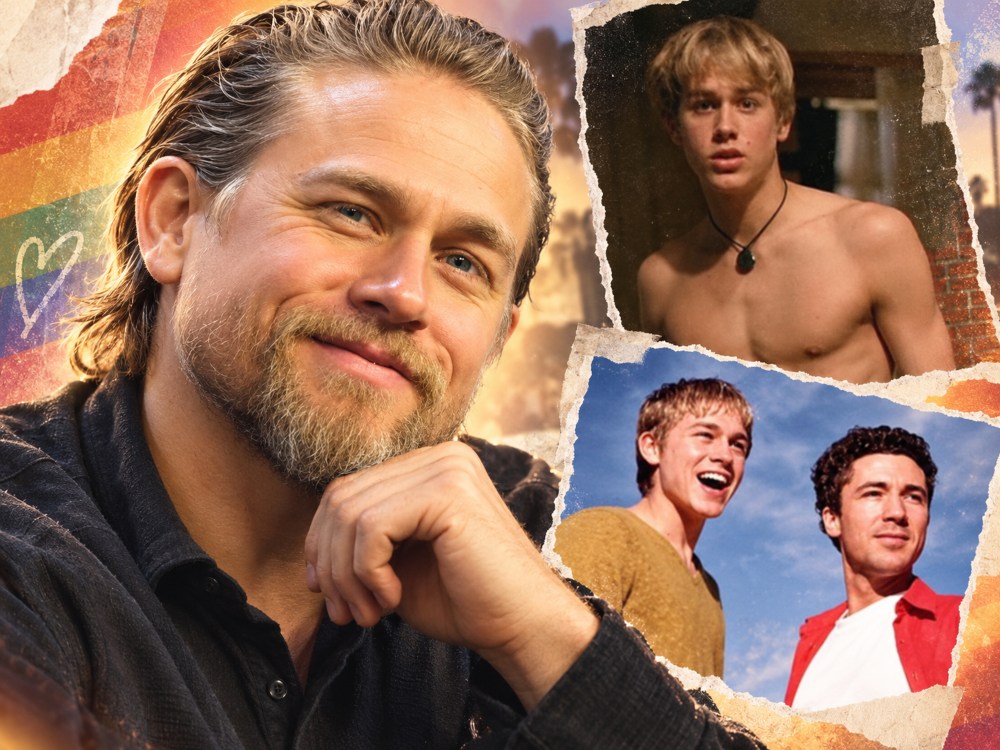

Charlie Hunnam is looking back fondly on the groundbreaking gay series that launched his career, as he returns to Netflix in another story steeped in queer themes and sexual repression.
Long before Sons of Anarchy, The Gentlemen or Monster, Hunnam was 18 and playing Nathan Maloney, the fearless 15-year-old at the centre of Russell T Davies’ Queer as Folk.
The Channel 4 drama premiered in 1999 and followed Nathan, Stuart Jones and Vince Tyler through Manchester’s gay scene at a time when seeing queer sex, relationships and nightlife depicted so unapologetically on mainstream British television was still genuinely disruptive.
More than 27 years later, Hunnam remains proud of what the series achieved.
“What an outpouring of support and celebration that show enjoyed!” Hunnam tells Out. “It was such a beautiful experience and way to start my career.”
“We made an important piece of television.”
‘We Added A Lot Of Discourse’
Hunnam says the social landscape surrounding LGBTQ+ people was considerably different when Queer as Folk was filmed in the late 1990s.
“There wasn’t equality with the gay and heterosexual population,” he says. “We certainly added a lot of discourse to the conversation that was being had at that time.”
That is something of an understatement.
Created by Russell T Davies, the show arrived while Britain was still debating major reforms affecting gay and bisexual men, including equalising the age of consent.
Its explicit sex scenes and refusal to present queer characters as inherently tragic generated both acclaim and controversy.
For Hunnam, it also became the role that introduced him to an international audience.
“I look back on that with very fond memories and a lot of gratitude,” he says.
From Nathan Maloney To Andrew Borden
Hunnam is now back working with Ryan Murphy following his starring role in Monster: The Ed Gein Story.
This time, he plays Andrew Borden in Netflix’s Monster: The Lizzie Borden Story, opposite Ella Beatty as Lizzie, Rebecca Hall as Abby Borden and Vicky Krieps as family maid Bridget Sullivan.
The real Lizzie Borden was accused of killing her father and stepmother with an axe in Massachusetts in 1892 but was acquitted at trial.
Murphy’s version takes considerable dramatic licence with the story, including imagining Lizzie and Bridget in a sexual relationship and portraying Andrew as abusive and sexually exploitative.
Those elements should not be mistaken for established historical fact.
Hunnam says the show instead uses them to construct what he describes as a deeply dysfunctional household.
“It’s a tragic and intriguing story,” he says.
Within the drama, he says Andrew’s relationships with Bridget and Lizzie help create an increasingly volatile dynamic involving power, jealousy and resentment.
Queerness At The Centre Of The Story
For Monster, Lizzie’s sexuality becomes one of the central ways the series explores repression.
Ella Beatty says that was part of what attracted her to the role.
“I hope audiences will find a lot of current and topical information in our story,” she says.
“Her story is so enduring because it feels very relevant today. It’s about how important it is to feel seen and to be loved.”
Beatty says the character’s relationship with Bridget becomes crucial to understanding the fictionalised Lizzie’s emotional life.
“She’s never felt recognised as a human being before,” Beatty explains.
“We can all relate to that first experience of feeling loved by someone and how that can reconfigure the chemistry of your brain, body and spirit.”
She is also clear that emotional understanding is not the same thing as excusing violence.
“Violence and murder are unjustifiable, but the human part of this story is universal.”
‘There’s Queer Energy Everywhere’
Rebecca Hall, who plays Lizzie’s stepmother Abby, is even more direct about the series’ queer perspective.
“There’s queer energy everywhere!” Hall says.
“This whole thing is very queer. That’s what I loved about it and what drew me to it.”
For Hall, the series is less interested in presenting a straightforward true-crime reconstruction than examining women trapped by Victorian expectations around gender, sexuality and family.
“Adding another layer of repressed sexuality makes it even richer,” she says.
“Everyone is repressed in some way.”
That makes Hunnam’s involvement feel strangely circular.
His career began with a series that helped push openly gay life into mainstream television.
Nearly three decades later, he is again appearing in a production using queerness to examine what happens when people are denied the freedom to live openly.
The historical circumstances may be very different — and Monster takes considerable liberties with the record — but the underlying fascination with repression, identity and the need to be seen is something Hunnam has been exploring on screen since the beginning.
Monster: The Lizzie Borden Story is streaming now on Netflix.