








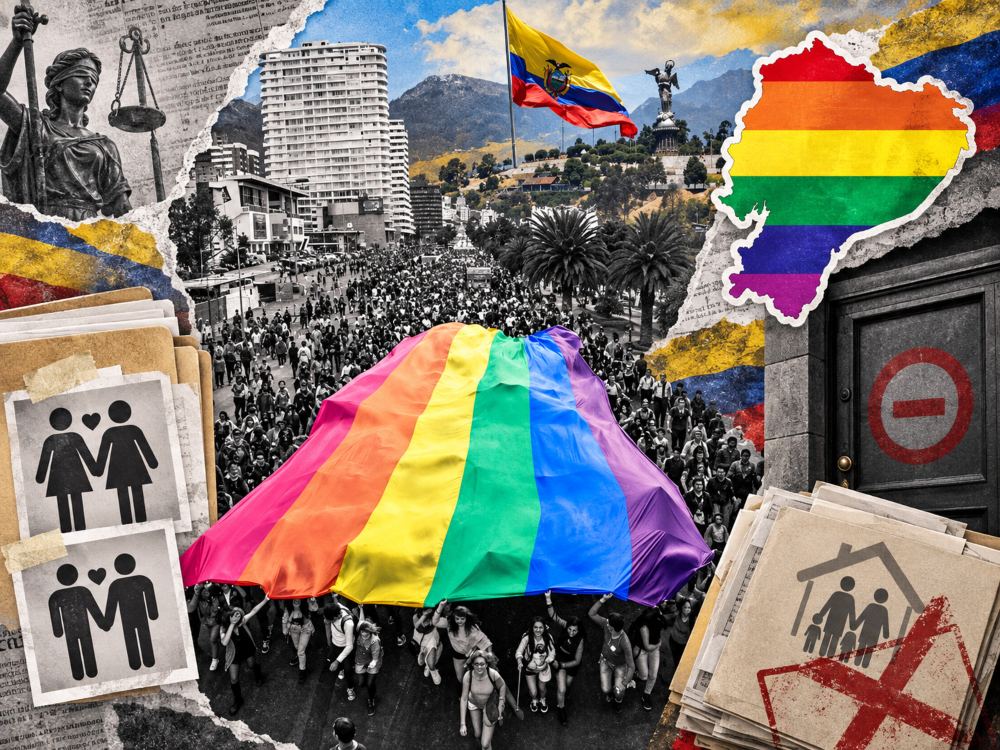

Ecuador has introduced a new adoption law that explicitly excludes LGBTQ+ people from adopting in several circumstances and has raised serious concerns about the rights of families with transgender children.
The Reform Law Of Various Legal Bodies For The Streamlining Of Adoption took effect on 14 August after being approved by the National Assembly with 118 votes.
The law is intended to reduce delays in adoption and shorten the time children spend in institutional care, but LGBTQ+ and human rights organisations say it embeds discrimination into the process.
Single LGBTQ+ People Now Explicitly Excluded
Ecuador’s Constitution already states that adoption by couples is restricted to different-sex couples.
The new reform goes further by stating that single people seeking to adopt must also be heterosexual.
That means lesbian, gay and bisexual people applying alone can now be excluded before their individual parenting ability is even assessed.
The Ecuadorian LGBT Federation has criticised the requirement, arguing that heterosexuality is not evidence of parental fitness and that being LGBTQ+ does not make someone less capable of raising a child.
It has also questioned how authorities would determine whether a single applicant is heterosexual without intruding into their private life.
Trans Families Face New Legal Risk
The law has also alarmed advocates because of provisions affecting parents of transgender children.
It describes the promotion of medical, surgical or pharmaceutical procedures intended to “modify the biological sex” of a child as conduct that can justify the loss of parental rights.
Human Rights Watch says the wording could place families at risk simply for supporting medically recommended gender-affirming care.
Critics are particularly concerned because the term “promoting” is broad and could be interpreted inconsistently by courts or authorities.
Human Rights Watch Condemns The Reform
Human Rights Watch says improving Ecuador’s adoption system is a legitimate goal, but argues that it should not come at the expense of LGBTQ+ people or trans children.
“Improving the adoption system is a legitimate legislative goal, but it should not be used as a pretext to entrench discrimination and undermine children’s health,” senior LGBT rights researcher Cristian González Cabrera said.
The organisation says blanket exclusions based on sexual orientation run against international human rights standards that require parenting ability to be assessed individually rather than through stereotypes.
Ecuador’s LGBTQ+ Rights Record Is Mixed
Ecuador legalised same-sex marriage nationwide in 2019 following a Constitutional Court ruling and its Constitution includes strong protections against discrimination based on sexual orientation and gender identity.
At the same time, the Constitution continues to restrict adoption by couples to different-sex couples.
The new law now widens that exclusion to single LGBTQ+ applicants as well.
That creates a striking contradiction: same-sex couples can legally marry in Ecuador, but they remain unable to adopt together, while gay, lesbian and bisexual people may now also be barred from adopting alone.
Constitutional Challenges Could Follow
LGBTQ+ organisations are calling for close constitutional scrutiny of the law.
The Ecuadorian LGBT Federation says adoption decisions should focus on a person’s ability to provide care, stability, safety and support rather than their sexual orientation.
It has also warned that the provisions affecting trans children should be interpreted narrowly so they are not used to punish parents for affirming or supporting their children.
For LGBTQ+ families, the concern is that a law presented as making adoption faster may instead make family formation more unequal.