








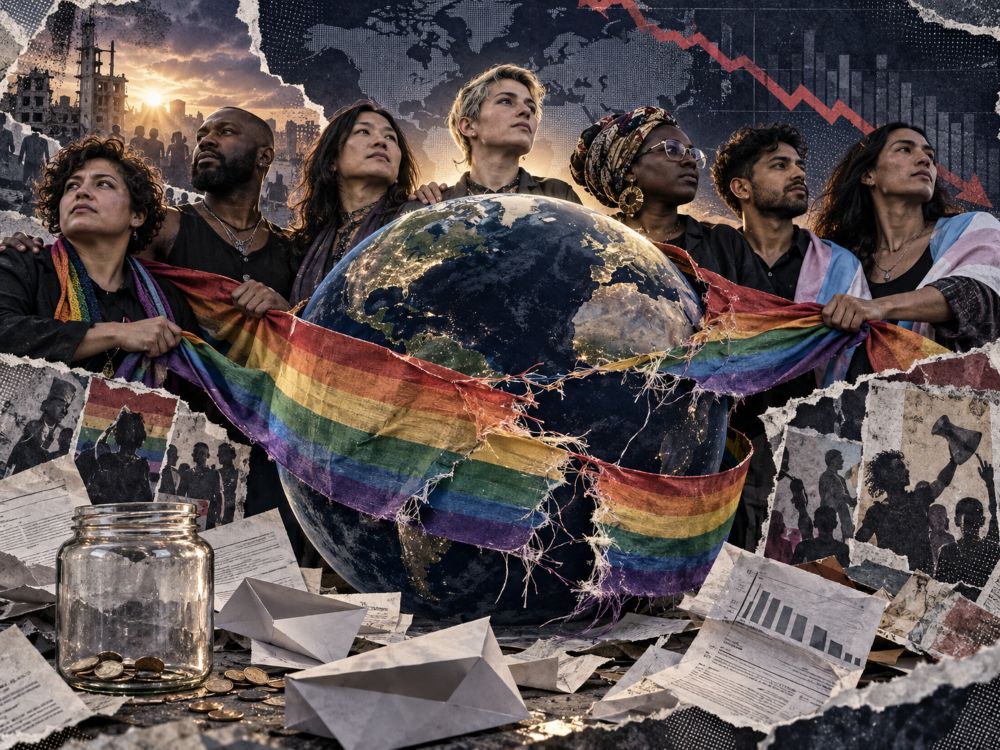
A major new report has revealed the scale of the global funding crisis facing LGBTQ+ organisations, with almost half of affected groups losing more than half their budgets and more than a third warning they could close within a year.
Outright International’s new report, Breaking Point: The Urgent Need To Invest In Global LGBTIQ Movements, surveyed 229 organisations across 94 countries and carried out 24 in-depth interviews.
Of those surveyed, 203 reported losing funding since January 2025.
The findings paint a grim picture of organisations cutting healthcare, laying off staff, closing community spaces and losing the ability to respond when LGBTQ+ people face violence, arrest or displacement.
And those losses are falling hardest on communities already facing some of the greatest barriers.
US Aid Cuts Triggered A Global Shock
The crisis accelerated immediately after Donald Trump returned to the White House in January 2025.
On his first day back in office, Trump ordered a 90-day pause on nearly all US foreign development assistance while programmes were reviewed for consistency with his administration’s foreign policy.
What began as a temporary freeze quickly became something much bigger.
Termination notices started arriving within weeks. By April, the Global Equality Fund — which had supported LGBTQ+ organisations and human-rights defenders in more than 100 countries — had shut down.
USAID stopped operating as an independent agency on 1 July 2025, with surviving programmes moved into the State Department.
PEPFAR was not abolished, but its work was significantly narrowed, including reduced support for community-led HIV prevention and treatment serving key populations.
Other governments, foundations and corporate funders have also reduced or withdrawn support during the same period.
Outright says the combined result has been a dramatic contraction in funding for LGBTQ+ movements worldwide.
Half Lost More Than 50% Of Their Budgets
Among the organisations that reported funding losses, 49% had lost more than half of their total budget, while 75% lost more than a quarter.
Those losses are particularly dangerous because many of the organisations were already operating on small budgets.
Almost three-quarters of affected groups had annual budgets below US$250,000, leaving little or no reserve to absorb a sudden funding shock.
The impact has quickly moved beyond balance sheets.
Half of affected organisations have reduced health services, including mental-health and sexual and reproductive healthcare.
Some 45% have cut or stopped HIV prevention, treatment or care, while 63% say they can no longer adequately respond to emergencies involving violence, arrests, displacement or urgent relocation.
That figure rises even higher in conflict and humanitarian settings.
Trans People And LBQ Women Hit Hardest
The report found that the effects are not evenly distributed.
Trans, non-binary and gender-diverse people were named by 71% of affected organisations as among those experiencing the deepest impacts.
Lesbian, bisexual and queer women were named by 61%.
In many places, LGBTQ+ organisations are not simply advocacy groups.
They may also be the only accessible provider of HIV services, emergency accommodation, legal assistance, safe spaces or relocation support for people who face discrimination within mainstream institutions.
When those organisations disappear, there is not always another service waiting to replace them.
That is particularly concerning in countries where queer and trans people already face criminalisation, violence, authoritarian government or weak legal protection.
More Than A Third Could Close Within A Year
The report’s most alarming finding may be what comes next.
Forty percent of affected organisations described themselves as being at severe or immediate risk, including 10% facing immediate risk of closure.
Asked separately how likely they were to be forced to shut down entirely within the next 12 months, 36% said likely or very likely.
Only 3% described themselves as stable.
Outright says the damage is already visible.
Shelters and offices have shut. Specialist staff have been laid off. Services communities relied on have disappeared.
And once trust, expertise and local networks are lost, simply restarting funding later may not be enough to rebuild them.
A Movement That Was Already Underfunded
The funding crisis has hit a movement that was never generously resourced to begin with.
Outright argues that global LGBTQ+ work has historically received only a tiny share of international development spending.
That has left many grassroots organisations heavily dependent on a small number of governments, foundations and intermediary funders.
When one major donor changes direction, the consequences can therefore be immediate and global.
The Trump administration’s decisions exposed just how fragile that model was.
But Outright is also clear that rebuilding should not simply mean returning to how things worked before January 2025.
What The Report Says Needs To Happen
Outright is calling for urgent bridge and emergency funding before more organisations close.
It also wants donors to move towards flexible, multi-year grants that can pay for staff, rent, security and core operations rather than funding narrowly defined projects alone.
The report calls for renewed investment in community-led HIV and healthcare services, dedicated funding for emergency protection and relocation, and greater priority for trans and gender-diverse people and LBQ women.
It also urges corporate funders not to disappear simply because visible LGBTQ+ support has become politically contentious.
Companies that consider public campaigns too risky, it argues, can still fund organisations quietly, match staff donations or support trusted intermediary funds.
Building Something More Resilient
For Outright, the crisis is about more than restoring individual grants.
It is also a warning about what happens when global LGBTQ+ movements become too dependent on a handful of powerful donors.
The organisation argues that future funding needs to be broader, more flexible and less vulnerable to sudden political shifts.
“The goal should not be to recreate the funding landscape that existed before January 2025,” the report says.
Instead, it calls for a system that is larger, more diverse and better able to reach organisations working where LGBTQ+ people face the greatest barriers.
The numbers make clear how urgent that task has become.
For many groups, the question is no longer whether programmes will be cut.
It is whether the organisation itself will still exist a year from now.
Focus Keyphrase:
Meta Description:
Social Media Summary
Social Handles: @outrightintl