








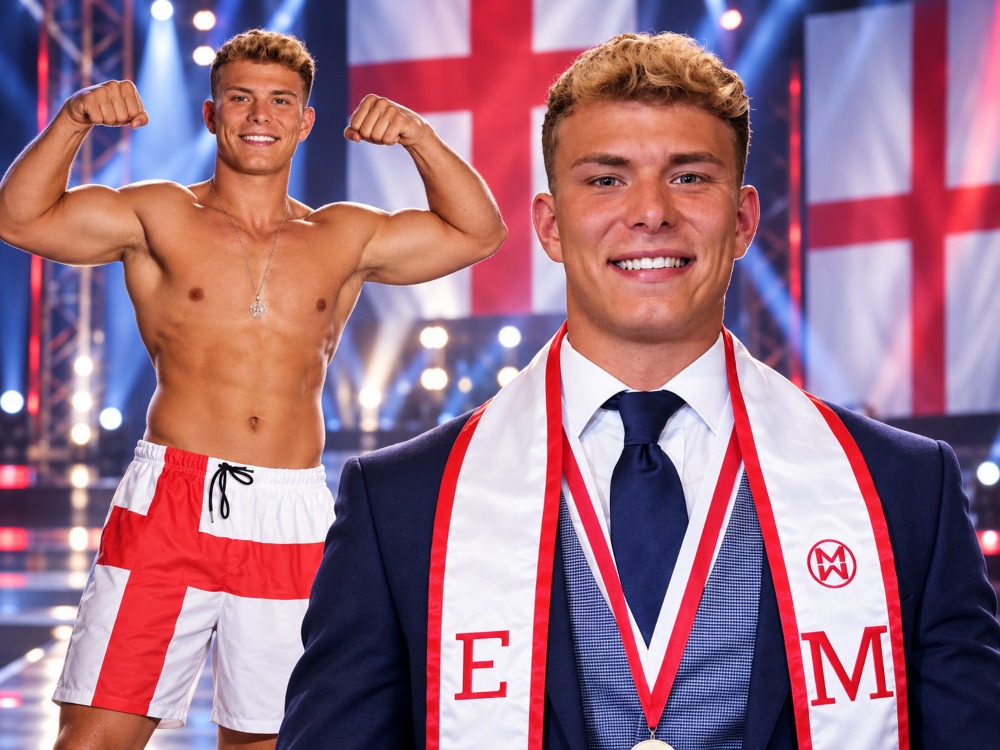

England appears to have developed an unexpected national emergency: a shortage of hunks willing to enter Mr England.
Organisers of the male pageant are searching for more contestants after only seven men reportedly signed up for this year’s competition, well short of the 12 they hope to take forward.
Eligible men aged 17 to 27 are being encouraged to apply, with Miss England contestants even being asked to nominate friends and boyfriends who might fancy their chances.
Organiser Angie Beasley says men have simply been “shy and slow” to put themselves forward since applications opened.
The next Miss and Mr England event takes place at Melton Theatre in Leicestershire on Sunday, 11 October, where contestants will compete in front of judges as organisers continue the search for England’s next representative on the international pageant circuit.
So, What Makes A Mr England?
According to organisers, they are looking for more than someone who photographs well.
Prospective contestants should be confident, charismatic, sporty, community-minded and willing to get involved in charitable activities.
The competition includes sporting and modelling elements, although entrants do not need to be professional athletes or arrive with superhero-level abs.
The successful Mr England contestant can go on to represent the country internationally, following in the footsteps of reigning titleholder Manuel Alcantara-Turner.
The Coldstream Guards soldier won Mr England in 2024 after being selected from a field of 12 finalists and went on to represent England at Mr World.
Organisers are hoping a last-minute recruitment drive can once again uncover some hidden talent.
From King’s Guard To WWE
Mr England has produced some surprisingly varied alumni.
Alcantara-Turner had served in ceremonial duties around Queen Elizabeth II’s funeral and King Charles III’s coronation before exchanging his bearskin for a pageant sash.
Another 2024 finalist, Dorset sheep farmer and wrestler Nathaniel Cranton, has since pursued professional wrestling under the name Tristan Angels.
That year’s competition drew a much larger initial pool of applicants before the finalists were selected, making 2026’s slow start particularly noticeable.
Whether England has genuinely run out of eligible hunks or they simply need a little more persuading remains open for debate.
Aotearoa Took Pageantry In A Different Direction
New Zealand’s best-known comparable queer competition ultimately took a very different approach.
Mr Gay New Zealand evolved away from judging contestants primarily on appearance and instead focused on finding people who could become visible leaders within Aotearoa’s LGBTQ+ communities.
By 2021, finalists were being assessed on community engagement, outreach, public speaking, natural leadership and mana.
They also completed challenges including fundraising for the then-New Zealand AIDS Foundation, an LGBTQ+ knowledge test, an opinion piece, public speaking and a formal interview.
That year’s winner, Bharat Mahajan, used the platform to talk about LGBTQ+ representation in healthcare, mental health and strengthening leadership within Rainbow communities.
The contrast shows how broadly the idea of a male pageant can be interpreted.
For Mr England, appearance, confidence, sport and charisma remain central.
For Mr Gay New Zealand, the emphasis had shifted towards what someone could actually do with the title once the sash was on.
England Still Needs A Few More Hunks
For now, Mr England’s most pressing issue is simply finding enough men willing to enter.
Applications remain open ahead of the October event, with organisers hoping the attention around the so-called “hunk shortage” might itself convince a few reluctant contenders to step forward.
And really, what better recruitment strategy is there than telling an entire country it may be running dangerously low on handsome men?
Challenge accepted, England.