










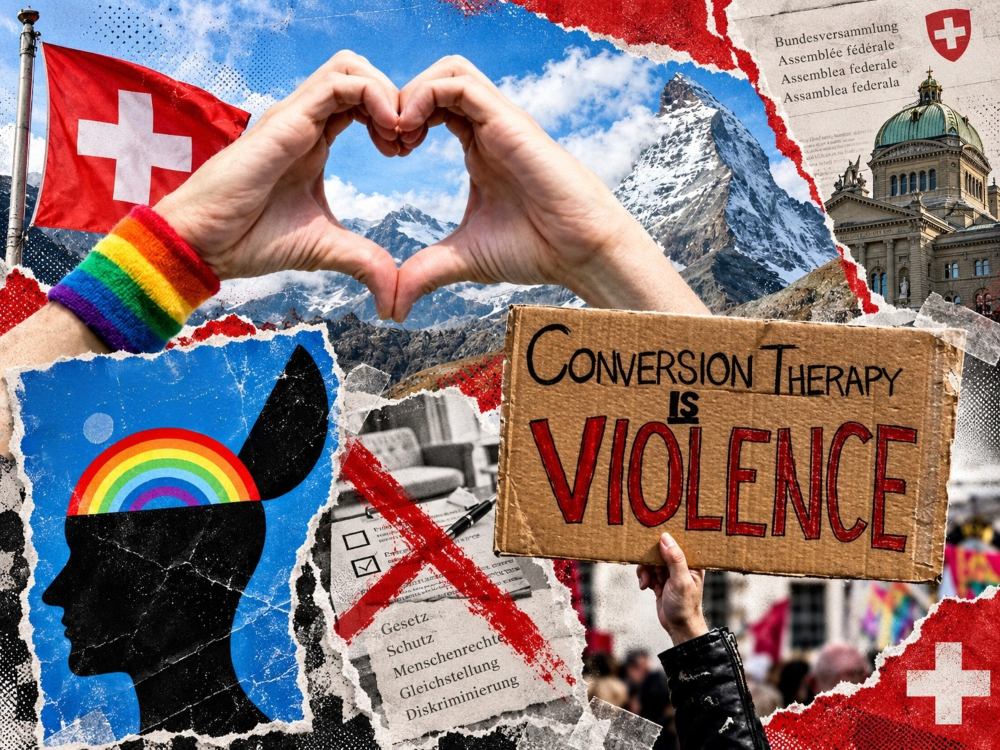
Switzerland has moved closer to nationwide regulation of so-called conversion therapy after the Federal Council said stronger national protections should be considered.
In a report released on 2 September, the Swiss Government acknowledged that conversion practices targeting lesbian, gay, bisexual, trans and queer people continue to occur in the country and can cause significant harm.
While the Federal Council stopped short of formally endorsing a specific national ban, it rejected conversion practices and said more precise federal regulation could help replace Switzerland’s current patchwork of cantonal rules.
Canton-Level Bans Have Created Uneven Protection
Protections currently vary depending on where someone lives.
Neuchâtel became the first Swiss canton to ban conversion practices in 2023, with Valais later introducing its own prohibition. Other cantons, including Vaud and Geneva, have also moved towards restrictions.
The Federal Council said existing Swiss law already provides substantial protections against harmful practices, but acknowledged that the growing number of cantonal measures raises the question of whether clearer nationwide rules are needed.
A federal approach could create one consistent standard across Switzerland rather than leaving LGBTQ+ people with different protections from canton to canton.
Conversion Practices Are Widely Condemned
Conversion practices attempt to change, suppress or eliminate a person’s sexual orientation, gender identity or gender expression.
Major medical and psychological bodies internationally reject the premise that LGBTQ+ identities require treatment and warn that such practices can cause serious psychological harm.
The Swiss report similarly concluded that conversion practices can cause considerable suffering and said the government clearly opposes them.
Europe Is Moving Towards Wider Restrictions
Switzerland’s review comes as pressure grows across Europe for stronger action against conversion practices.
Earlier this year, the European Commission called on all EU member states to prohibit them and said it plans to issue a formal recommendation in 2027.
Eight EU countries currently have explicit national bans: Malta, France, Germany, Greece, Belgium, Spain, Cyprus and Portugal.
Germany’s law primarily protects minors and adults whose consent is compromised, while other countries have adopted broader restrictions.
Switzerland is not a member of the European Union, but the growing number of bans across the region adds momentum to its own debate.
National Legislation Could Be Next
The Federal Council has not yet presented legislation or committed to the exact form a national law would take.
Its latest report nevertheless represents a significant shift by acknowledging that the current system may need clearer federal rules.
For LGBTQ+ communities, a national approach would mean protection no longer depended so heavily on which canton someone lived in.
The next step will be whether Switzerland’s parliament turns that possibility into legislation.