









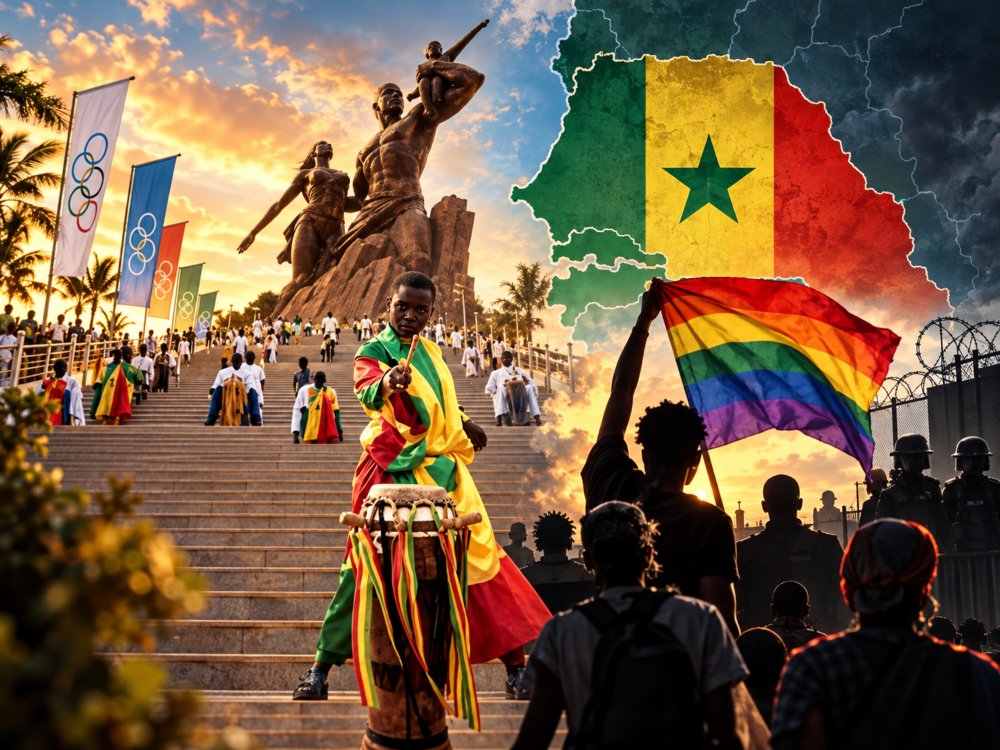
Senegal is preparing to become the first African country to host an Olympic event. But less than three weeks before the Dakar 2026 Youth Olympic Games begin, Human Rights Watch has documented mass arrests, alleged forced HIV testing and growing fear among LGBTQ+ people in the host nation.
On 31 October, Senegal will make sporting history.
Around 2,700 young athletes from 206 delegations are expected to arrive for the Dakar 2026 Youth Olympic Games, the first Olympic event ever staged on the African continent. Competition will continue until 13 November across Dakar, Diamniadio and Saly.
But as Senegal prepares to welcome the world, a new Human Rights Watch investigation has documented a sharply deteriorating environment for LGBTQ+ people living there.
Published on 12 October, the investigation alleges mass arrests, forced HIV testing, barriers to legal representation, physical abuse and growing fear of accessing healthcare.
Human Rights Watch says some LGBTQ+ Senegalese people have gone into hiding, restricted their movements or fled the country altogether.
The findings raise an uncomfortable question for the Olympic movement: how does a commitment to non-discrimination operate when a Games host is simultaneously enforcing laws that criminalise consensual same-sex relationships?
Anti-LGBTQ+ penalties strengthened
Consensual same-sex sexual activity has been criminalised in Senegal since 1965.
In mid-March 2026, Senegal’s parliament approved amendments to Article 319 of the penal code that substantially increased those penalties.
The maximum prison sentence for consensual same-sex conduct was doubled to 10 years, while the maximum fine increased to 10 million CFA francs.
The amendments also introduced offences carrying up to seven years in prison for the broadly defined “promotion” or “glorification” of homosexuality, as well as financing or supporting LGBTQ+ people and organisations.
The legislation was adopted overwhelmingly, with 135 lawmakers voting in favour, none against and three abstaining.
UNAIDS warned at the time that the tougher law risked undermining Senegal’s HIV response, particularly if LGBTQ+ people became afraid to seek testing, treatment or support.
The final legislation includes an exemption intended to protect authorised health organisations carrying out public-health work.
But Human Rights Watch’s investigation suggests fear surrounding healthcare has nevertheless intensified.
Hundreds reportedly arrested
Human Rights Watch interviewed 39 people in Senegal, including former detainees, lawyers, health professionals, journalists, civil-society representatives and members of the country’s queer community.
The organisation said it could not independently establish the total number of people arrested under the crackdown.
However, Senegalese human rights group RADDHO recorded at least 212 arrests between February and July, while the HIV Justice Network reported more than 300 over the same period.
HRW says security forces have identified suspected LGBTQ+ people through information taken from confiscated phones, allegations from other people and raids on private premises.
One 23-year-old man told researchers that he and friends were arrested while preparing for a fashion show at his home in Thiès in December 2025.
He alleged that police confiscated their phones and subjected them to physical abuse.
The charges against the group were ultimately dropped for lack of evidence.
Allegations of forced HIV testing
Some of the most serious findings concern healthcare.
Human Rights Watch says detainees reported being subjected to HIV testing without informed consent, with positive results then allegedly being used to support additional criminal charges.
Of those detained during the crackdown, 82 people were also charged with alleged voluntary HIV transmission, although those charges were dismissed by a court in August.
The allegations are particularly significant because Senegal’s own 2010 HIV/AIDS law protects medical confidentiality and informed consent, including protections against mandatory HIV testing for detainees.
A doctor in Dakar told HRW that approximately one-third of some patients had stopped attending appointments for HIV treatment because of fear surrounding the crackdown.
UNAIDS had already warned in March that criminalisation can push people away from health services.
It noted that 79% of people living with HIV in Senegal were receiving treatment, but that new infections had increased by 36% between 2010 and 2024 — making continued access to healthcare particularly important.
For people living with HIV, maintaining treatment is essential both for individual health and for preventing transmission.
When fear of arrest or disclosure discourages people from accessing that treatment, the consequences become a wider public-health concern.
Lawyers fear taking cases
The crackdown is also affecting access to legal representation.
Lawyers told HRW they feared that defending people accused of same-sex conduct could expose them socially, professionally or even legally under the new provisions targeting the “promotion” of homosexuality.
One lawyer said colleagues and family members had urged him not to represent people accused under Article 319.
Another told researchers that detainees had been pressured to waive their right to legal representation and had sometimes been questioned without a lawyer present.
Human Rights Watch argues that these conditions risk undermining the right to a fair trial.
A community retreating from public life
Behind the arrest figures is a wider climate of fear.
A 22-year-old university student told HRW that harassment in his neighbourhood became so intense he began waiting until dark before returning home to avoid being recognised.
A 27-year-old community worker described LGBTQ+ community life as increasingly isolated, saying his partner fled the country after friends were arrested and police raided his home.
A psychologist at Cheikh Anta Diop University told HRW that consultations had tripled since March, with young men seeking support for severe anxiety, fear, hypervigilance and withdrawal from social life.
Human Rights Watch wrote to Senegalese authorities on 29 September seeking responses to its findings.
It said it had received no response by the time its investigation was published.
The Olympics arrive
From 31 October to 13 November, Dakar 2026 will bring thousands of athletes and officials to Senegal.
The Games are being promoted as a milestone not only for Senegal but for the entire African continent.
Earlier this year, the Dakar organising committee and the International Labour Organisation signed an agreement aimed at making the Games a model for social sustainability, decent work and respect for human rights.
The Olympic Charter also explicitly prohibits discrimination on grounds including sexual orientation.
Those commitments now sit alongside Senegal’s criminalisation of same-sex relationships and Human Rights Watch’s allegations about how those laws are being enforced.
What has the IOC said?
Concerns about LGBTQ+ safety in Senegal have already been raised with the International Olympic Committee.
In August, the IOC told Outsports that it was working with the Dakar organising committee and Senegalese authorities to ensure Olympic Charter principles were upheld.
The IOC said Senegalese authorities had provided assurances that obligations under the host agreement would be respected.
“We have full confidence in the Organising Committee and the Senegalese authorities,” an IOC spokesperson said.
The organisation also stressed that it does not have the mandate or ability to change the domestic laws of a sovereign country.
Human rights advocates have argued that assurances alone may not answer questions about what protections will exist in practice.
ILGA World told Outsports that clear safeguards should be established for athletes, journalists, workers, volunteers and other people involved with the Games.
The concern extends beyond international visitors.
LGBTQ+ Senegalese people will remain subject to the country’s criminal laws after the Olympic flame has gone out and international delegations have returned home.
Human Rights Watch calls for change
Human Rights Watch has urged Senegal’s government to end arbitrary arrests, protect access to legal counsel and healthcare, prohibit forced HIV testing and investigate alleged abuses.
It has also called for Article 319 to be repealed and for Senegalese authorities to publicly guarantee that residents, visitors and participants will be protected from discrimination and arbitrary arrest during the Youth Olympics.
The IOC cannot itself repeal Senegalese law.
But Dakar 2026 places the country’s human-rights record alongside one of the Olympic movement’s most fundamental principles: that participation in sport should take place without discrimination.
For two weeks, the world’s attention will be on Senegal.
Human Rights Watch’s investigation is a reminder that for LGBTQ+ Senegalese people, what happens after those two weeks matters just as much.