







A five-judge panel of Botswana’s High Court has heard a landmark challenge from two women seeking legal recognition of their relationship through civil marriage — a case that could make Botswana only the second African country with marriage equality.
A landmark fight over same-sex marriage has reached Botswana’s High Court, with Bonolo Selelo and Tsholofelo Kumile asking judges to rule that excluding them from civil marriage violates their constitutional rights.
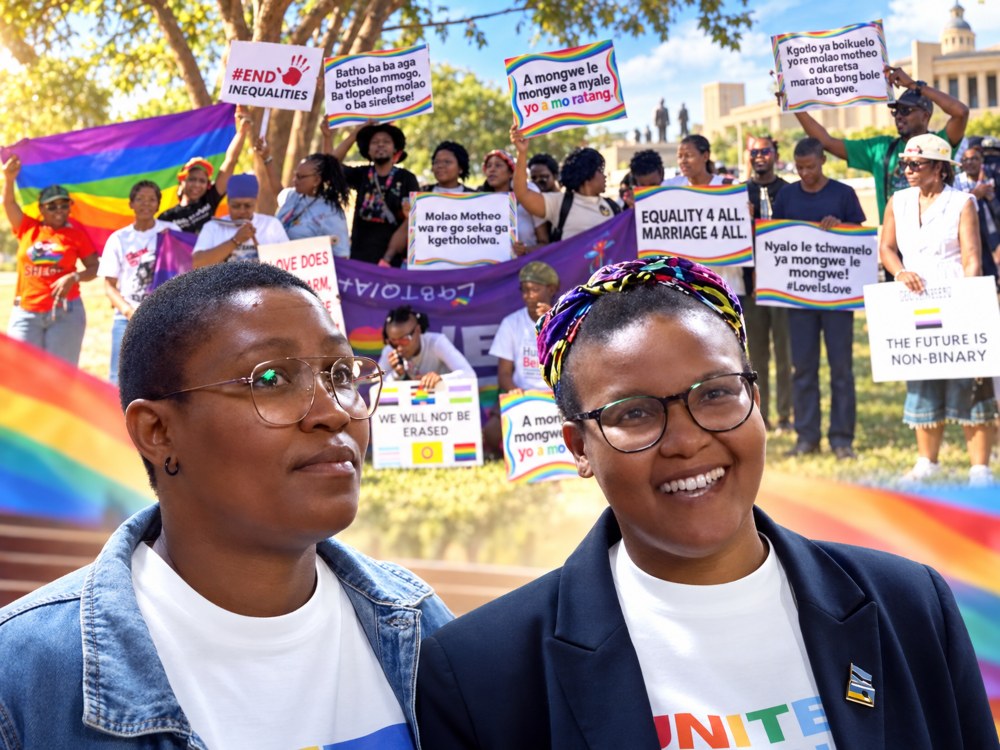
The court heard two days of arguments in Gaborone on 22 and 23 October, with supporters and opponents gathering outside as the five-judge panel considered one of the most consequential LGBTQ+ rights cases in Botswana since the country decriminalised consensual same-sex relations.
Marriage-equality supporters carried rainbow flags and signs reading “Love does not harm” and “marriage 4 all”.
Christian groups opposing the case also gathered outside, carrying placards rejecting same-sex marriage.
How the case began
Selelo and Kumile became engaged in March 2024 and later sought to have their intended marriage recognised under Botswana law.
On 8 May 2025, the Department of Civil and Registration refused to publish the banns for their marriage, telling them that the marriage they wanted was not supported by existing law.
That refusal triggered the legal challenge.
The couple are pursuing three linked arguments: a judicial review of the department’s decision, a constitutional challenge to the refusal itself, and a constitutional challenge to section 10(2) of the Marriage Act if the provision is interpreted as excluding same-sex couples.
They argue that denying them access to civil marriage infringes constitutional protections involving dignity, equality, non-discrimination, expression and freedom of association.
LEGABIBO joins the couple’s case
Botswana LGBTQ+ rights organisation LEGABIBO — Lesbians, Gays and Bisexuals of Botswana — was formally admitted as the third applicant in September.
The organisation argues that the consequences of excluding same-sex couples from marriage extend far beyond symbolism.
Civil marriage brings legal protections around property, inheritance, maintenance, next-of-kin recognition, medical decision-making and family security.
Without access to marriage, same-sex couples can be forced to rely on private legal arrangements for protections that opposite-sex married couples receive automatically.
“The matter is not only about challenging the administration and the Marriage Act at its core,” the Southern Africa Litigation Centre said.
The central question, it added, is whether the state can treat adult citizens differently because of the sex of the person they love and still claim their constitutional rights have not been affected.
Government says marriage law contemplates a man and a woman
Botswana’s government is opposing the application.
Court filings reported earlier this year show the state arguing that the Marriage Act contemplates marriage between a man and a woman, pointing in part to references to a “bridegroom” and a “bride” in the legislation.
The government has also argued that Botswana’s Constitution permits some differentiation in matters relating to marriage and disputes the couple’s claim that their constitutional rights have been violated.
Reporting from the October hearing says the state also relied on arguments around procreation, culture, tradition and the role of Parliament in deciding whether marriage law should change.
Those claims are contested by the applicants, who argue that civil marriage cannot constitutionally be denied solely because both prospective spouses are women.
Religious groups also oppose the case
Three religious or conservative organisations were admitted as respondents alongside the government:
Botswana House of Prayer and Transformation, Dingwetsi Association of Botswana and the Evangelical Fellowship of Botswana.
The High Court also admitted University of Botswana human-rights scholar Dr Onthatile Olerile Moeti as an amicus curiae, or friend of the court.
LEGABIBO says much of the opposition presented at the hearing relied on Christian doctrine.
The applicants’ case, however, is centred on the civil institution of marriage and constitutional protections rather than whether religious bodies should be required to alter their theology.
That distinction matters.
A ruling recognising civil same-sex marriage would concern the legal relationship between citizens and the state, rather than requiring religious denominations to change their beliefs about marriage.
Botswana has already made major LGBTQ+ legal progress
The case arrives after significant changes in Botswana’s LGBTQ+ legal landscape.
In 2019, the High Court struck down laws criminalising consensual same-sex intimacy, finding they violated constitutional rights.
The government appealed, but Botswana’s Court of Appeal upheld the decriminalisation ruling in 2021.
In that case, the Court of Appeal said criminalisation served to stigmatise gay people and intruded unnecessarily into citizens’ private lives.
The current marriage case asks the courts to go substantially further.
Decriminalisation means the state cannot punish adults for consensual same-sex intimacy.
Marriage equality would require the state to recognise same-sex relationships on the same legal footing as opposite-sex marriages.
Why marriage recognition matters
For Selelo, Kumile and LEGABIBO, this is not simply about having a ceremony.
Marriage creates a legal framework that affects everyday life.
It can determine who inherits property, who is treated as next of kin, who may make medical decisions, how assets are divided, whether maintenance rights exist and how families are recognised by the state.
That is why LGBTQ+ advocates argue that excluding same-sex couples creates a practical legal disadvantage, even in countries where homosexuality itself is no longer criminalised.
LEGABIBO has described that exclusion as concrete rather than symbolic.
Could Botswana become Africa’s second marriage-equality country?
If Selelo and Kumile ultimately succeed, Botswana could become the second sovereign African country to recognise same-sex marriage nationwide.
South Africa became the first in 2006 after its Constitutional Court ruled the exclusion of same-sex couples from marriage unconstitutional.
No other African country currently provides nationwide civil marriage equality.
That would make any favourable ruling in Botswana significant well beyond the country’s borders.
It could also build on Botswana’s previous constitutional jurisprudence recognising that protections against discrimination can extend to sexual orientation, even where it is not expressly listed in every constitutional provision.
Judgment expected in April
The High Court has now reserved its decision.
According to reporting from the hearings, judgment is scheduled for 2 April 2027.
Until then, Selelo and Kumile remain unable to marry under Botswana’s civil marriage system.
LEGABIBO says its advocacy will continue while the country waits.
Whatever the outcome, the case has already placed one fundamental question squarely before Botswana’s courts:
Can the state deny two consenting adults access to marriage solely because they are both women?