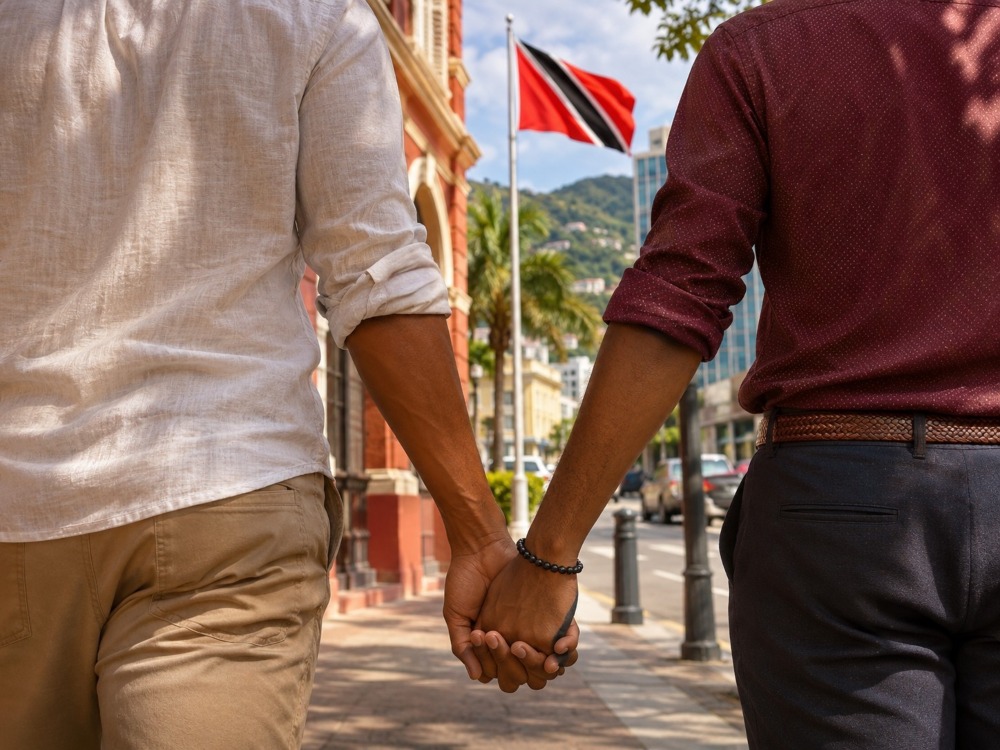
A landmark victory for LGBTQ+ rights in the Caribbean! After nearly a decade of legal battles, Trinidadian activist Jason Jones has won a unanimous ruling that laws criminalising private, consensual same-sex intimacy between adults violate constitutional rights.
LGBTQ+ communities in Trinidad and Tobago are celebrating a major legal victory after the country’s highest court of appeal ruled against legislation criminalising consensual same-sex sexual activity.
On Tuesday 10 November 2026, the Judicial Committee of the Privy Council in London unanimously ruled in favour of activist Jason Jones, overturning a previous judgment that had restored criminal penalties for gay sex.
All five judges agreed that provisions of Trinidad and Tobago’s Sexual Offences Act 1986 infringed constitutional protections relating to private and family life.
The decision marks a significant moment for LGBTQ+ equality in the Caribbean nation, where laws targeting same-sex relationships have their roots in British colonial rule.
Nearly A Decade Fighting For Equality
For Jason Jones, the victory represents the culmination of a legal battle that began in 2017.
Jones challenged sections 13 and 16 of Trinidad and Tobago’s Sexual Offences Act, which criminalised certain sexual acts between consenting adults of the same sex.
The legislation included offences described as “buggery” and “serious indecency”, with criminal penalties that could be imposed on people engaging in private, consensual relationships.
In April 2018, Trinidad and Tobago’s High Court ruled in Jones’s favour, finding that the restrictions violated constitutional rights.
However, that victory was challenged.
In March 2025, the country’s Court of Appeal partially reversed the decision, finding that constitutional protections for certain older laws prevented the courts from striking down the restrictions.
Jones refused to give up.
He took his case to the Judicial Committee of the Privy Council, which serves as Trinidad and Tobago’s final court of appeal.
And this time, all five judges sided with him.
What Did The Court Decide?
The Privy Council examined whether the challenged provisions of the Sexual Offences Act could be protected from constitutional scrutiny because similar offences existed before Trinidad and Tobago adopted its republican constitution in 1976.
The judges rejected that argument.
Although the restrictions had colonial origins, the court found that the 1986 legislation represented a new legal framework rather than simply preserving the earlier provisions unchanged.
That meant the relevant sections could be assessed against the constitutional rights of individuals.
The judges concluded that criminalising private, consensual same-sex intimacy between adults could not be justified.
They ruled that sections 13 and 16 must be interpreted consistently with the Constitution, so that they do not criminalise those relationships.
The court also dismissed the Attorney General’s cross-appeal.
Importantly, the substantive judgment has been delivered, but the judges are still considering the precise wording of the final legal order.
Their preferred approach is to restore the remedy established by the High Court in 2018, with further written submissions to be considered before the order is finalised.
Jason Jones Celebrates A Major Victory
Following the judgment, Jones welcomed the decision as a significant achievement for Trinidad and Tobago’s LGBTQ+ community.
Speaking to local media, he acknowledged the years of legal work involved and thanked the lawyers, community advocates and supporters who helped pursue the case.
The activist has previously described experiencing harassment, discrimination and violence because of his sexuality.
His legal challenge argued that criminal laws targeting consensual same-sex relationships undermined his right to privacy and contributed to a climate of fear.
The Privy Council’s judgment recognised the constitutional importance of protecting private relationships and individual dignity.
However, Jones also acknowledged that changing the law does not automatically eliminate discrimination.
LGBTQ+ people in Trinidad and Tobago continue to face challenges relating to social acceptance, safety and equal treatment in everyday life.
A Significant Moment For The Caribbean
The ruling is another development in a wider legal movement challenging laws inherited from British colonial rule.
Several Caribbean nations have faced constitutional challenges to legislation criminalising same-sex relationships.
Courts in countries including Barbados and Antigua and Barbuda have previously ruled against similar restrictions.
However, laws criminalising consensual same-sex activity remain in force in other parts of the region.
The Trinidad and Tobago judgment could provide an important legal reference for future challenges, although each country’s constitution and legal circumstances differ.
It also demonstrates the role that individual activists and community organisations can play in pursuing constitutional protections.
Aotearoa Marks 40 Years Since Homosexual Law Reform
For rainbow communities in Aotearoa New Zealand, the judgment comes during a particularly significant anniversary year.
In 1986, New Zealand passed the Homosexual Law Reform Act, decriminalising consensual sexual activity between men aged 16 and over.
The legislation followed years of campaigning, parliamentary debate and public protest.
Forty years later, Trinidad and Tobago’s LGBTQ+ communities have achieved a major legal breakthrough through a different pathway.
While New Zealand’s reform was achieved through Parliament, Jones pursued his challenge through the courts.
Both histories illustrate the lengthy legal and political processes that can be involved in removing discriminatory criminal laws.
The Fight For Equality Continues
The Privy Council’s judgment represents a significant legal victory, but it does not resolve every issue affecting LGBTQ+ people in Trinidad and Tobago.
It does not establish marriage equality or automatically introduce comprehensive protections against discrimination.
The final wording of the court’s remedial order also remains to be settled.
Nevertheless, the ruling provides constitutional protection against criminal punishment for private, consensual same-sex intimacy between adults under the challenged provisions.
For Jones and those who have supported his campaign, it marks the successful conclusion of the central legal question in a case that began almost a decade ago.
And for LGBTQ+ communities across the Caribbean, it is another milestone in the continuing effort to ensure that consensual love and intimacy are not treated as crimes.