









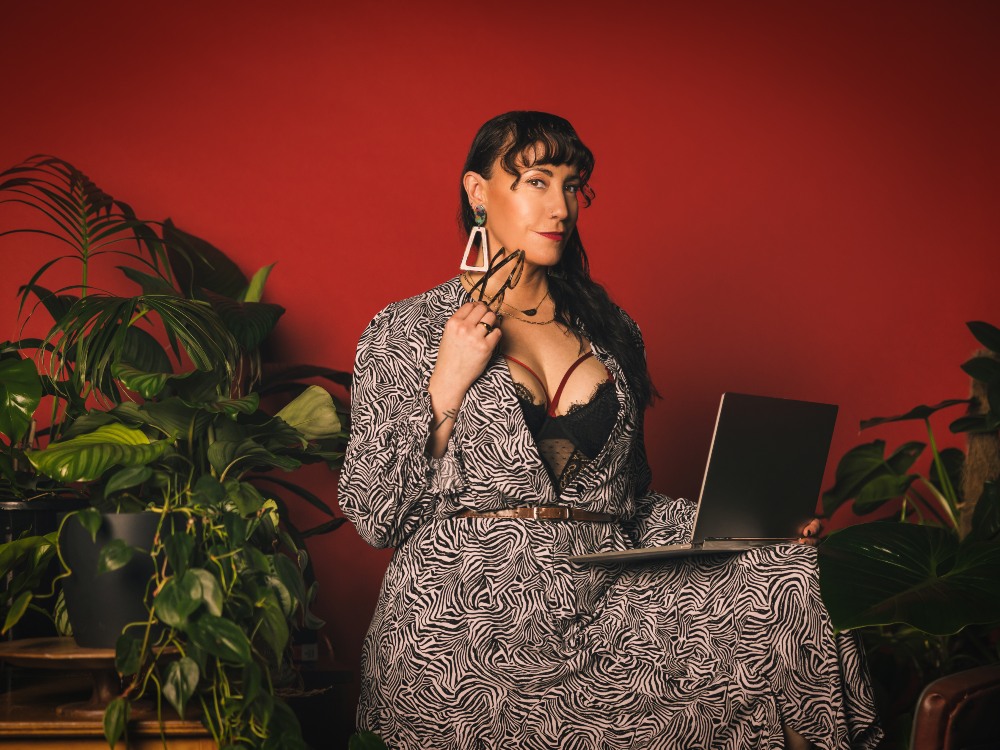


Bronwyn Turei discusses her role in WET, the bold new Māori–Pasifika play exploring sexuality, shame and the power of speaking out.
When actor and musician Bronwyn Turei (Ngāti Porou) talks about WET, the new Māori–Pasifika play she is starring in for the Te Ahurei Toi o Tāmaki Auckland Arts Festival, she does not describe it in grand statements or sweeping predictions. She talks about people. Queer people, mothers, anyone who has ever shunned society’s expectations, and what might crack open for them when they watch her character, Aroha, a Māmā and secret “cliterature” writer, finally take up space in her own story.
Speaking to queer audiences
When I ask Turei which parts of WET will speak to queer audiences, especially younger ones still feeling out their place in the world, she immediately mentions Fetu: “a character who is unapologetically themselves and out and proud, but dealing with being with someone who isn’t.”
“That shame, that questioning of yourself and who you are, will really resonate,” she says.
But the connection goes beyond individual characters.
“There’s the universality of erotic language. That element of taboo. All of us crave being seen, validated, wanted and safe. It’s human. I think it will resonate strongly for queer audiences, as well as the rest of us schlubs out here.”
Sexuality & ageing
One of the most powerful threads in WET is its interrogation of how society looks at, and limits, women’s sexuality.
“There’s this idea that from 40, women aren’t really seen as sexual beings any more,” Turei says. “You’re relegated into caretaker, motherhood, the mature one. But the gear shift happens from that point. You need that part of yourself more than ever, because you’re finally coming into who you really are.”
It is a sentiment many will recognise, especially the idea that womanhood after motherhood is often flattened into a single role.
“You feel like you’re moved out of that ingénue vibe. You’re the mother, the matron, the caretaker, on the fast track to the crone. And it’s like, no, I just created life. I am a goddess right now.”
Using humour to combat shame
There is something inherently queer about tackling shame through comedy, and Turei knows it.
“Humour is a magical tool,” she says. “There’s the old saying: get them laughing and while their mouth is open, drop the truth in.”
It is an approach the play leans into: the slippery line between the erotic and the awkward, the personal and the performative.
“Shame is an isolator, humour is a connector. The queer community has that down to a fine art. We’re trying to dismantle loneliness and take away shame so people can experience liberation through honest connections. We’re all just under-developed human hearts stumbling around looking for connection.”
Turei is thoughtful when I ask what she hopes young queer people might take away from seeing Aroha on stage.
“That it’s okay to tell your loved ones what you need, and not be afraid of those conversations. Help your close network unlearn old ways of thinking and be open to new dialogue. That can create reassurance, listening, no judgement.”
She pauses, choosing her words carefully.
“I’d love people to feel empowered to confidently ask for what they need. Silence is often the biggest enemy.”
Discussing your desires
If you have ever left a show and immediately started debriefing about the big emotional themes, this one might take you in a slightly different direction.
“I think it will surprise people how much they want to talk about their sexual fantasies with their friends,” Turei says, cracking up. “Pandora’s box opening a bit.”
During development, the cast workshopped their own fantasies — “or what our sex room would look like” — and the experience reinforced something fundamental.
“It’s nice to take the taboo off and realise we all have our things. Talking about them stops them turning into internalised shame. You might discover you’re pretty boring in the grand scheme of things.”
She says this warmly, highlighting that the aim is for audiences to feel included, not exposed.
“I hope people go away and talk about their own fantasies.”
The best gay icon for the job
If Aroha’s secret “cliterature” podcast ever launched a Pride special, Turei knows exactly who she would put behind the mic.
“Janelle Monáe. She and Aroha are the same generation. I’d love to hear what crosses over culturally and about their respective awakenings. Her expression through her music and videos is so sexy and full of ownership. Inspirational.”
It is easy to imagine Monáe in that fictional studio, bold, brilliant and boundary-busting, which is exactly the territory WET wants to play in.
Come for the cliterature, stay for the kōrero
For all the discussion of desire, power, shame and connection, Turei ends the conversation in the most unpretentious, Aotearoa-theatre way possible.
“I hope people come and see it, enjoy it, and if you feel like chatting with us afterwards. That’s what a theatre foyer is for. Come say hi.”
It is the kind of warmth that makes WET feel less like a mysterious new festival work and more like an invitation — to laugh, squirm, recognise yourself, and maybe even to talk about things you have never said out loud.
And if Turei has it her way, there will be plenty of those conversations echoing through Te Pou Theatre this March.