








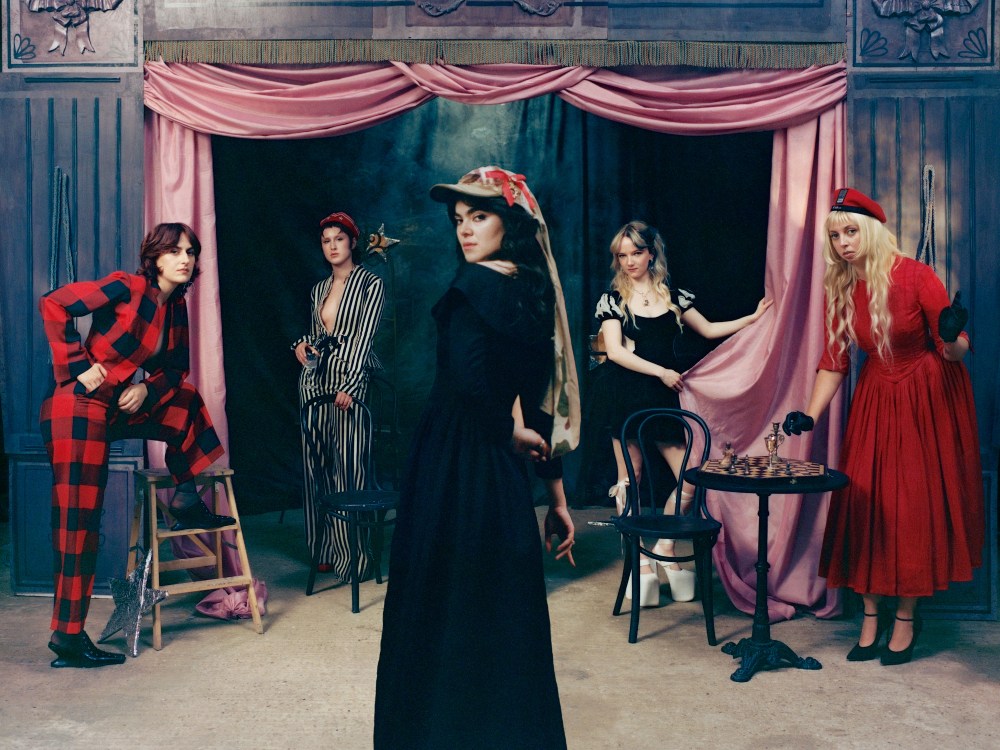
YOUR EX meets Abigail Morris, lead singer of The Last Dinner Party, the all-female UK band making waves with their theatrical, emotionally charged pop and strong connection to queer audiences.
There’s a particular kind of electricity that happens when a band arrives already fully formed – not just musically, but aesthetically, emotionally and politically. The Last Dinner Party didn’t edge quietly into view. They arrived in a rush of velvet, theatrical excess and unapologetic feeling, as if pop music had suddenly remembered that drama is not a flaw but a feature.
If you’ve somehow missed them until now, The Last Dinner Party are a London-based five-piece whose music feels closer to opera or theatre than to the stripped-back minimalism that’s dominated indie pop for the past decade. Their songs are lush, confrontational and emotionally maximalist – full of desire, guilt, longing, power and release.
Frontwoman Abigail Morris doesn’t shy away from the obvious question. Is the drama an act, or is it simply who she is?
“Are you asking me if I’m dramatic?” she asks playfully.
“Yes – it’s me,” she laughs.
“Personally, I’m very extroverted. I love to perform, and that’s how I express myself artistically. We’re not very minimal in how we want to tell stories. It’s just what comes naturally.”
That instinctive theatricality is central to why The Last Dinner Party have connected so quickly with queer audiences in particular. There’s a long lineage of queer devotion to excess – to camp, spectacle, big feelings and unapologetic emotion – and Morris is keenly aware of the community forming in front of her each night.
“The people I connect with the most are young, mainly female, queer people,” she says. “They’re always at the front of the show, at the barricade, and they’re the ones I meet afterwards.”
One of the most powerful moments in their live set comes during My Lady of Mercy, a song Morris describes as exploring queerness in dialogue with Catholicism. During the song, she routinely steps down to the front row to sing directly with the crowd.
“Almost every single show, someone gives me a lesbian flag or a pride flag,” she says. “It becomes this really triumphant, celebratory moment. We get letters and DMs from queer people, and it’s incredibly special to feel like we’ve created a space where people can express themselves safely.”
That sense of safety and recognition is something fans return to again and again. Morris describes waiting by the tour bus after shows and hearing, night after night, from young people who found community through the band.
“People tell us our music helped them find friends in the queer community, or helped them feel able to express themselves artistically without shame,” she says.
“The fact that this happens so often is kind of insane.”
Despite the emotional weight fans place on the band’s work, Morris is adamant that she doesn’t write with an audience in mind. If anything, she believes the opposite approach would hollow the songs out.
“I started writing music because it was how I processed everything in my life and my mind,” she explains. “I never write thinking about other people, because when you try to write something that feels universal or relatable, it often becomes generic. The music that resonates most with me is deeply specific and personal.”
That specificity is precisely what gives The Last Dinner Party’s songs their power. Desire, in their world, is rarely tidy or romanticised. It’s complicated, sometimes uncomfortable, often intense – and all the more recognisable because of it.
As their success grows, Morris admits she feels pulled in two directions: the urge to push further into obscurity and abrasion, and the temptation to write another undeniable pop hit.
“I’m interested in how to write something that’s catchy but also uncomfortable,” she says. “I think that’s possible.”
The band’s trajectory so far suggests she’s right. While many artists talk about the so-called “difficult second album”, Morris says their second record came easily. It’s the third that looms largest.
“I feel like the next one needs to be more like a PhD,” she says. “I’m older, in a different place in my life and my brain development.”
Being a frontwoman – especially one thrust quickly into global attention – has also forced Morris into a reckoning with visibility, insecurity and mental health. She speaks candidly about the internal toll of being so publicly exposed.
“Being very visible shines a spotlight on unresolved issues,” she says. “There’s a reason many front people struggle with things like substance abuse or eating disorders. Fame amplifies those vulnerabilities.”
The difference, she says, is that The Last Dinner Party face it together. The band operates democratically, without ego or hierarchy, making decisions collectively – even when it’s difficult.
“That creates safety,” she says simply.
For all their theatrical grandeur, there’s something quietly radical about that structure too: a band of women refusing the myth that chaos and conflict are prerequisites for great art.
And then there’s the elephant in the room – the fact that they’re an all-female band. For the first years of their rise, Morris notes, that fact dominated coverage, often to the exclusion of the music itself.
“It felt like novelty,” she says. “As if that was the most interesting thing about us.”
While she acknowledges that women in music are still criticised in ways men often aren’t, Morris is clear-eyed rather than embittered. The band has built a supportive, respectful team around them – many of them women – and that has changed everything.
What emerges instead is a picture of a band grounded in care: for each other, for their audience, and for the emotional truth of their work. They are unafraid of excess, unashamed of desire, and deeply committed to creating music that feels lived-in rather than manufactured.
Whether you’re discovering them for the first time or already pressed against the barricade, The Last Dinner Party are a band worth paying attention to.
And they’re only just getting started.
The Last Dinner Party play Auckland’s Spark Arena on Thursday 22 January. Tickets from Ticketmaster.