










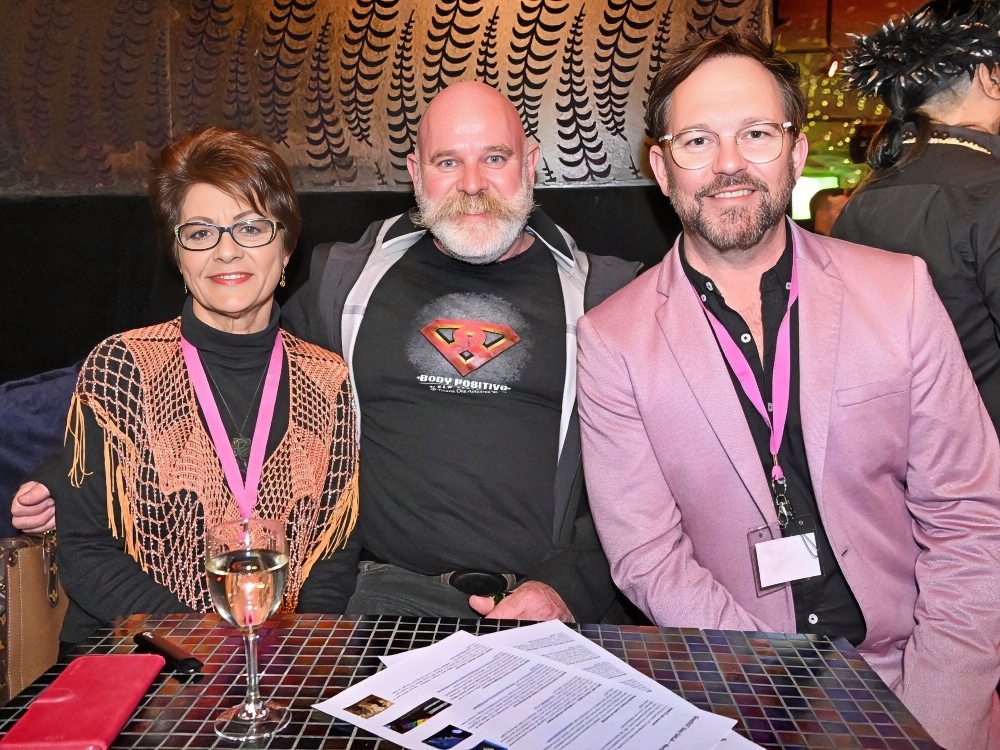

Karen Ritchie, newly appointed Officer of the New Zealand Order of Merit, reflects on decades of advocacy for people with HIV, sex workers, and LGBTQ+ communities.
When Karen Ritchie was named an Officer of the New Zealand Order of Merit (ONZM), she cried. Not out of surprise alone, but from a deep well of memory — of friends lost, battles fought, nights spent sitting beside hospital beds, and decades of quietly holding queer communities together when others would not.
“I wish my parents were alive to see it,” she says simply.
Karen’s honour recognises a lifetime of service to people living with HIV and AIDS, sex workers, and LGBTQ+ communities — work that began in the terrifying early years of the epidemic, when a diagnosis was widely seen as a death sentence and compassion was often in short supply.
Fighting Fear & Stigma
Karen has worked in health administration, including sexual health settings with the New Zealand AIDS Foundation, often encountering people at the very moment their lives changed forever.
“I used to see a lot of them come in and get their diagnosis — HIV or AIDS,” she recalls. “Back then, it was very, very scary. A death sentence for many.”
The medical fear was matched by social cruelty. Many families, already struggling to accept that their loved one was gay, walked away entirely once HIV entered the picture.
“Once families knew, they disowned them,” Karen says. “The stigma was real.”
It was during these years that her advocacy ceased to be theoretical. It became personal, emotional, and urgent.
Courtney Cartier
One name comes up again and again when Karen speaks about why she kept going — the beloved drag queen, Courtney Cartier.
Courtney had no family support. Karen became that support — driving her to appointments, sitting with her, ensuring she was cared for during her final months at Herne Bay House, a respite facility for people with HIV.
“I strongly believe people should never have to die alone,” Karen says.
She was with Courtney the night she died.
“I said to her, ‘It’s time for you to go now, baby. Your mum and dad are waiting.’ She took her last breath there. It was heart-wrenching.”
For Karen, a mother herself, that night changed something fundamental.
“I thought, this is so wrong. People shouldn’t be treated like this. I was adamant things had to change.”

Inspired to Help
Out of that grief grew some of Karen’s most enduring legacies. The Cartier Bereavement Charitable Trust was established so people dying of HIV would not be denied dignity in death simply because their families had abandoned them.
“We rallied as a community,” she says. “We did shows and fundraising to pay for funerals.”
The trust enabled access to government funding and community fundraising, ensuring people could be buried with respect. For Karen, it was never about charity — it was about justice.
“Nobody should ever have to worry about what happens to them when they die.”
Another initiative was the under-35 HIV support group she established through Body Positive. Younger people, newly diagnosed and often newly out, needed space to talk without fear.
“They were scared,” she says. “So we met once a month. They could sit together and just open up.”
Challenging the Law
Karen’s advocacy extended well beyond HIV. As part of the Prostitutes’ Collective, she worked alongside Catherine Healy to push through the Prostitution Reform Act — a landmark piece of legislation that decriminalised sex work and dramatically improved safety.
“People were getting HIV. Police were constantly busting sex workers. It was ridiculous,” Karen says.
After the law passed, she inspected brothels and enforced condom use.
“If owners were pushing workers not to use condoms, I told them I’d take them to the government. It was the law.”
She was equally uncompromising on Karangahape Road, where she became known as the “Mother of K Road” after repeatedly intervening when police mistreated queer and trans people.
One night, she witnessed police throw a trans woman onto concrete outside the old Legend Bar.
“I went out and confronted them. Then went down to the police station, saw her in her cell to check she was okay. I didn’t tolerate that behaviour!”
What’s Improved (and What Hasn’t)
Karen is clear-eyed about progress. HIV medication today is “incredible”. People live long, healthy lives. Transmission is preventable. Fear no longer defines every diagnosis.
“If you rang me tomorrow and said you’d been diagnosed, I’d give you a big hug,” she says. “But it’s no longer a death sentence.”
But she’s also honest about setbacks. Karangahape Road, she believes, is less safe now than it once was, with rising homelessness, violence and drug activity.
“Police and council need to work together,” she says.
Honour, Legacy, and Memory
The ONZM, Karen insists, belongs to the community as much as it does to her.
“I’m so proud of the community for trusting me,” she says. “And for supporting each other.”
Her final message is one she returns to again and again — a reminder that progress is built on sacrifice.
“Never forget those who walked before you,” she says. “They paved the way so you could be who you are.”
For many in Aotearoa’s queer communities, Karen Ritchie is one of those people. The ONZM simply puts into words what her community has known for decades: that love, when paired with courage, can change lives — and laws — forever.