










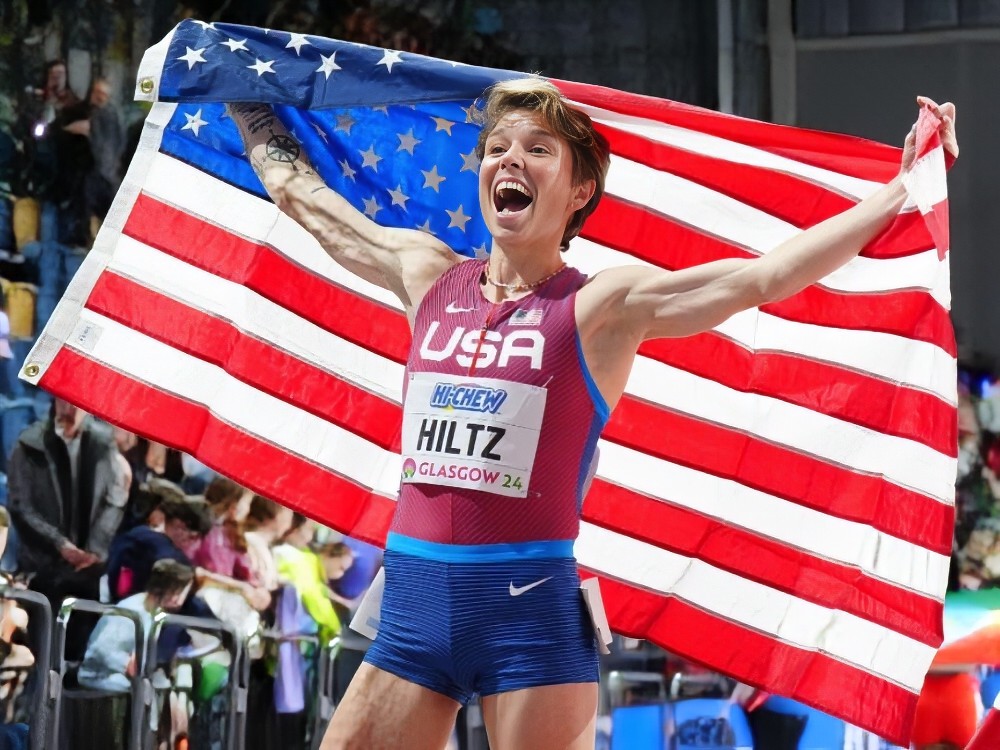

Non-binary runner Nikki Hiltz has spoken out against the International Olympic Committee’s (IOC) newly announced ban on trans women competing in women’s events at the Olympic Games.
The IOC revealed the policy on 26 March, saying that eligibility for female categories will now be decided through one-time gene-screening sex tests. According to the committee, the measure is intended to “ensure fairness and protect safety, particularly in contact sports”.
Hiltz responded on Instagram the same day, criticising the move and warning of its broader impact. “Attacks on trans people have consistently led to more policing and regulation of ALL women’s bodies,” they wrote. “Everyone is hurt by transphobia.”
Under the policy, athletes found to carry the SRY gene, typically associated with the Y chromosome, will not be considered “biologically female” and will therefore be barred from competing in women’s categories. The rules will also apply to intersex athletes who have experienced male puberty.
Hiltz did not hold back in their response, adding:
“Y’all already know where I stand on this but this policy is so f****** stupid and is not solving a problem that exists.”
They went on to challenge the rationale behind the decision, writing: “I don’t know who needs to hear this but ZERO trans women competed in the Paris Olympics. Only ONE trans woman weightlifter competed in Tokyo 2021 and she did not win a medal. Can we please stop obsessing over trans people? And [I don’t know] maybe focus our time, energy, and resources into real problems women’s sports face?”
Hiltz is a high-profile American middle-distance athlete and a prominent advocate for trans rights. In 2021, they publicly came out as trans in honour of International Transgender Day of Visibility.
IOC President Kirsty Coventry defended the policy, saying: “As a former athlete, I passionately believe in the rights of all Olympians to take part in fair competition.”
She also said the new rules were “based on science and has been led by medical experts”.
Explaining the reasoning behind the policy, Coventry said: “At the Olympic Games, even the smallest margins can be the difference between victory and defeat. So, it is absolutely clear that it would not be fair for biological males to compete in the female category. In addition, in some sports it would simply not be safe.”
She added: “Every athlete must be treated with dignity and respect, and athletes will need to be screened only once in their lifetime. There must be clear education around the process and counselling available, alongside expert medical advice.”