









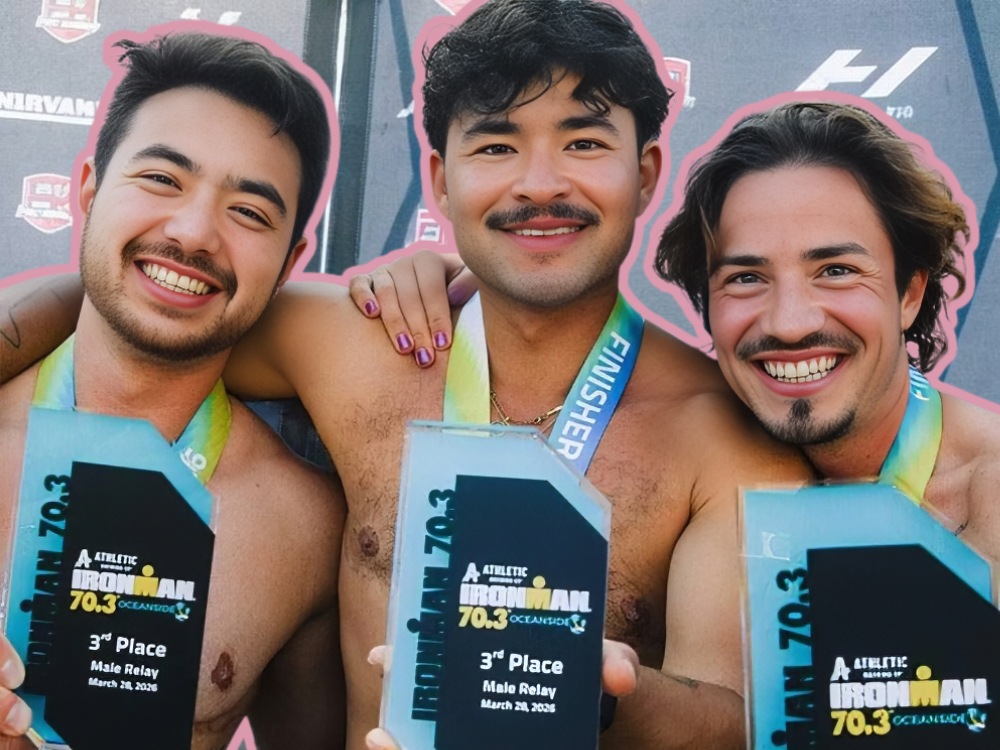

At the 2026 Athletic Brewing Ironman 70.3 Oceanside in California on Saturday, 28 March, more than 3,000 age-group athletes and over 60 professionals took part — but one relay team stood out for far more than its result.
Competing together as Team Iron Transmasc were transgender swimmer and three-time Ivy League champion Schuyler Bailar, disabled trans nonbinary artist and cyclist Chella Man, and trans nonbinary marathoner Cal Calamia. Of the three, only Calamia had previously competed in an Ironman event.
Their performance turned heads. Team Iron Transmasc finished third in the men’s relay division, crossing the line ahead of around 200 other relay teams made up of cisgender men aged 25 to 29.
“Yeah, we kind of crushed it,” Calamia told Out after the event. “Chella was a little more like, ‘Alright, let’s just kind of see what happens.’ But Schuyler and I are very competitive, so we were sort of tracking the leaderboard and seeing what was possible.”
The trio also found humour in the experience, especially while moving through the area between each leg of the race.
“We were cracking up about the ‘transition zone.’ Been there, done that!” they said.
The relay came down to the final running leg, with Calamia pushing for the finish after Bailar completed the swim in the Pacific Ocean and Man, who is deaf, took on the cycling stage with their cochlear implants turned off.
“Chella pushed themself further than ever before to make this happen,” said Calamia. “But all of us pushed ourselves as much as we could.
“There was a runner that was also competing in the relay that I passed at the very, very end of the whole thing, within the last 10 meters,” they said. “I had to close the deal. There was no part of me that would quit. And we got that spot on the men’s podium! It was amazing!”
After collecting their medals and posing for photos, the group made time to celebrate the moment together.
“We were just playing — splashing in the ocean, doing cartwheels, piggyback rides,” Calamia said. “I genuinely haven’t felt this amazing in a very long time. I felt my inner child just explode out of me.”
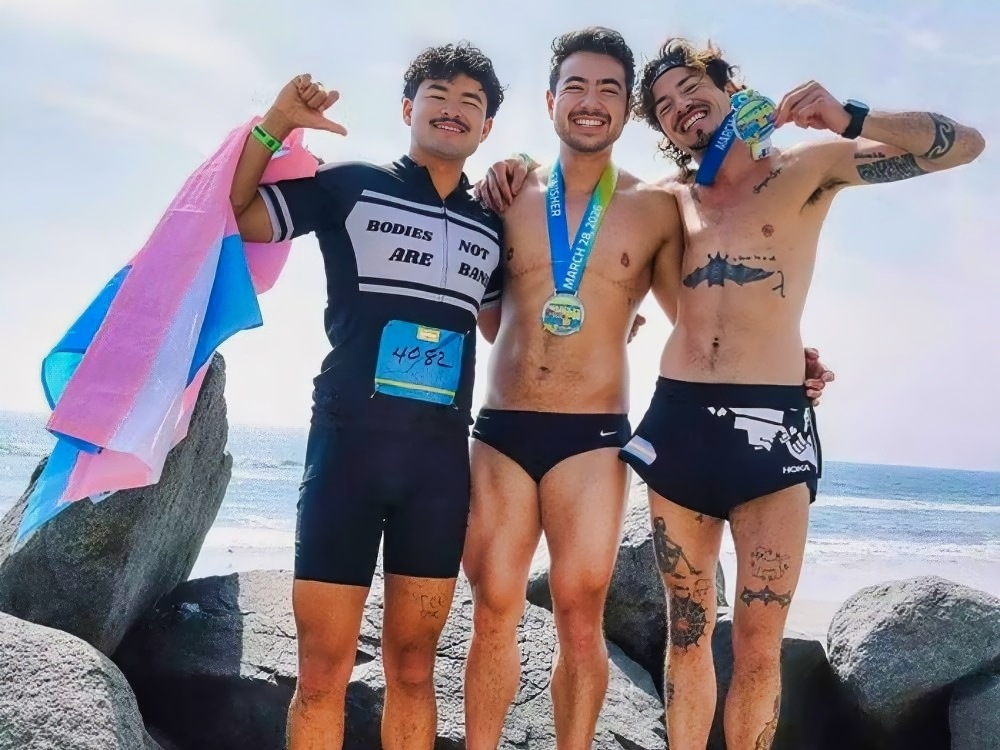
Calamia said the team also benefited from “undoubtedly having the biggest support crew” of any relay team on the course. Each athlete wore something that visibly affirmed their identity for the crowd.
“I had a trans flag on my running shorts,” they said. “Schuyler had trans-colored goggles and Chella had a cycling suit on that said, ‘bodies are not bans.’ We felt like we were fighting for something bigger than ourselves.”
The race took place only days after the International Olympic Committee’s decision to ban transgender women from competition beginning with the 2028 Summer Olympics in Los Angeles, a ruling that Bailar said had hit hard.
“One of the reasons that the recent IOC decision is so devastating is because it sends a message that sports are going to lead through discrimination, as opposed to being on a progressive way of moving humanity forwards, which is what they should be doing,” Bailar said before the race.
“This concept of trans athletes being the singular thing that threatens fairness in sports is predicated upon the false conception that there currently exists fairness in sports,” he added.
“We have massive disparities in sports that are largely due to systemic oppression, the same oppression that oppresses trans people, patriarchy, misogyny, classism and socioeconomic disparity, racism being a huge a huge factor as well. And if we put all these things together and we consider, what does fairness actually look like? Now we can recognise that we don’t actually have a level playing field.”
Bailar also pointed out how rarely trans women have appeared at Olympic level competition.
“Can anybody even name any trans women who competed in the women’s category? And if you can name more than one you are literally making shit up,” he said.
Before the event, Man also reflected on the wider significance of the team’s participation and what the race represented in the current political climate.
“I just really want to be thinking about this moment in the world that has unfortunately become so politicised, but that we want to play and we want to be included. And I feel like that’s at the centre of all of our work here,” they said.
“I honestly feel like I’m going to be thinking a lot about trans youth, all trans people. What we’re doing is truly like a kinetic metaphor for community,” Man added. “Because it literally sums up how we all bring a different gift and a different perspective and the complexity of that to the table in one moment of movement that’s connected together. It’s really badass.”
Bailar said the team’s presence in sport was about more than simply showing up.
“I think our ability to step into sport and say, ‘We’re going to be here anyways, we’re going to show up in all of our complexity for ourselves and for other people who can’t show up,’ hopefully that can be a statement to anybody who cares to take empowerment from that,” he said.
For Calamia, the relay is only the beginning.
“We’re already talking about what we’re going to do next,” they said. “We want to scale this up and get more trans athletes doing relays like this. We’re just excited to keep inspiring people and providing a counterweight to the other conversations about trans athletes.”
Their third-place finish was more than a result on a podium. It was a vivid display of endurance, solidarity and trans joy, even as Man gently pushed back on the need to turn every moment into a statement.
“It is trans joy, but it’s also just joy, you know? And I want to just soak up this moment with my friends and not have it have to be fuel or alchemised into a greater thing.”
Still, their performance carried weight beyond the course itself. Every stage of the relay underscored a powerful message: that trans people belong in sport, that community matters, and that joy can endure even in the face of exclusion.
Their road to the finish line reflected months of training, years of resilience and a shared determination to show up fully as themselves.
And they are not finished yet.
“This is not work we could do in isolation,” said Calamia. “We’re doing something that’s really important — for trans people and beyond.”