











YOUR EX meets the queer creative team behind SUGAR
When SUGAR played Brisbane, writer Ro Bright says the politics of the show shifted in real time.
“Every country we take SUGAR to, the politics around sex work, sugar culture, and the trans community is different,” Bright tells YOUR EX. “We encounter laws that take away our rights and safety, that increase discrimination, that change down to the day and hour that we are performing the show.”
Then came a night that brought that reality painfully close to the stage.
“During our Brisbane season, the courts were literally pausing rights to gender-affirming care for our young people as Tomáš was hitting the stage to perform,” Bright says. “This means our story has a different weight in every place we bring SUGAR, and we acknowledge that in the show.”
On the surface, SUGAR is a cheeky, sexy, pop-soaked cabaret solo show about a non-binary sex worker chasing a Pretty Woman-style happy ending. Beneath the glitter, it is about safety, fantasy, community and the right of queer and trans people to be more than cautionary tales.
Created by Bullet Heart Club, written by Bright, directed by Kitan Petkovski and performed by Tomáš Kantor, SUGAR arrives at the Auckland Live Cabaret Festival after seasons in Melbourne and Edinburgh, bringing with it queer pop anthems, wicked humour and a lead character determined to be adored on their own terms.
For Bright, that impulse to imagine another world began early.
“Most of my early memories are of living in the tropics, on a massive farm that my dad managed,” they say. “We were isolated, so I liked to create fairy tales in my head to entertain myself.”
Those private fairy tales became something more powerful when Bright found theatre.
“As a kid, I got to play dudes, got to play fairies like Puck in A Midsummer Night’s Dream. I could, for a moment, show parts of myself that, growing up in a restrictive Christian high school, I was never allowed to express,” Bright says.
That history sits close to the heart of SUGAR, a show that refuses to make its non-binary lead a symbol of isolation or tragedy.
“I’m a late bloomer,” Bright says of coming out. “The ’90s in media/culture were brutal around what ‘girls’ or ‘women’ were supposed to look and be like. There was no non-binary representation or conversation happening in Tauranga. I always knew I was non-binary. Always felt it, since my earliest memories. But I had no language for it and no way to describe it to others.”
Finding that language coincided with finding community in Melbourne.
“When I moved to Naarm, where there is a big trans community, I met so many non-binary folk who were further along in their journey than me, and they helped me find all the words and community I needed.”
Community is central to SUGAR. While the show is drenched in pop spectacle, Bright is clear that it is also about the networks that keep queer and trans people safe.
“In SUGAR, we speak about how the trans and gender-diverse community and sex worker community have always got along,” they say. “We build communities together. And looking at sugaring, where young people like our character Sugar can naively find themselves going solo, it is community that keeps you grounded and safe.”
For director Kitan Petkovski, who grew up in Auckland, creative spaces offered the freedom to be authentically himself. That freedom has shaped his long collaboration with Bright as Bullet Heart Club, a collaboration that began with the musical Daffodils, which first toured Aotearoa stages before it was ultimately adapted into a film. Petkovski says the relationship has endured because of honesty, loyalty and shared creative obsession.
“We stay in each other’s pockets,” he says. “We talk a lot. We send each other inspiration for new projects. We see shows together. We are brutally honest with each other. And we live by the rule of ‘showing up’, no matter what.”
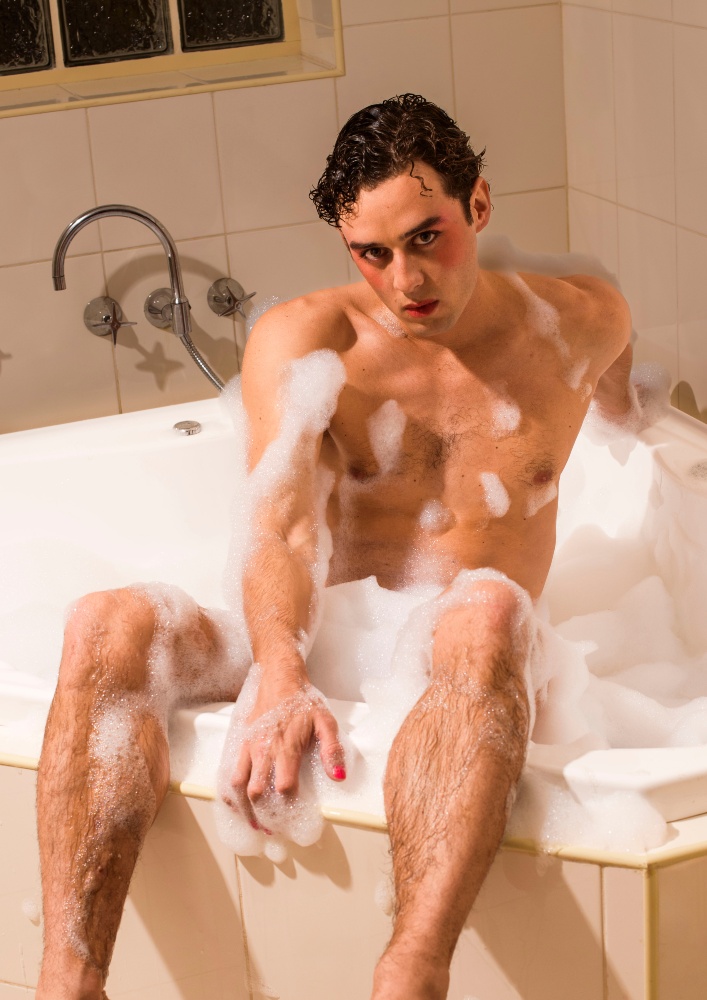
That trust becomes especially important in SUGAR, where the tone swings between camp excess, emotional truth and pop-powered chaos.
Asked what a queer approach to directing looks like here, Petkovski does not hesitate.
“Queer dramaturgy is about the resistance of heteronormative rules, structures and storytelling conventions,” he says. “If Sugar’s approach to seduction is through a cello-humping routine to Chappell Roan, then we’re on the right track.”
At the centre of SUGAR is Tomáš Kantor, the Melbourne-born performer tasked with carrying this solo show.
Performing SUGAR is no small feat. For 70 minutes, Kantor sings, acts, dances, seduces and carries the audience through Sugar’s fantasy and fallout.
“I have one inbuilt sip of water at around the thirty-minute mark, so I need to be super hydrated before, and always have a big full-body and vocal warm-up and cool-down required,” Kantor says. “It’s a lot, but I wouldn’t have it any other way!”
Praise has followed, with critics calling Kantor a “superstar-in-the-making” and a “born entertainer”. Their response feels very Sugar.
“I try to ‘stay humble’, but in this case that’s kind of counterproductive,” they laugh. “I’m a star, baby! It’s the mantra you need with a character like Sugar: no apology for the hard work and sex appeal, but owning that and flaunting it instead.”
That confidence is part of what makes SUGAR feel so fresh. It refuses to flatten queer experience into pain, even while acknowledging the politics pressing against the people it represents.
Beneath the pop songs and punchlines is a story about fantasy, survival and the insistence that queer people deserve joy.
Or, as Sugar might put it, a happy ending is never too much to ask for.