










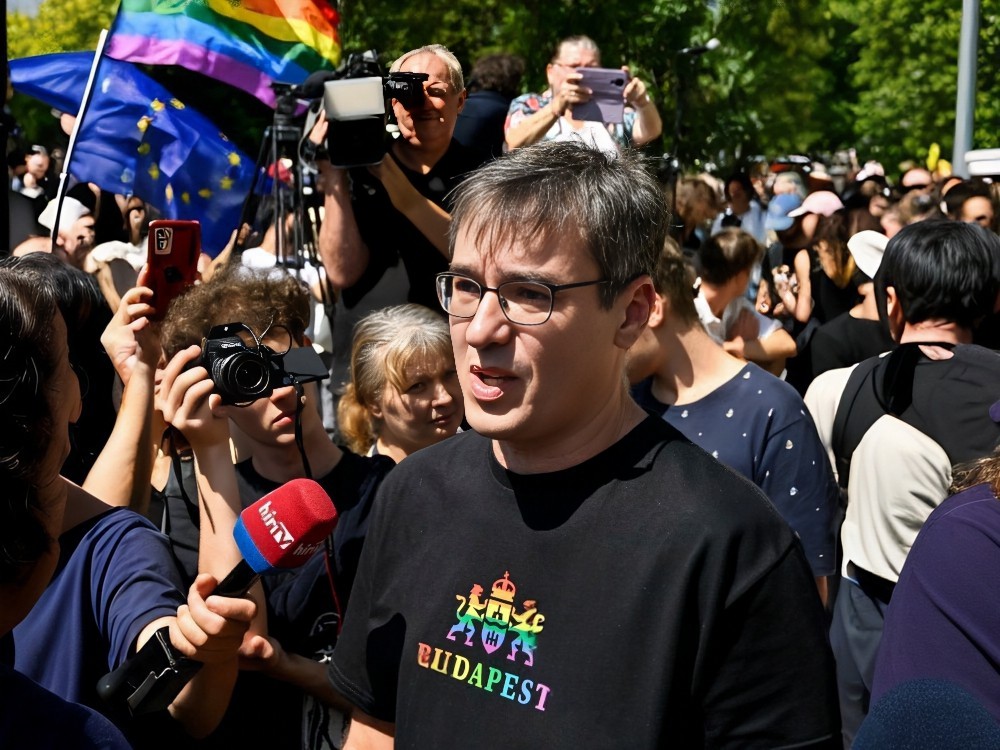

Hungarian authorities have dropped charges against Budapest mayor Gergely Karácsony over his role in organising the city’s 2025 Pride march.
Prosecutors confirmed the decision in a statement issued on 4 June, citing a landmark European Court of Justice ruling against Hungary’s anti-LGBTQ+ laws.
The 2025 march went ahead in June despite warnings of possible legal consequences from Viktor Orbán’s government, which had passed a law banning public events involving the LGBTQ+ community.
Speaking at the march, Karácsony told attendees: “Neither freedom nor love can be banned in Budapest.”
Authorities later charged Karácsony in January with organising the event despite a prohibition order.
Following his indictment, he said: “It seems that in this country, this is the price you pay if you stand up for your own freedom and the freedom of others.”
Prosecutors have now said the case will not continue.
“Considering the ruling by the European Court… the prosecutors dropped charges against the Budapest mayor for violating the law on freedom of assembly,” they said.
How the case unfolded
Budapest Pride took place on 28 June 2025, with more than 100,000 people participating. Organisers said at the time that a record 200,000 people attended.
In April, the European Court of Justice ruled that Hungary’s anti-LGBTQ+ laws violated EU rules and infringed EU values of equality and minority rights.
Karácsony has served as Budapest’s mayor since 2019. A prominent opposition figure associated with green and centre-left politics, he has positioned Budapest as more socially liberal than Hungary’s national government.
He has also repeatedly clashed with the central state over governance, funding and democratic norms.
What it means for Budapest Pride
The legal threat surrounding the 2025 march had been widely discussed ahead of the event, with LGBTQ+ advocates warning that the government’s restrictions were part of a broader attack on freedom of assembly and minority rights.
Hungarian police announced on 29 May that Budapest Pride will be allowed to take place in 2026, with the march scheduled for 27 June.
Budapest Pride is one of Central Europe’s most prominent Pride events and has repeatedly drawn international attention amid Hungary’s culture-war politics.
In recent years, it has functioned not only as a celebration but also as a visible protest against anti-LGBTQ+ laws and democratic backsliding.