









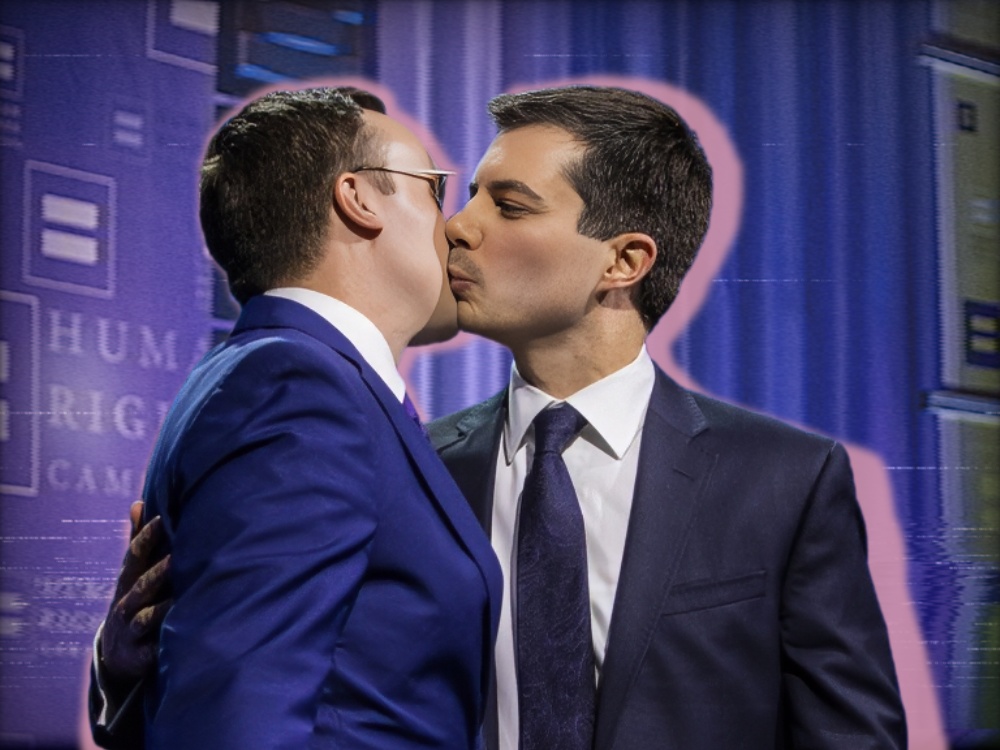


Former US Transportation Secretary Pete Buttigieg has emerged at the top of a new national poll testing possible candidates for the 2028 Democratic presidential nomination.
The latest Emerson College Polling survey found that 19% of likely Democratic primary voters supported Buttigieg, making the openly gay former cabinet secretary the leading candidate in the hypothetical contest.
California Governor Gavin Newsom followed closely with 17%, while Georgia Senator Jon Ossoff and New York Representative Alexandria Ocasio-Cortez tied for third place with 13% each.
Former vice-president Kamala Harris received 8%, followed by Kentucky Governor Andy Beshear on 7% and Pennsylvania Governor Josh Shapiro on 5%. Illinois Governor JB Pritzker attracted 3%, while 13% of respondents remained undecided.
Buttigieg’s Lead Is Within a Crowded Field
The poll does not establish Buttigieg as a decisive frontrunner.
His two-point advantage over Newsom is small, and Emerson cautioned that results involving voter subgroups carry greater uncertainty than its overall sample.
The national survey was conducted from 19 to 20 July among 1,100 likely voters. Its full sample had a credibility interval comparable to a margin of error of plus or minus 2.9 percentage points, while the Democratic primary subgroup would have a wider interval because it included fewer respondents.
However, the findings continue a positive polling trend for Buttigieg.
An Emerson survey conducted in May also placed him first among possible Democratic candidates, with 18% support. Newsom received 16%, Ocasio-Cortez 11%, and Harris and Shapiro each attracted 10%.
Other surveys have produced different leaders, highlighting how unsettled the potential 2028 contest remains. A May AtlasIntel poll placed Ocasio-Cortez first, followed by Buttigieg and Newsom.
With no major candidate having formally entered the race, early polls largely measure name recognition, current popularity and speculation rather than support for established campaigns.
Support Differs Between Men and Women
Emerson found that Buttigieg’s support was evenly divided by gender, with 19% of both men and women backing him.
Newsom performed considerably better among women, receiving 25% support compared with 8% among men. Ocasio-Cortez also drew stronger support from women, while Ossoff performed better among men.
“Ossoff was added to the Democratic ballot test this month, and entered at 13%, driven by stronger support among men, at 18%, compared to 8% among women,” Emerson College Polling executive director Spencer Kimball said.
“Newsom is strongest among women at 25%, compared to 8% of men. Similarly, Rep. Ocasio-Cortez’s support is higher among women, at 16%, compared to 9% of men. Buttigieg, on the other hand, has equal support among both men and women at 19%.”
Vance and Rubio Nearly Tied Among Republicans
The poll also found an extremely close race for the hypothetical Republican nomination.
Vice President JD Vance received 39% support, while Secretary of State Marco Rubio followed on 38%. Florida Governor Ron DeSantis and Donald Trump Jr each received 5%, with 9% undecided.
That represents a dramatic change from Emerson’s August 2025 poll, when Vance received 52%, and Rubio attracted only 9%.
Although polling fields and voter attitudes can change considerably over time, the comparison suggests Rubio has become a much more serious potential rival to Vance.
Democrats Lead the Generic Congressional Ballot
The survey also contained encouraging results for Democrats ahead of the 2026 midterm elections.
When likely voters were asked whether they would support a generic Democratic or Republican congressional candidate, Democrats led by 53% to 42%.
The 11-point advantage was the party’s largest in an Emerson national poll during the current election cycle. However, a single poll should not be treated as a prediction of the national result, particularly when district boundaries, individual candidates and voter turnout will determine control of Congress.
Buttigieg Keeps 2028 Speculation Alive
Buttigieg has not announced another presidential campaign, but he has repeatedly declined to rule one out.
While campaigning for Democratic candidates in Iowa in July, Buttigieg was asked whether he would exclude the possibility of running in 2028.
“Nope,” he replied.
“I already have a lot of great friends in Iowa, and it’s been fun to reactivate some of those relationships in the service of the ticket that’s on the ballot right now in ’26,” he added.
“I’m super focused on this year’s election. The future will come, but right now, we got a very important set of elections in front of us right now.”
He also fuelled speculation during an April appearance with civil-rights leader the Reverend Al Sharpton.
Sharpton asked whether he should reserve a table for Buttigieg at Sylvia’s restaurant in Harlem, where presidential candidates traditionally meet with him.
“You save me a seat, I’ll be there,” Buttigieg responded.
During a February visit to New Hampshire, another influential early-primary state, Buttigieg was more cautious.
“I’m a long way from any kind of decision,” he said, while explaining that his immediate focus was supporting Democratic candidates and causes during the 2026 election cycle.
For now, Buttigieg’s position at the top of the Emerson poll gives supporters another reason to believe he could mount a second presidential campaign.
The 2028 election remains more than two years away, however, and a crowded potential field means the Democratic nomination is still very much unsettled.