










A candidate for municipal office in Moscow has been sentenced to 10 days’ administrative detention after a court ruled that a rainbow-coloured T-shirt shown in an online video displayed an “extremist” symbol.
Daniil Neonov, a candidate for the council of Moscow’s Shchukino district and supporter of the Rassvet political party, was convicted by the Tushinsky District Court under Part 1 of Article 20.3 of Russia’s Code of Administrative Offences. The provision covers the public display of symbols associated with organisations that authorities have designated extremist.
The case follows Russia’s escalating use of extremism laws against LGBTQ+ people, organisations, media outlets and symbols.
Video Showed Seven-Colour “LOVE” Design
The prosecution reportedly centred on a video posted to Neonov’s Telegram channel, Daniil Neonov – Candidate for Deputy, on 16 July.
In the clip, Neonov was shown wearing a headband with animal ears, a cat mask and a black T-shirt bearing the word “LOVE” in seven rainbow colours.
Neonov identifies as a femboy, according to Russian LGBTQ+ publication Parni+.
At his hearing, he denied the charge and reportedly argued that the design contained seven colours, whereas the widely recognised LGBTQ+ Pride flag uses six.
The court nevertheless concluded that the shirt represented a symbol connected with what Russian authorities call the “international LGBT movement” and imposed 10 days of administrative detention.
Russian law permits up to 15 days of detention for a first offence involving the display of symbols attributed to an extremist organisation. A repeat offence can expose a person to more serious criminal penalties.

Lawyer Initially Denied Access
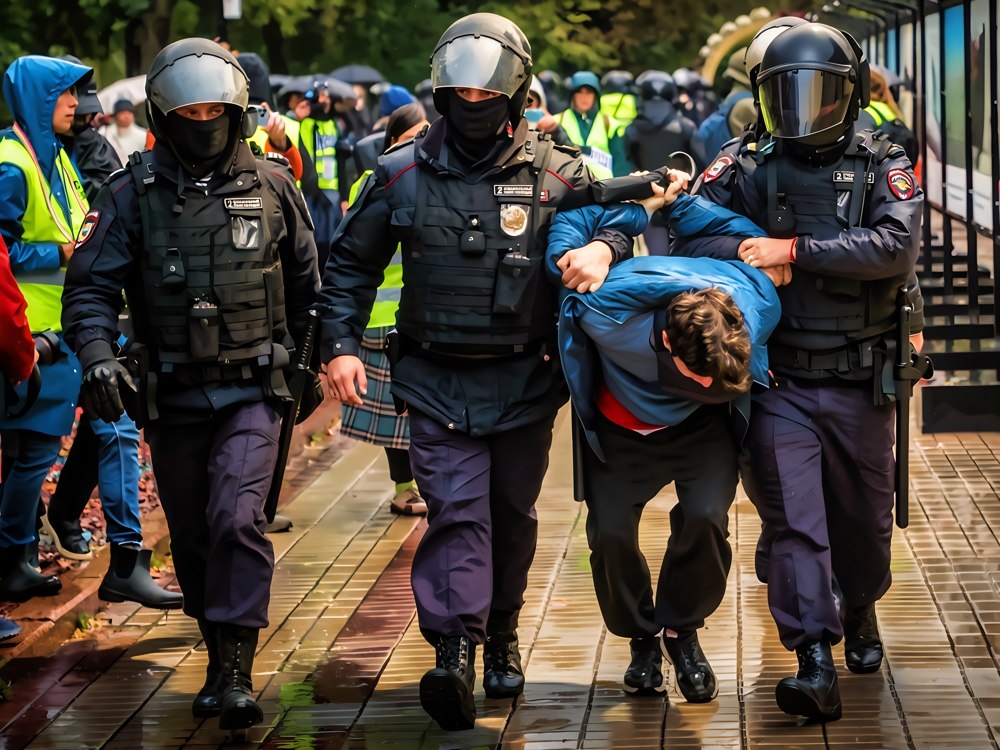
Independent Russian outlet SOTAvision reported that Neonov was taken to Moscow’s Mitino police station shortly before 1pm and remained there for more than six hours.
A lawyer who arrived at the station initially struggled to obtain confirmation that Neonov was being held there. Authorities later kept him in custody overnight and did not immediately allow the lawyer to meet him, according to the outlet.
Neonov subsequently alleged that officers choked and beat him while he was in custody and that one officer ordered him not to speak with journalists.
Those allegations have not been independently verified, and Russian authorities have not publicly responded to them.
SOTAvision also reported that police attempted to gain access to Neonov’s mobile phone, but he refused to unlock it without a family member present.
Conviction Could Block Election Campaign
The administrative conviction is also expected to affect Neonov’s attempt to run for public office.
Under Russian election rules, a finding involving the display of “extremist” symbols can prevent a person from standing for election for one year after the judgment enters into force.
Russian authorities have used similar prosecutions against opposition politicians and activists ahead of elections, including cases involving old social-media posts and images connected with organisations or platforms classified as extremist.
Russia’s Expanding Anti-LGBTQ+ Crackdown
In November 2023, Russia’s Supreme Court declared the vaguely defined “international LGBT movement” an extremist organisation after a closed hearing requested by the Ministry of Justice.
The supposed movement has no clear structure, leadership or membership. Human-rights groups warned that the lack of a meaningful definition would allow authorities to treat almost any expression of LGBTQ+ identity, advocacy or solidarity as extremist activity.
Since the ruling, Russian courts have prosecuted people over Pride flags, rainbow images and other LGBTQ+-associated material.
Human Rights Watch reported in June 2025 that Russian courts had issued more than 100 extremism-related convictions linked to the designation, most involving administrative offences for allegedly displaying symbols.
Authorities have since expanded the campaign by separately banning established LGBTQ+ organisations and media projects.
In April 2026, courts designated Parni+ and the Moscow Community Centre for LGBT+ Initiatives as extremist organisations. Parni+ said the decision was intended to criminalise LGBTQ+ visibility, independent journalism and public solidarity with queer communities.
Human Rights Watch said nine organisations providing LGBTQ+ advocacy, health information, legal assistance or community support had been banned as extremist by May 2026.
Rainbow Design Treated as Extremist Symbol
Neonov’s case illustrates how the broad 2023 decision is being applied not only to organised activism but also to clothing and personal expression.
The court’s decision effectively treated the seven-colour “LOVE” design as a prohibited symbol despite Neonov’s argument that it did not reproduce the six-colour Pride flag.
Human-rights organisations have described Russia’s use of extremism legislation against peaceful LGBTQ+ expression as discriminatory and incompatible with the rights to freedom of expression, association and non-discrimination.
Neonov’s sentence also demonstrates how anti-extremism charges can carry political consequences beyond detention, potentially removing candidates from elections even when the alleged offence involves a T-shirt rather than violence or an organised extremist group.