









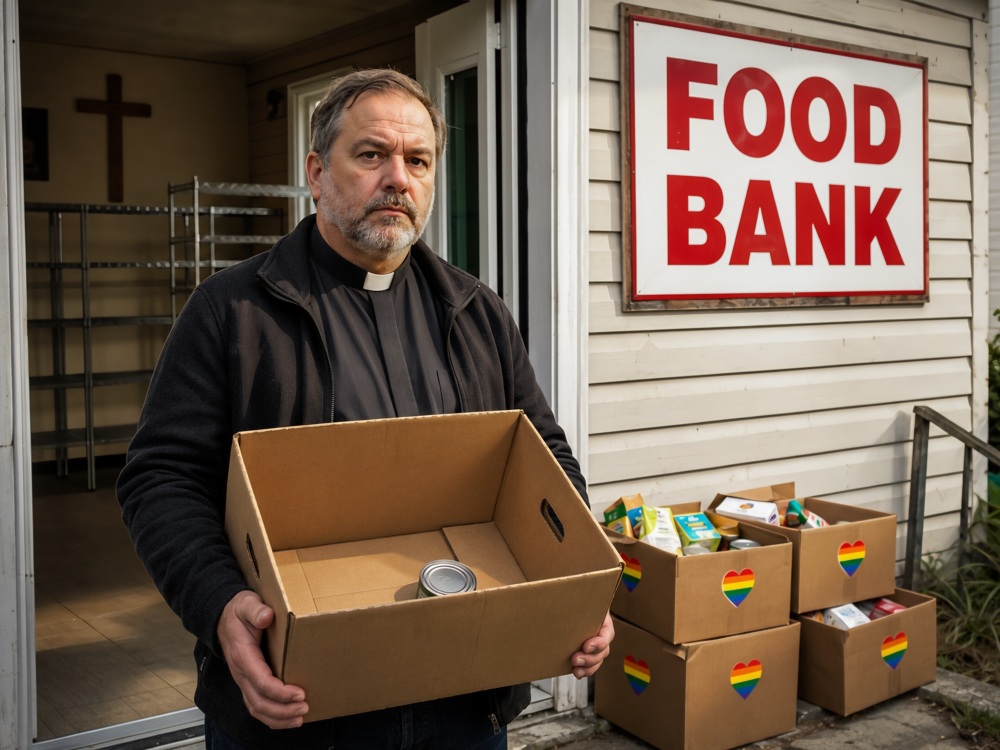
A West Virginia food bank that previously served thousands of families each month has been left with empty shelves after its pastor refused assistance from organisations he says are associated with the LGBTQ+ community.
Pastor Alvin Christian, who operates God’s Store House Food Bank in Bluefield, West Virginia, explained the decision in a Facebook Live video that has since been deleted.
According to Friendly Atheist, which first reported the story on 30 July, Christian said he had rejected supplies after learning that some organisations involved in food-assistance donations supported LGBTQ+ people.
“Are y’all tied in or partners with LGBQ, T, whatever? And they said ‘yes.’ I done some more research and found out that they are part of the gay rights movement,” Christian said during the broadcast.
“To stand with faith in God, I refuse to receive food from anybody that is tied into that,” he continued, referring to LGBTQ+ inclusion.
Christian said he did not want to be “part of a gay rights movement” because of partnerships involving Feeding America, the nationwide network that works with food banks across the United States.
In another video, later archived by a Facebook user, Christian showed viewers rows of empty cupboards, freezers and warehouse shelves.
“As you can see, our cupboards are empty, our freezers are empty. We have nothing in the warehouse as far as food-wise as of this moment,” he said.
Before the disruption, God’s Store House Food Bank had reportedly become an important source of support for communities across West Virginia and neighbouring Virginia.
The organisation was said to be assisting more than 800 families a day and about 8,000 individual families each month across four counties.
Christian later said the food bank was not refusing all donations. Instead, he claimed he did not want to buy food from organisations if the money involved could indirectly benefit LGBTQ+ groups.
Feeding America, however, is a non-profit network made up of 200 food banks. It distributes donated food through its network rather than selling supplies to individual food banks.
Christian also maintained that God’s Store House would continue serving anyone who needed assistance.
“I will not discriminate against anybody,” he said.
Critics have highlighted what they see as a contradiction between promising to provide food to LGBTQ+ people while refusing to work with organisations because they support LGBTQ+ inclusion.
Christian said he was looking for an alternative supplier and asked supporters to pray that “God will open another door.”
The controversy carries added significance because LGBTQ+ communities experience disproportionately high levels of poverty and food insecurity.
In a 2022 podcast appearance, Feeding America chief equity officer Ami McReynolds said 22 per cent of LGBTQ+ adults lived in poverty and were twice as likely as other adults to experience hunger.
Research published by the United States Department of Agriculture in 2022 also found that transgender people were “almost 2.5 times more likely than cisgender people to face food insufficiency during the pandemic.”
A 2020 study from the Williams Institute found that some LGBTQ+ people were hesitant to seek help from faith-based aid organisations because they feared discrimination or judgement.
Critics argue that decisions such as Christian’s could deepen those concerns, discouraging vulnerable people from approaching religious charities even when they urgently need food or other assistance.
The immediate consequences are also being felt throughout the wider community. With the food bank’s storage areas depleted, thousands of families who previously relied on the service may now face uncertainty while Christian searches for another source of supplies.