









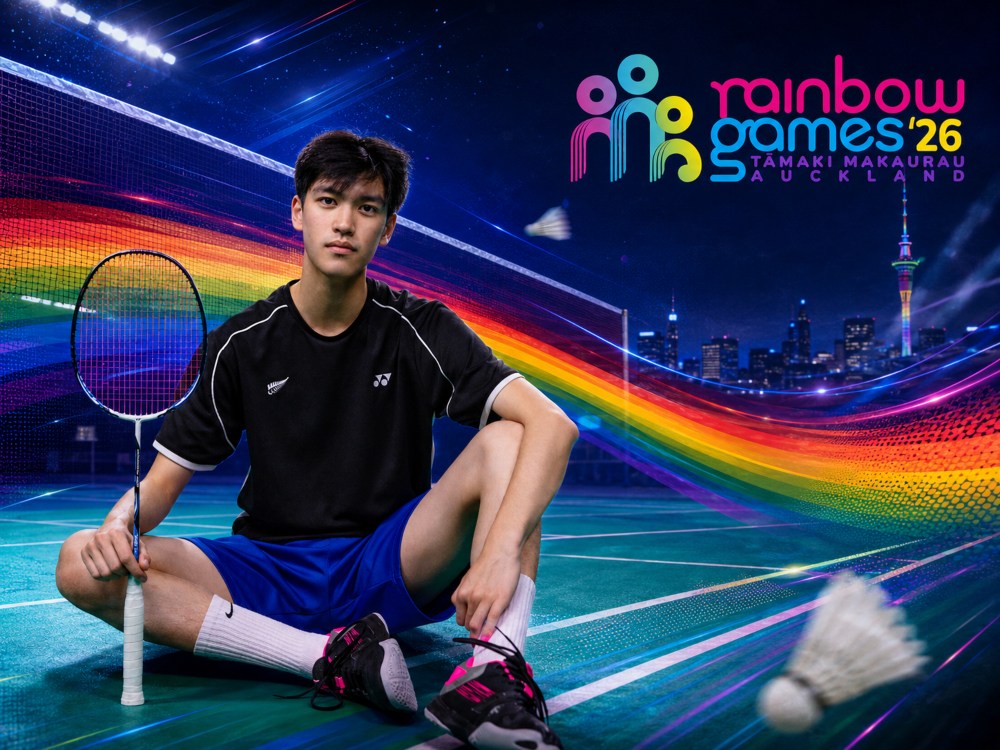
Ahead of the Rainbow Games 2026, which starts on 29 October, RG ambassador Hugo Chou reflects on queer life at an all-boys school, taking his LGBTQ+ group to Lil’ Gay Out and going home ready to tell his mum he was gay
By Year 13, your closest friends knew you were gay, and you were helping to lead your school’s LGBTQ+ group, but you hadn’t told your family. Tell us a bit about what life was like for you at this time?
Year 13 felt like the easiest and happiest my life had ever been. I was in a really comfortable place academically, I was performing well in sport and music, I was a prefect, and I was surrounded by this incredible group of friends who made me feel like I was on top of the world. That stability gave me the confidence to pursue things I genuinely cared about. I founded a peer-support programme for younger students and became the leader of the Diversity/LGBTQ+ Group at Westlake Boys.
Being secure in those other parts of my identity changed the way I viewed something that had caused me so much anxiety before: my sexuality, and particularly the fear of being judged for it at an all-boys school. Eventually, I thought: I’m going to have to be myself at some point, so why not now? I didn’t want being gay to feel like a taboo subject anymore.
The one place where that confidence hadn’t quite reached was home. I still had all the classic questions running through my head: When is the right time? How do I tell them? What if they don’t accept me?
Deep down, though, I knew my mum loved me endlessly. Looking back, so many of those fears were manifestations of the anxiety that can come with being queer and closeted, rather than a reflection of who she actually was. It started to feel wrong that so many people knew this important part of me while the woman who loved me most didn’t.
What was the LGBTQ group like when you became involved?
When I first arrived at Westlake in Year 9, I joined the LGBTQ+ group with this wonderfully naïve expectation that high school would be some profound new chapter of my life. I imagined walking into a room and suddenly finding this huge community of queer friends. Instead, I walked in and there were maybe three or four people there, including the teacher in charge. It was pretty depressing!
After that year, the student leading it graduated and nobody really took over, so the group essentially disappeared. It wasn’t until Year 13 that I decided to revive it.
I would love to say I brought it back and suddenly dozens of students came flooding through the doors, but absolutely not. Our first meeting attracted about eight people, and eventually we settled at around four or five regulars. But I actually became really proud of that little group.
In an all-boys school, simply choosing to walk into an LGBTQ+ meeting could require courage. These students kept showing up, connecting with their community, having a yarn over lunch and creating a space where nobody had to explain or hide themselves.
Taking that group to Lil’ Gay Out therefore felt significant to me. We weren’t a massive movement. We were a handful of kids. But for the first time, we were taking our little school community outside the gates and connecting it with something much bigger. There was something incredibly meaningful about that.
You’ve said you were the first person in your school’s history to take a group to an event like this. What did it take to make that happen, and how did the school respond?
Oh, the bureaucracy of it all: what a total pain in the ass.
Obviously, any school trip requires a decent amount of administration: approvals, transport, risk management and, worst of all, permission slips. But a permission slip becomes a completely different problem when you’re taking students to an LGBTQ+ event. How on God’s green earth is a kid who isn’t out to their parents supposed to get a form signed saying, essentially, I’d like to go on a school trip to celebrate queer culture?
That was one of the biggest frustrations for me. Lil’ Gay Out was this fabulous opportunity for young people to experience queer culture, meet other LGBTQ+ students and realise that there was a much bigger community beyond their own school. Yet the students who might have needed that experience most could also face the greatest barrier to attending. Thankfully, I had some wonderful teachers supporting me with approvals, administration and transport. Mrs Dawber, one of our deans at the time, was amazing.
There were still disappointing moments. I wanted to promote Lil’ Gay Out at assembly, as prefects and clubs regularly did for other school events. The school refused. I was told it was for our own safety; announcing a gay event in front of an entire boys’ school could get students too riled up and their reaction might be difficult to control. I understood the concern, but it was also deeply disappointing. Protecting queer students shouldn’t require making us invisible.
Take us through the Lil’ Day Out itself. Did any moments make you feel particularly liberated?
We had gone from this tiny LGBTQ+ group sitting together at lunchtime at an all-boys school to suddenly being surrounded by queer young people from across Auckland. There was something incredibly liberating about being in an environment where queerness wasn’t the unusual thing in the room. Nobody needed to whisper about it or wonder who might be watching.
The moment that sticks with me most was definitely the drag makeup session. It was incredibly fun and liberating, while simultaneously confirming that I had absolutely no idea how makeup worked. I was completely out of my depth.
Thankfully, so was almost everyone else. There was something really lovely about all of us collectively struggling to look fabulous. Suddenly you’re laughing with people you’ve never met, comparing your questionable makeup skills, putting glitter everywhere and connecting almost instantly.
That’s what made the day special. It wasn’t a seminar about what it means to be queer. We were simply allowed to have fun being ourselves. For young queer people who spend so much time monitoring how they speak, dress or behave, that freedom can actually be quite profound.
You ended the day wearing a rainbow heart sticker on your cheek, glitter, eyeshadow, and a Pride flag.
It became a much bigger moment than I expected.
Before leaving, I remember having to make a decision about what I was going to do with myself. I could wipe off the makeup, remove the glitter and rainbow heart, put the flag away and go home looking exactly as I always did.
Or I could let that day become a pivotal moment in my life. I was petrified about what might happen if I chose the second option. But underneath all of that fear was this incredible excitement. I wanted to know what life might feel like without constantly carrying the weight of the closet around with me. It was almost a pinch-me moment because I knew I was standing at a crossroads. If I went home like this, there was no pretending anymore. Something was going to change.
So I kept everything on.
I distinctly remember standing outside our front door for what felt like forever. It was probably five minutes, but when your heart is racing it feels much longer. I was trying to construct the perfect sentence in my head: How do I start this? What words do I use?
I was fumbling over sentences before I’d even walked through the door. But I was determined. There was no backing away now. I had spent the entire day allowing myself to be openly queer, and I didn’t want to walk into my own home and suddenly hide again. Eventually, I accepted that there was never going to be a perfect way to tell her. Coming out doesn’t come with some beautifully written script where you say exactly the right thing… And realistically, I was about to walk through the door wearing eyeshadow, glitter and a rainbow heart while carrying a Pride flag. The nail was already firmly in the coffin.
You began by asking, “Do you know what rainbow means?”
After all that anxiety, I approached my mum and asked, very seriously, “Do you know what the rainbow means?” She didn’t. I suddenly realised I had to explain the entire concept to her before I could even come out. The longer I talked, the more I was shaking, sweating and feeling my heart pound, all while she was sitting there playing Hay Day on her phone! Eventually, after years of anxiety and this enormous build-up in my head, I told her. And she basically went, “Okay,” and went back to Hay Day. She then explained that she would love me no matter what because I was her child, and that all she wanted was for me to be happy. I cried and hugged her. Years of fear disappeared within minutes.
The one question that caught me completely off guard was, “Are you sure you want to be gay? I mean, it’s pretty hard out there.” To be fair to her, she wasn’t wrong! But I think that question also showed how innocent and foreign queerness was to her. She genuinely seemed to think I had looked at the available lifestyle options and selected “gay” despite its obvious disadvantages. It was funny, incredibly sweet, and so quintessentially my mum.
What came next for you?
I think so much of being closeted is about the fear of being found out. You become incredibly conscious of yourself: how you talk, how you move, what you wear. You tone down parts of your personality because you’re terrified somebody might look at you and think, “He’s gay.”
After coming out to my mum, I came out publicly on Instagram. The response completely overwhelmed me. Friends from school, badminton and different parts of my life all converged in that comment section: more than 120 people congratulating me, supporting me and essentially telling me that being myself changed absolutely nothing about how they saw me.
I realised that the catastrophe I had constructed in my head wasn’t waiting for me on the other side. Instead, there were all these people ready to embrace me.
From that day onwards, I decided that the only person who could really hold me back was me. I had spent enough time presenting this washed-out, edited version of myself because I was worried that the full version might be too gay, too loud or too much. Coming out killed a lot of that embarrassment. I chose to live loudly and proudly. Looking back at the kid who made that decision, I’m incredibly grateful that he was brave enough to give me the life I have now.