










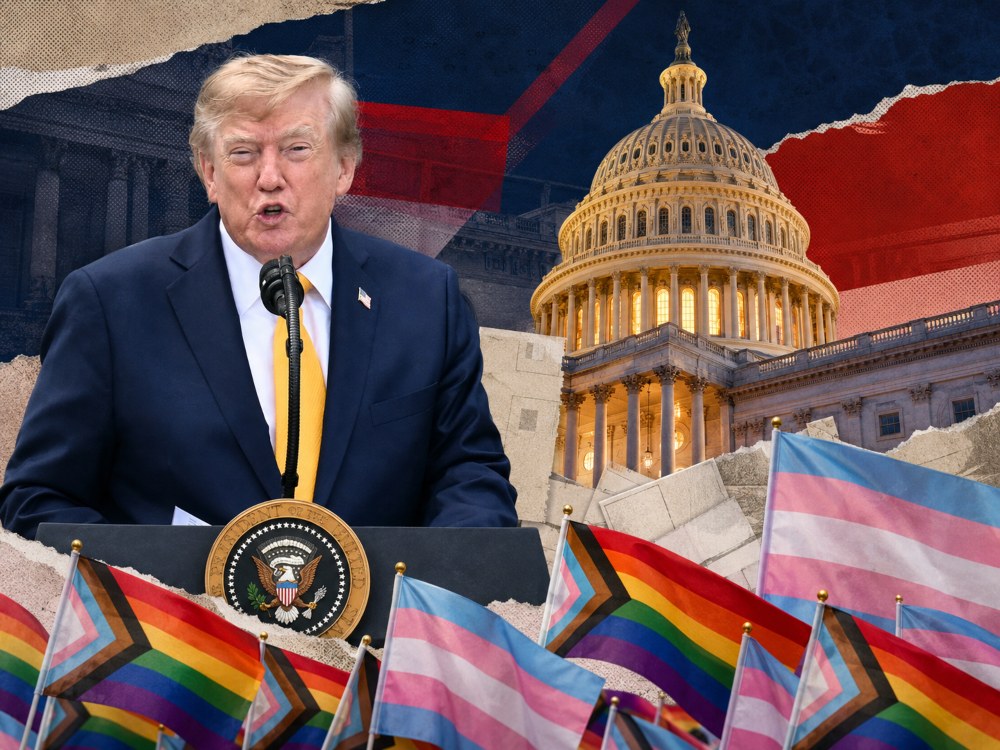
The Trump administration is proposing sweeping changes to the 2030 US Census that could make a question about “biological sex” compulsory, prompting concerns about what transgender Americans could be required to disclose to the federal government.
The Census Bureau published the proposed rules on 10 September as part of a much broader overhaul covering demographic questions, immigration status and who counts towards congressional representation.
Under the proposal, questions about race, ethnicity and sexual orientation would be prohibited from the short-form decennial census.
Questions about “biological sex”, date of birth and household relationships, however, could still be included to help verify the population count.
Crucially, those three subjects would also be exempt from a proposed rule saying respondents cannot be required to answer other demographic questions.
That means a biological-sex question is not currently confirmed for the 2030 Census, but if the Bureau adds one, the proposed rules could make answering it mandatory.
Why Trans Advocates Are Concerned
The proposal does not define exactly how a future “biological sex” question would be worded.
It also does not explicitly say transgender respondents would be required to identify their sex assigned at birth.
But the language has attracted concern because the Trump administration has repeatedly defined sex at federal level in strictly biological terms.
Queer news outlet The Needle argues that, if the Census ultimately requires respondents to provide their sex assigned at birth, transgender Americans could face a difficult choice between disclosing information that identifies them as trans, refusing to answer or providing an answer inconsistent with the government’s definition.
The outlet went further, describing the proposal as an attempt to create a list of transgender Americans.
There is currently no evidence in the proposed rule that the Census Bureau intends to create such a registry.
That distinction matters.
What the proposal does establish is a regulatory pathway under which biological sex could become a mandatory piece of census information.
For trans people already facing reduced federal recognition of their gender identity, that possibility alone is likely to raise privacy concerns.
Census Responses Remain Legally Protected
Individual census information is subject to strong federal confidentiality protections.
Under Title 13 of US law, Census Bureau responses can generally only be used for statistical purposes.
The Bureau cannot publish information identifying an individual respondent, and personal census answers cannot ordinarily be handed to another government agency or court for use against that person.
Census employees are also legally required to protect confidential information.
That means information supplied directly on a census questionnaire is not supposed to become an enforcement database available to agencies such as immigration authorities.
The proposal’s discussion of administrative records, however, involves a separate issue.
The Census Bureau says it is considering using its extensive access to records held by agencies including the Treasury Department, Department of Health and Human Services, Department of Homeland Security, Department of State, US Postal Service, state and local authorities and commercial data providers.
The purpose outlined in the proposal is primarily to determine immigration status and where people should be counted.
Major Changes To Who Counts For Representation
The sex-question controversy is only one part of a much larger proposal.
The Census Bureau also wants to change which US residents are included when seats in the House of Representatives are divided among states.
Under the proposed rule, US citizens and lawful permanent residents would be included in the apportionment population.
Undocumented migrants and other foreign citizens whose immigration status is considered less permanent than lawful permanent residency would not.
That could include people lawfully living in the US under temporary work, study or humanitarian statuses.
The Bureau is considering using government and commercial records to determine those statuses and is also seeking feedback on whether a legal-status question should appear directly on the census form.
These changes could have major consequences because the decennial census determines how House seats are divided among states and feeds into electoral redistricting.
The Census Bureau argues its proposed approach better reflects its interpretation of constitutional requirements around “usual residence”.
Civil-rights organisations and other critics are expected to challenge that interpretation, particularly because the Constitution refers to apportionment based on the “whole number of persons in each State”.
Race And Sexual Orientation Questions Would Be Banned
The proposal would also prevent the short-form census from asking about race, ethnicity or sexual orientation.
The Bureau argues those questions are not necessary for the census’s core constitutional purpose of counting the population and says reducing the number of questions could improve response rates and reduce privacy risks.
Race and ethnicity are currently collected by the decennial census and have historically been used for redistricting, enforcement of civil-rights laws and analysing disparities.
Sexual orientation has not historically been a standard question on the short-form census, although the Census Bureau collects LGBTQ+ information through other surveys and datasets.
Under the proposed regulations, those questions could still appear in the American Community Survey and other Census Bureau surveys that are not used for the population enumeration.
What Happens Next
None of the proposed changes are currently in effect.
The Census Bureau is accepting public submissions until 13 October 2026, after which the administration can revise, finalise or abandon parts of the rule.
Federal law already requires adults to respond to compulsory census questions.
A person who wilfully refuses or neglects to answer a required question can legally face a fine of up to US$100, while deliberately providing a false answer can carry a fine of up to US$500.
Those penalties help explain why LGBTQ+ advocates are watching the wording of any future sex question closely.
For transgender Americans, the central issue is not yet that the government has ordered them to disclose their trans status.
It is that the administration is creating a framework that could make a government-defined biological-sex question compulsory on one of the largest data collections in the United States.
Exactly how that question would be written — and what respondents would be expected to provide — remains unresolved.