









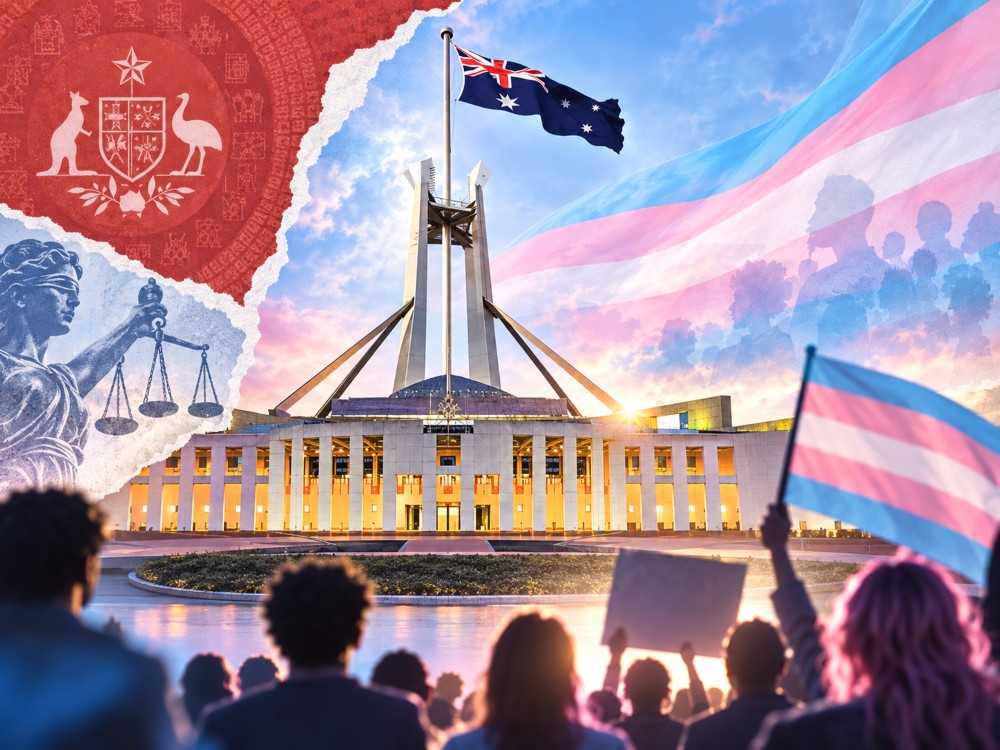


A coalition of 100 Australian organisations is urging federal MPs to reject attempts to redefine “sex” in the Sex Discrimination Act, warning proposed changes could weaken protections for transgender and intersex people as well as women more broadly.
The open letter brings together women’s organisations, LGBTQ+ groups, unions, disability organisations and mental-health advocates.
Signatories include ACOSS, ACON, Equality Australia, Women With Disabilities Australia and Women’s Legal Services Australia.
The intervention comes after the Senate again blocked an attempt by Liberal Senator Michaelia Cash to revive legislation that would introduce a biological definition of sex into federal discrimination law.
“Redefining ‘sex’ in the Act, or removing gender identity as a protected attribute, would strip protections from transgender Australians and weaken safeguards for women more broadly,” the letter says.
“It would render entire groups of people invisible in law and trigger a cascade of damaging consequences.”
Senate Rejects Latest Attempt To Revive Bill
Cash introduced the Sex Discrimination Amendment (Restoring Common Sense and Recognising Biological Sex) Bill 2026 in July.
The bill did not progress past its first reading.
On 15 September, Cash attempted to return it to Parliament’s agenda through a procedural motion.
That motion was defeated 32 votes to 22.
Support came from Coalition, One Nation and United Australia Party senators, while Labor, the Greens and an independent senator voted against reviving it.
Cash argues the Sex Discrimination Act should explicitly recognise biological sex and says the change would strengthen protections for women and girls in areas such as sport, changing rooms and other female-only spaces.
She has indicated she intends to keep campaigning for reform.
What The Current Law Protects
Australia’s Sex Discrimination Act currently protects people from discrimination on several separate grounds.
Those include sex, sexual orientation, gender identity and intersex status.
Gender identity is defined in the Act as a person’s gender-related identity, appearance, mannerisms or other characteristics, regardless of whether they have undergone medical intervention and regardless of their sex designated at birth.
Intersex status is also independently protected.
Those protections apply across areas including employment, education, accommodation and access to goods and services.
The 100 signatories argue that replacing the current legal framework with a narrow biological definition could create uncertainty about how those overlapping protections operate.
Advocates Say Women’s Rights And Trans Rights Are Not Opposed
The letter strongly rejects the idea that protecting trans people necessarily undermines women’s equality.
“For decades, Australian governments have recognised transgender people in law and allowed amendments to identity documents,” it states.
“These protections have coexisted with women’s rights without evidence of safety issues or systemic failures.”
Equality Australia CEO Anna Brown said changing the meaning of sex in the Act would create new legal problems rather than solve existing ones.
“Changing the meaning of ‘sex’ in the SDA doesn’t solve a problem — it creates one,” she said.
The coalition also argues that a rigid biological definition could affect women who do not conform to conventional expectations around appearance, bodies or femininity.
That could result, they say, in increased scrutiny of people in workplaces, schools and public facilities.
Intersex Groups Warn Against Binary Definitions
Intersex advocates have also raised concerns.
Dr Morgan Carpenter, executive director of Intersex Human Rights Australia, said attempts to define sex as an exclusively binary biological category fail to reflect people born with innate variations in sex characteristics.
“Proposals to define biological sex in law don’t respect people whose innate characteristics are not typically female or typically male,” he said.
“These proposals coercively reassign many of us to categories we’ve never lived in.”
Australia’s existing Sex Discrimination Act expressly recognises intersex status as a protected attribute.
That means any attempt to rewrite the definition of sex would need to be considered alongside those existing protections.
The Debate Is Likely To Continue
Cash and supporters of the bill maintain that federal law needs clearer sex-based definitions to protect women and girls.
Opponents argue the proposed changes could reduce protections for trans and intersex Australians and create new uncertainty for women themselves.
For now, the proposed legislation is not proceeding.
But with Cash promising to continue campaigning for change, the 100 organisations behind the open letter are making clear they intend to defend the existing framework.
Their message to MPs is straightforward: Australia’s anti-discrimination laws should protect more people, not fewer.
Focus Keyphrase:
Meta Description:
Social Media Summary