










Award-winning choreographer Oli Mathiesen explores queer archetypes, Māori identity and what happens when culture is appropriated by the politics it once resisted
I haven’t always been intrigued by the Village People. In fact, their hyper-masculine personas, cheap choreography and recent political alignment have done everything to deter me. Yet the culturally irrelevant group, whose timeless discography is embedded in the Western world’s pop zeitgeist, harbours a history of discourse and tension that closely mirrors my own experiences as a dancer.
The band was formed in the late ’70s by French producers Jacques Morali and Henri Belolo, who pulled together gay male archetypes they had plucked from Greenwich Village in Lower Manhattan. Yet the group assembled as an image of American queerness did not reflect the fact that the majority of its members identified as straight. Only two of the six were openly gay, with lead singer Victor Willis standing firmly in his heterosexuality.
This idea of performed queerness, and of gay stereotypes becoming a marketing commodity, is where their story intersects with mine.
Performing identities and amplifying my queerness, gender and indigeneity on stage is no foreign sensation. As an artist, these parts of myself become assets as the arts increasingly look to prioritise the stories of minority groups.
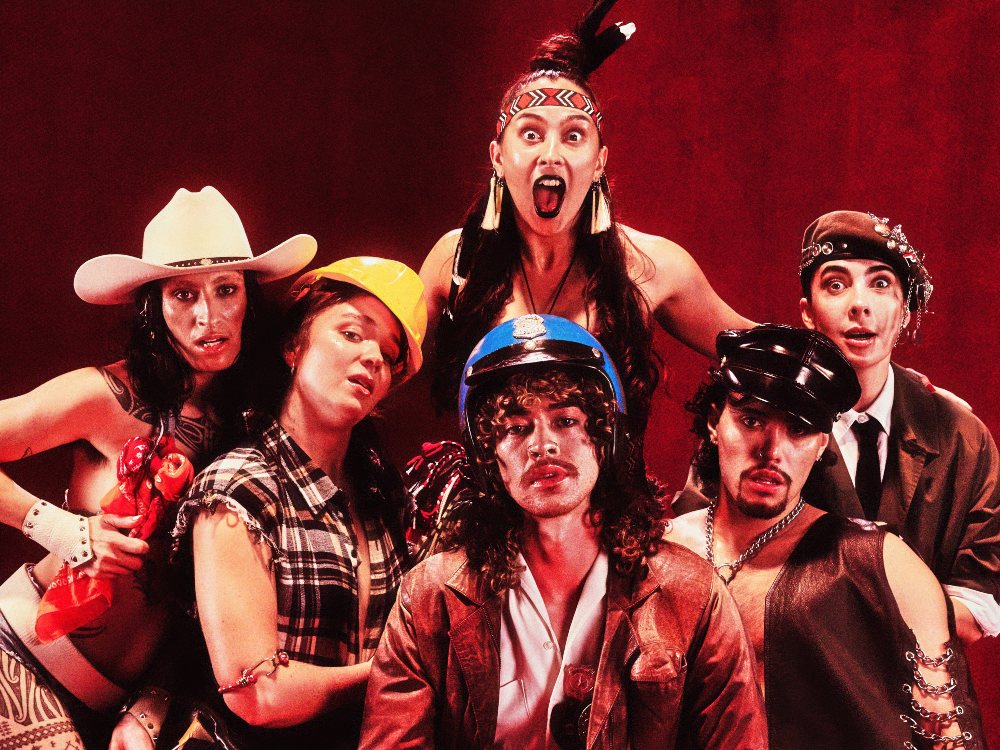
The cast of YMCĀ and I have worked closely together over the past six years, both within Atamira Dance Company and on external projects. We are colleagues, yes, but beyond that our friendships run deeply through our existence, particularly as Māori.
Our assembled group of six dancers, performing our queerness and indigeneity on stage within a Western dance form, in Western theatre contexts and within Western funding structures, creates a mirrored image of those disco icons.
It is here that we create a takatāpui rebirth of the Village People, with a cast caught between character and confession. The staging of queerness and indigeneity interrogates the archetypes, the macho men and the appropriation of ourselves.
But it is the Village People’s recent performance, and therefore endorsement, at Trump’s inauguration that makes the story tense.
The irony of a right-wing, anti-gay, anti-queer and anti-trans politician using a song that, unbeknownst to him, was born from a celebration of gay male stereotypes is highly reflective of the intelligence and comprehension of the man.
It is hypocrisy, but it is also camp, as the man punches his arms into the sky to a song about cruising.
It mirrors very similar actions performed by our own country’s current government and political figures, such as the ACT Party’s ‘Happy Māori’ AI image campaign or Winston Peters using Chumbawamba’s ‘Tubthumping’ at his 2024 rally.
But the group that performed alongside Trump was not the original band, with the exception of lead singer Willis.
Former member Jim Newman stated it was an “entirely separate entity than the long Storied Village People. Our Village People would never, ever perform at Trump rally,” Newman said. “We would never give him the right to use those songs, and we would never slap the face of the strong, especially gay audience, that made us who we are today.”
It raises a question about legacy and the integrity of a group or organisation’s kaupapa through ever-changing political landscapes.
Through this work, I want to create something that is politically rich, fiercely queer and undoubtedly Māori. I want to capture the essence of what this group of six dancers cares so deeply about — what we live and breathe every day through our existence.
I want to create something that, no matter how the context shifts around it, no matter who performs it or where it is performed in 50 years, cannot be weaponised.
A work whose kaupapa cannot be stripped from the movement.
Where the takatāpui cannot be removed from the dance.
Atamira Dance Company presents Oli Mathiesen’s new work YMCĀ on 13 & 14 October at Q Theatre, Auckland, as part of Tempo Dance Festival, and on 31 October at Theatre Royal, Nelson, as part of Nelson Arts Festival