








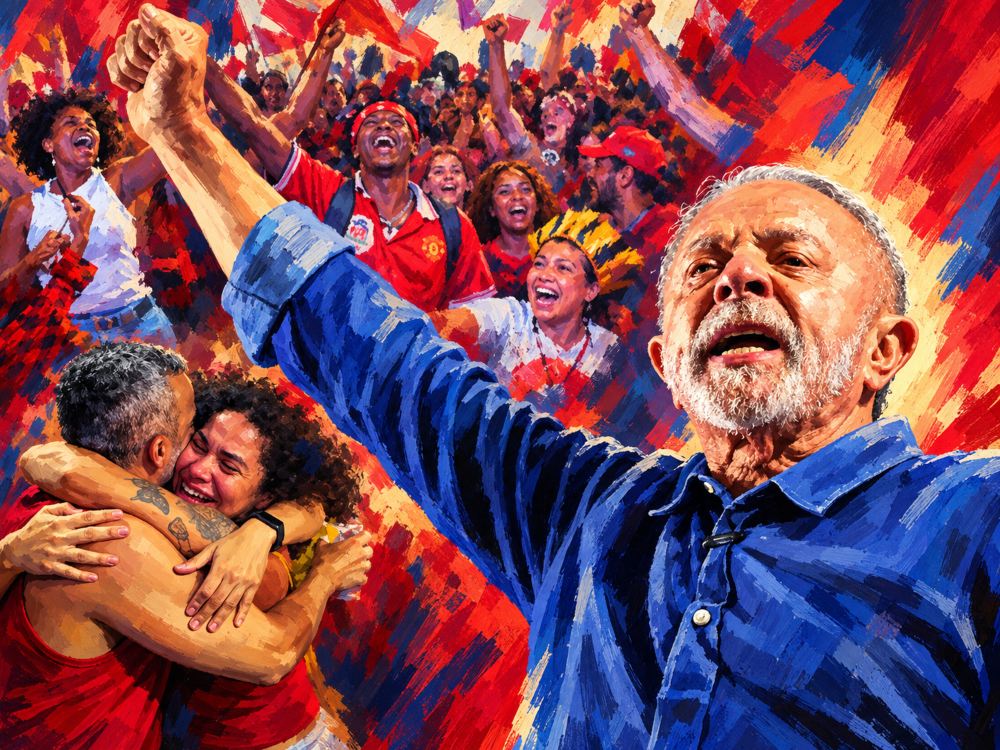
Brazil’s electoral court has formally declared Luiz Inácio Lula da Silva the winner of the country’s presidential election, securing an historic fourth term as challenger Flávio Bolsonaro refuses to concede defeat.
Brazilian President Luiz Inácio Lula da Silva has won re-election, defeating conservative challenger Flávio Bolsonaro by more than 4.4 million votes in Sunday’s presidential runoff.
Brazil’s Superior Electoral Court (TSE) confirmed Lula received 64,256,232 votes, or 51.79% of valid ballots, compared with 59,826,041 votes, or 48.21%, for Bolsonaro.
That gave Lula a final margin of 4,430,191 votes.
More than 158 million Brazilians were eligible to vote in the second round, with around 128.2 million turning out.
Abstention stood at approximately 19.2%, down from 21.08% in the first round.
Lula promises to govern for all Brazilians
Celebrating his victory, Lula struck a conciliatory tone and said the campaign was over.
“As we win elections, we no longer have adversaries,” he told supporters.
“I have to govern for 215 million… I have to govern for all cities.”
The victory gives Lula an unprecedented fourth non-consecutive presidential term, after earlier serving from 2003 to 2010 and returning to office following his 2022 victory over Jair Bolsonaro. His new term begins on 5 January 2027.
It was also an unusual electoral comeback.
Flávio Bolsonaro finished ahead of Lula in the first round, with 47.03% against Lula’s 45.16%, before Lula overtook him in the runoff. Brazilian media described it as the first time a presidential candidate who finished second in the opening round went on to win the second.
Flávio Bolsonaro refuses to concede
Bolsonaro has rejected the result and said he intends to seek its annulment.
His objections have centred partly on a last-minute decision to extend voting by two hours because of transport disruption and severe weather.
Both campaigns had requested measures addressing difficulties getting voters to polling stations, while Brazil’s electoral authorities have said the extension did not alter the integrity of the result.
Bolsonaro has not presented evidence showing that the roughly 4.4-million-vote margin resulted from electoral fraud.
His refusal to concede also differs from the response of his own Liberal Party, which has recognised Lula’s victory.
US President Donald Trump, a political ally of the Bolsonaro family, has separately claimed the election looked “rigged”, but Reuters reported that he offered no evidence for the allegation.
What did the election mean for LGBTQ+ Brazilians?
For Brazil’s LGBTQ+ communities, the candidates offered notably different policy frameworks.
Lula’s 2026 programme explicitly included LGBTQIA+ people, proposing inclusive public policies taking account of sexual orientation and gender identity, as well as measures aimed at tackling discrimination in employment and public security.
Flávio Bolsonaro’s published government programme, by contrast, did not directly mention LGBTQIA+ people, according to analysis of the presidential platforms.
However, in the final week of campaigning, Bolsonaro made a direct appeal to LGBTQ+ voters.
At a rally in Fortaleza, he said gay and LGBTQ+ Brazilians would “always be welcome” and promised they would prosper under his government.
He also said during the campaign that he did not intend to remove existing civil rights for same-sex couples, including legal recognition of relationships and inheritance rights.
Those statements came despite his own history of comments criticised as homophobic. In 2011, Flávio Bolsonaro said that being gay was not “normal” and questioned whether a father could feel pride in having a gay child, according to Folha de S.Paulo.
LGBTQ+ rights remain a major issue in Brazil
Brazil has significant legal protections for LGBTQ+ people.
Same-sex marriage has been recognised nationwide since 2013, legal gender recognition is available, and a 2019 Supreme Court ruling extended protections against discrimination and hate crimes based on sexual orientation and gender identity.
But legal recognition has not eliminated violence or discrimination.
International LGBTQ+ rights organisation Outright International notes that Brazil continues to experience particularly serious violence against sexual and gender minorities, especially transgender people.
The 2026 election also brought greater LGBTQ+ representation to Congress.
Three transgender women — Erika Hilton, Duda Salabert and Thabatta Pimenta — were elected to the Chamber of Deputies, while several other successful candidates publicly identified as gay, lesbian or bisexual.
A more conservative Congress awaits Lula
Lula’s presidential victory does not mean his government will have a straightforward path through Congress.
The parliamentary elections produced a significant shift to the right, strengthening conservative and centrist blocs capable of challenging the president on issues including environmental policy, criminal justice and social policy.
AP reports that proposals being discussed by lawmakers include measures affecting transgender rights, abortion and affirmative action.
That means LGBTQ+ policy over Lula’s next term will depend not only on the presidency, but also on negotiations with an increasingly conservative legislature.
What happens next?
For the presidential result itself, Brazil’s electoral authority has spoken clearly.
Lula won.
The TSE formally announced his re-election after all votes were counted, and the official margin stands at more than four million votes.
Flávio Bolsonaro can pursue legal challenges through Brazil’s courts, but refusing to concede does not invalidate the certified result.
For LGBTQ+ Brazilians, Lula’s victory keeps an administration that has explicitly included sexual orientation and gender identity in its policy programme in power.
But with a strengthened conservative Congress and Bolsonaro disputing the outcome, the political fight surrounding equality, gender and LGBTQ+ rights is far from over.