






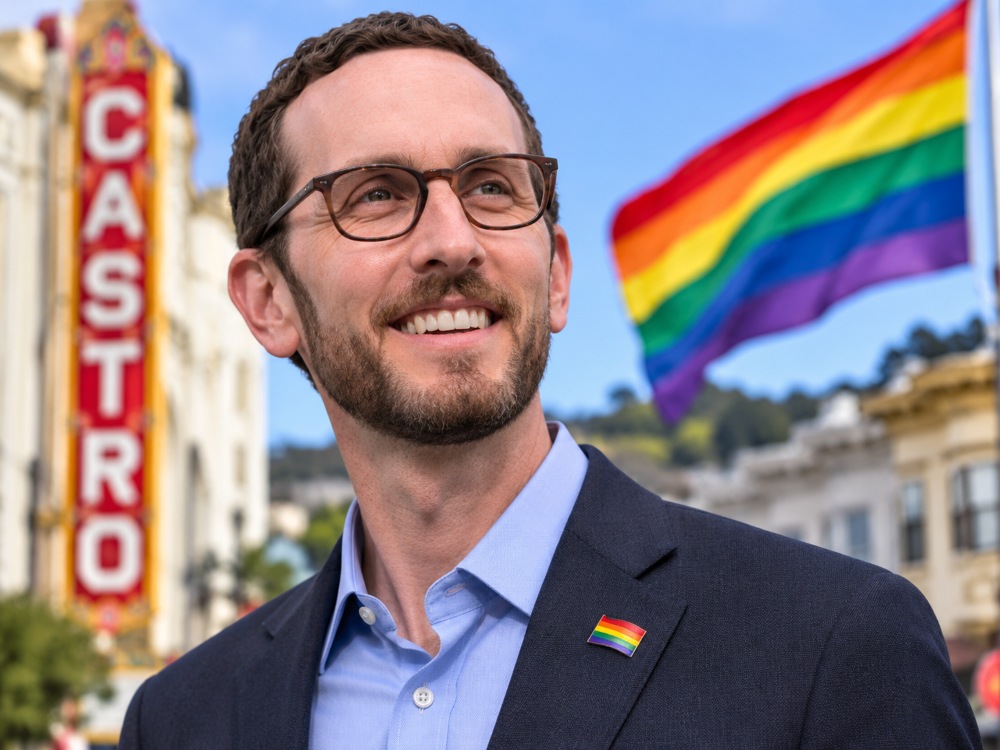

San Francisco has made rainbow history! Openly gay California state senator Scott Wiener is heading to the US Congress, becoming the first openly LGBTQ+ person elected to represent the city in the House of Representatives.
Wiener, a longtime advocate for LGBTQ+ rights, HIV prevention and transgender healthcare protections, is set to replace former House Speaker Nancy Pelosi, who is retiring after nearly four decades representing San Francisco in Washington.
His victory follows the 3 November US midterm elections, with fellow Democrat and San Francisco supervisor Connie Chan conceding on Wednesday 4 November, California time.
Although ballots were still being counted, Chan acknowledged that she no longer had a realistic path to victory and congratulated Wiener.
The result marks a significant milestone for LGBTQ+ political representation in a city internationally recognised for its rainbow culture and activism.
From San Francisco’s Castro To Congress
For Wiener, the election has particular personal significance.
The openly gay politician moved to San Francisco in 1997, drawn to a city whose LGBTQ+ community had become a symbol of visibility, acceptance and activism.
Reflecting on his election, Wiener recalled arriving at the Castro Muni Station nearly three decades earlier and immediately feeling at home.
His political career began at a local level, serving on San Francisco’s Board of Supervisors before being elected to the California State Senate in 2016.
Over the following decade, he developed a legislative record spanning housing affordability, public transport, healthcare access and LGBTQ+ equality.
Now, he’s preparing to represent California’s 11th Congressional District, taking on a seat that has been held by one of America’s most prominent Democratic politicians since 1987.
A Long Record Of Fighting For LGBTQ+ Rights
Wiener’s involvement in LGBTQ+ advocacy began long before his political career.
He came out in 1990, during the HIV/AIDS crisis, and volunteered on an AIDS support hotline while studying at university.
That experience helped shape his later work on sexual health, healthcare access and equality.
As a California state senator, he authored several significant pieces of LGBTQ+ legislation.
Among them was Senate Bill 159, passed in 2019, which expanded access to HIV prevention medication by allowing qualified pharmacists to provide PrEP and PEP without a doctor’s prescription under specified conditions.
PrEP is medication used to prevent HIV before potential exposure, while PEP is taken after a possible exposure to reduce the risk of infection.
The legislation helped make HIV prevention medication more accessible by removing some barriers to obtaining treatment.
Wiener also authored California’s LGBTQ+ Seniors Bill of Rights, aimed at protecting older rainbow people from discrimination in long-term care facilities.
He additionally co-authored legislation introducing a non-binary gender marker on California identity documents.
His Landmark Protections For Transgender People
One of Wiener’s most notable legislative achievements was California’s 2022 gender-affirming healthcare protection law, Senate Bill 107.
The legislation established safeguards for transgender young people and their families seeking gender-affirming healthcare that is lawful in California.
It limits certain forms of cooperation by California authorities with investigations or legal proceedings originating in other states where that care may be restricted.
The legislation also provides protections concerning medical records and interstate legal processes.
Supporters say these measures are important for transgender people and families who may otherwise face legal challenges when accessing healthcare across state borders.
Opponents of such protections have raised concerns about states adopting different rules concerning gender-affirming care for minors and the extent to which one state’s laws should affect another’s.
Wiener has continued to support additional privacy protections for transgender and non-binary Californians.
His move to Washington comes as transgender healthcare and LGBTQ+ civil rights remain prominent subjects of debate in federal politics.
Taking Over Nancy Pelosi’s Historic Seat
Wiener’s election also marks a major transition for San Francisco.
Nancy Pelosi, who first entered Congress in 1987 and later became the first woman to serve as Speaker of the US House of Representatives, announced she would not seek another term.
Although both candidates seeking to replace her were Democrats, Pelosi endorsed Connie Chan rather than Wiener.
The contest highlighted different approaches to housing, economic policy and other priorities affecting San Francisco residents.
Following Chan’s concession, Wiener thanked his opponent for the campaign and acknowledged Pelosi’s longstanding contribution to the city.
He particularly highlighted her early work addressing the AIDS epidemic, when HIV was having a devastating impact on San Francisco’s gay community.
Pelosi’s departure closes an important chapter in the city’s political history, while Wiener’s election introduces a new generation of leadership.
A Rainbow Milestone In Washington
Wiener’s victory comes during an election that has also seen another significant LGBTQ+ political first.
In New Hampshire, Democrat Chris Pappas became the first openly gay man elected to the US Senate, defeating Republican John E. Sununu.
Together, the results mark two notable developments in openly LGBTQ+ representation at the federal level.
For Wiener, entering Congress will also mean moving from state-level policymaking to national legislative debates.
His campaign highlighted plans to address housing affordability, healthcare, public transport and climate change, alongside protecting LGBTQ+ rights.
However, the policies he helped enact in California will not automatically become federal law. Any nationwide legislation would need to pass through Congress and the normal legislative process.
Why This Matters For Rainbow Communities
For LGBTQ+ communities in Aotearoa New Zealand and around the world, Wiener’s election highlights the growing visibility of openly rainbow politicians in senior public office.
San Francisco has played a defining role in LGBTQ+ history, from the activism of Harvey Milk to its response to the AIDS epidemic and its continuing influence on queer culture.
Despite that history, the city has never previously elected an openly LGBTQ+ representative to the US House.
Wiener’s election changes that.
His legislative record also brings experience in HIV prevention, transgender healthcare protections and LGBTQ+ anti-discrimination measures to a national political arena.
How he translates that experience into federal legislation remains to be seen.