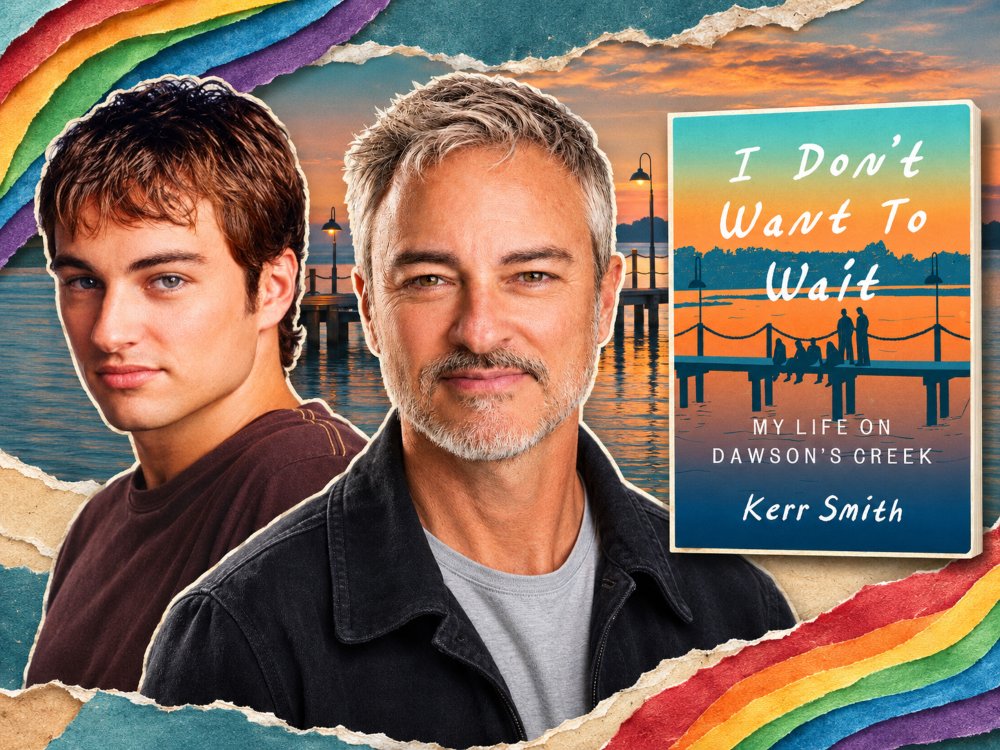
Remember Jack McPhee from Dawson’s Creek? Actor Kerr Smith is taking fans back to Capeside in a revealing new memoir, opening up about the groundbreaking gay storyline that changed television, the backlash he faced and the unforgettable kiss that helped make LGBTQ+ history.
More than 25 years after Dawson’s Creek became one of television’s most beloved teen dramas, Kerr Smith is revisiting the show that made him a star.
His new memoir, I Don’t Want to Wait: My Life on Dawson’s Creek, is released in the United States on 10 November 2026, offering behind-the-scenes stories from the hit series and new insight into his experiences playing Jack McPhee.
For LGBTQ+ audiences, Jack remains one of the show’s most significant characters, particularly for his coming-out journey and a landmark television moment that challenged the boundaries of mainstream entertainment.
And according to Smith, bringing that story to the screen wasn’t always easy.
The Gay Kiss That Made Television History
When Smith joined Dawson’s Creek during its second season in 1998, his character Jack McPhee was initially introduced as a potential love interest for Joey Potter, played by Katie Holmes.
However, series creator Kevin Williamson had something different in mind.
After several episodes, Williamson approached Smith about taking Jack’s storyline in a new direction.
That decision would see Jack come out as gay, becoming one of the most prominent LGBTQ+ teenage characters on American television at the time.
Then came the moment that would make television history.
In the third-season finale, True Love, which aired on 24 May 2000, Jack shared a passionate kiss with Ethan, played by Adam Kaufman.
The scene is widely recognised as the first romantic kiss between two men on American primetime network television.
For viewers who had rarely seen gay teenage relationships represented with the same emotional significance as heterosexual romances, the moment marked an important step forward.
‘We Did Ten Takes Of It!’
In a new interview with The Guardian, Smith revealed just how nervous he had been about filming the scene.
“I was so nervous for that kiss,” he recalled.
“We did ten takes of it. Ethan was nervous too, no matter what he says now.”
The actor remembered being reassured by the director, who encouraged him to approach the scene like any other romantic moment.
The important thing was making the characters’ feelings believable, regardless of their gender.
The kiss also required considerable determination behind the scenes.
Speaking to Us Weekly in 2020, episode co-writer Gina Fattore recalled that television network The WB had wanted the scene filmed from across the street and had expressed concerns about it appearing too passionate.
Showrunner Greg Berlanti, however, insisted that the kiss needed to communicate genuine romantic feeling.
The resulting scene became one of the show’s most memorable moments.
Kerr Smith Reveals Homophobic Backlash
While Jack’s storyline became an important moment for LGBTQ+ representation, it also attracted hostility.
Smith recalled protests outside the show’s Wilmington, North Carolina, studios following Jack’s coming-out storyline.
The actor told The Guardian that he remembered driving past demonstrators while travelling to work.
Although he initially believed their anger was directed at the programme rather than him personally, he later experienced a more disturbing incident.
While filming the horror movie The Forsaken in Arizona around 2001, Smith returned to his car to discover it had been vandalised with red graffiti, including homophobic slurs.
He never discovered who was responsible.
The actor revealed that he had kept the incident largely to himself for years, only deciding to discuss it publicly while writing his memoir.
His experience illustrates the hostility that could accompany portraying an openly gay character on mainstream television during the late 1990s and early 2000s.
‘The Storyline Changed My Life’
Despite the backlash, Smith says the positive response to Jack’s story has stayed with him throughout his career.
More than two decades later, fans still approach him to explain how seeing Jack on television helped them understand or accept their own sexuality.
Some have told him the storyline changed their lives.
Others have shared that the character helped them through particularly difficult periods.
Smith told The Guardian that the positive encounters have overwhelmingly outweighed the negative experiences.
For an entire generation of LGBTQ+ viewers, Jack’s storyline provided a rare opportunity to see a young gay character navigate coming out, friendship, family acceptance and romance on a mainstream television drama.
And importantly, Jack wasn’t simply a supporting character whose sexuality appeared in one episode.
His journey continued throughout the series, allowing audiences to follow his development over several seasons.
A Behind-The-Scenes Return To Capeside
Smith’s memoir goes well beyond Jack’s coming-out storyline.
The book combines his personal memories with interviews involving fellow cast members, crew, network executives, writers and series creator Kevin Williamson.
The actor revisits the friendships, creative decisions and occasionally chaotic behind-the-scenes experiences that shaped Dawson’s Creek.
In his recent interview, Smith admitted that he has spent much of his career trying to recreate the special atmosphere he experienced while working on the show.
The memoir also includes reflections on his late co-star James Van Der Beek, who played Dawson Leery.
Smith added a tribute chapter following Van Der Beek’s death in February 2026, inviting cast members and colleagues to share their memories of the actor.
Although Smith went on to appear in productions including Charmed, Final Destination, The Fosters and Riverdale, Jack McPhee remains one of his most recognisable roles.
Why Jack McPhee Still Matters
For LGBTQ+ audiences who grew up watching Dawson’s Creek, Jack’s journey remains an important part of television history.
His storyline arrived at a time when openly gay teenage characters were still relatively rare on mainstream American television.
The decision to portray his sexuality as an ongoing part of his life, rather than a brief plot twist, helped make the character meaningful to viewers navigating similar experiences.
Today, queer representation on screen is far more visible, but the impact of those earlier television moments continues to resonate.
Smith’s new memoir offers an opportunity to revisit that history through the memories of the people who helped create it.