








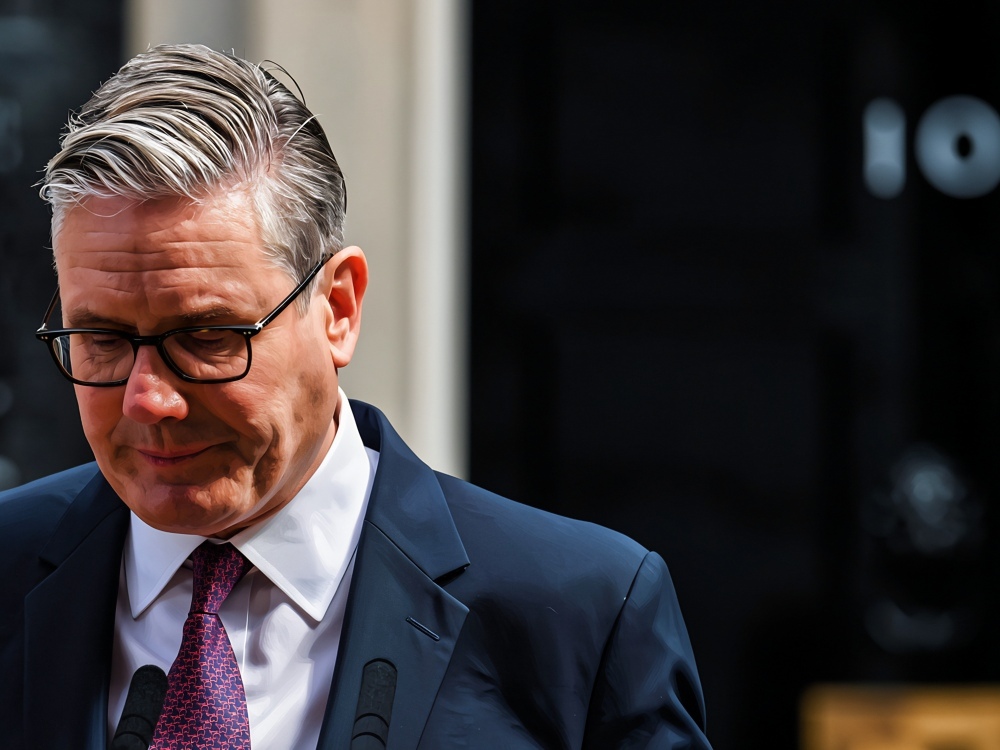

Former human rights lawyer Keir Starmer has resigned as leader of the UK Labour Party, following weeks of uncertainty in Downing Street and mounting pressure from within his own party.
Starmer announced his decision outside 10 Downing Street on 22 June, saying he would step down as Labour leader but remain as Prime Minister until a successor is chosen. The resignation comes less than two years after Labour’s 2024 general election victory.
“I will resign as leader of the Labour Party,” Starmer said.
As he ended his announcement, Starmer said he would spend more time on “the most important job” of “being the best husband” to his wife, Vic, and “being the best dad” to his children.
Calls for Starmer to resign intensified after the 7 May local elections, which saw Labour suffer heavy losses while Reform UK made major gains. Reuters reported that pressure from Labour MPs grew after the party’s poor local election performance and the rise of Nigel Farage’s Reform UK.
Starmer had initially insisted he was not going anywhere, but reports emerged last week that he was preparing to resign. His decision now triggers a Labour leadership process, with a new leader expected to be chosen in the coming weeks.
A complicated LGBTQ+ legacy
Before becoming Prime Minister in 2024, there had been hope that Starmer’s leadership would mark a positive shift for LGBTQ+ communities.
At the 2019 PinkNews Awards, where he was a guest of honour, Starmer said some of his “proudest” work had been with the Human Dignity Trust, an organisation that challenges laws across the Commonwealth that criminalise LGBT+ people.
Speaking to The Guardian the same year, he said he wanted “trust to be restored in the Labour party as a progressive force for good”.
Starmer also had a parliamentary record of voting in favour of LGBT+ equality. He backed a proposal in 2019 to make LGBT-inclusive education mandatory in the curriculum, and during his time as a barrister was involved in the legal battle to secure the right for LGBTQ+ people to serve in the military.
In June 2021, Starmer told PinkNews: “Trans people are one of the most discriminated groups in our society. Labour knows how much work there is to do… We’re committed to updating the [Gender Recognition Act] to introduce self-declaration for trans people.”
He also pledged to make hate crimes against LGBT+ and disabled people carry the same gravity as racist hate crimes. That change came into law in April 2026.
However, Starmer’s relationship with LGBTQ+ communities, particularly trans communities, became increasingly strained during his time as Labour leader and Prime Minister.
In 2024, around the time he became Prime Minister, Starmer caused controversy after telling The Times that trans women who had not had gender-affirming surgery “don’t have the right” to be in female-only spaces.
“They shouldn’t,” he said. “That’s why I’ve always said biological women’s spaces need to be protected.”
“A woman is a biological woman”
Starmer also appeared to step back from earlier support for LGBT-inclusive education and trans rights, saying, according to The Independent: “I’m not in favour of ideology being taught in our schools on gender.”
Following the April 2025 UK Supreme Court ruling that references to “woman” and “sex” in the Equality Act refer to biological sex, Starmer welcomed the decision, saying it provided “clarity”. The Labour Party’s own FAQ states that the ruling found references to “women” in the Equality Act 2010 refer to biological sex, meaning sex at birth.
Asked after the ruling whether he would repeat that trans women are women, Starmer said: “I think the Supreme Court has answered that question.” He added: “A woman is an adult female, and the court has made that absolutely clear.”
Under Starmer’s government, as of February 2026, there was no route for trans youth to receive new prescriptions for puberty blockers.
In 2024, Starmer told PinkNews that Labour was committed to a “full, trans-inclusive ban on conversion practices” if elected. As of May 2026, so-called “conversion therapy” had still not been banned in the UK.
Starmer’s resignation leaves behind a mixed and contested LGBTQ+ legacy: early promises on equality, legal experience in human rights, and support for LGBT+ protections, but also deep disappointment from many trans people and allies who say his government retreated from commitments when they mattered most.