









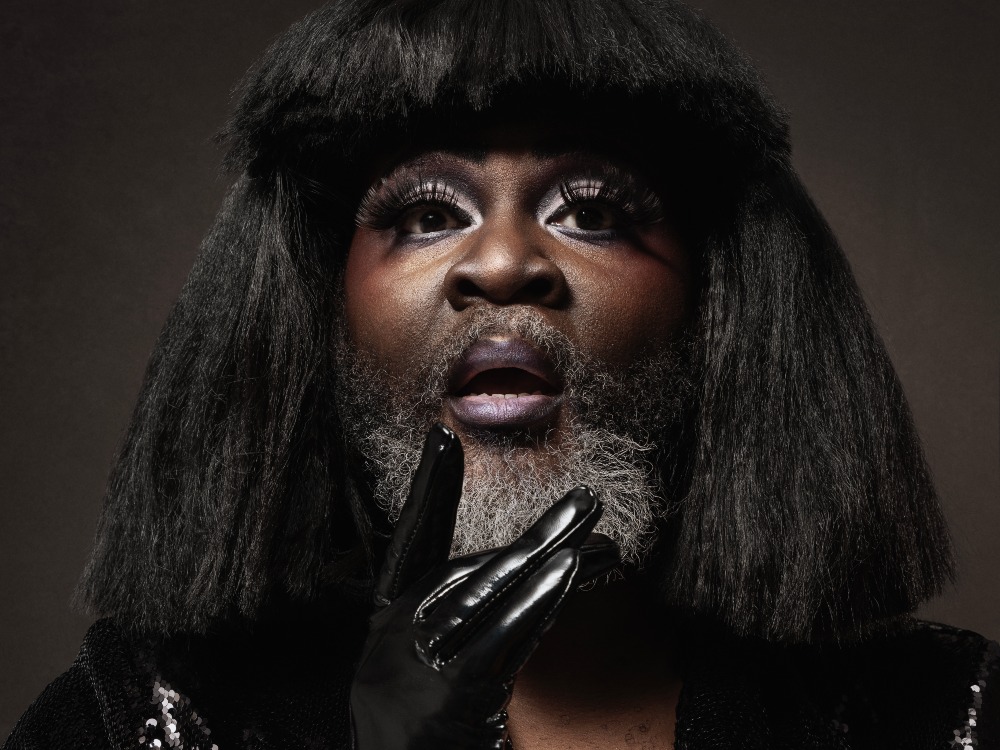

Le Gateau Chocolat returns to Tāmaki Makaurau this July for Auckland Live Cabaret Festival with Musicals Mayhem, but behind the glamour, Oliver Hall discovers an artist reshaping expectations around identity, visibility and hope in troubling times.
When Le Gateau Chocolat walks onto a stage, audiences often think they know what they are getting. They see a performer armed with sequins and wit, and expect a drag show with live vocals and a few camp laughs.
Then he opens his mouth and something far broader and profound begins to happen.
For more than 20 years, the British-Nigerian cabaret artist, opera singer and force of theatrical nature has been reshaping what audiences expect from cabaret and drag. This July, he returns to Tāmaki Makaurau for Auckland Live Cabaret Festival with Musicals Mayhem, a show described as a high-glamour collision of musical theatre, comedy and cabaret.
For the man behind the icon, George Ikediashi, performance has always been about more than entertainment. It is about being seen clearly in a world that keeps trying to reduce people to categories.
“When your identity is the majority in any country, you’re not ‘Black’, you’re just a human being,” he says, reflecting on moving from West London to Nigeria as a child, and then later returning to England.
That return came with a new and confronting awareness of how identity is read from the outside.
“Moving back to England, you are visualised as Black and Black comes with lots of connotations and stereotypes,” he says. “Society has gone, ‘This is the box that you live in because this is what we know of you’.”
“It’s the privilege of being a human being versus a human doing,” he explains.
“You’re a human doing when you’re just considered as Black, or fat, or queer. It’s exhausting whether you are in England or Nigeria!”
He tells us even walking down the street can become a performance he did not consent to.
“I was having a conversation with a friend telling him about how people might snigger or murmur or take surreptitious photos of me in public,” he says. “And my friend was like, ‘Well, if you dress like that’. I was like, ‘Dress like what? This is literally my self-expression.’”
For Le Gateau Chocolat, that self-expression is not an invitation for ridicule. It is simply existence.
“I don’t understand how any of what I do or how I dress means that I should expect people to be embarrassingly puerile.”
That visibility, however, also comes with purpose.
“I 100% feel like there is a responsibility to use one’s platform wisely,” he says, noting the Black opera singers Jessye Norman, Kathleen Battle and Leontyne Price as artists who “seismically changed the classical and opera world by being who they were”.
“They had to be excellent,” he tells us. “They couldn’t be associated with mediocrity, whereas there is the privilege of actually failing up when you’re not that good at something. And (that privilege is) mostly about looks.”
After two decades on international stages, what still thrills him is the moment an audience realises its expectations are collapsing.
“I was in Perth about to go on, and the stage manager, Evan, said to me, ‘What’s your favourite part about doing this?’ And I was like, ‘All of it’.”
“From the moment that I walk on stage to hours, days, weeks, years after, there are people who will think, ‘That was absolutely not what I was expecting’.”
He loves the puzzle that creates for people.
“There is something thrilling about that because their perception of what they think I am or should be has changed,” he says.
One email from an audience member after seeing his show Raw Cacao has stayed with him. The email acknowledged the audience had initially laughed when he arrived on stage to sing “Ol’ Man River”, expecting “their version of a drag show”.
“But by song four, they realise this is not what it is,” it read. “And by the end of the show, they’re like, ‘Why did I cry? What is this? Who are you?’”
It is feedback like this that keeps him moving from festival to festival, country to country, stage to stage.
“I have been doing this 20 years, my God!” he says. “International festivals still thrill me because I get to go to places that I never would have if I had stuck to just my law degree.”
The work keeps calling him back because it offers what he describes as an “uncomfortable opportunity and privilege” to reshape stereotypes and reframe understanding.
In a world where reactionary politics, demagoguery and fascism are again finding oxygen, he believes artists have work to do.
“This is when artists get to work, and this is when artists with marginalised identities have to be at the vanguard and use their platforms responsibly,” he says.
That responsibility may sound heavy, but for Le Gateau Chocolat, the key to it is not anger.
“The heart of all of this is love and hope.” That’s how you change minds.