








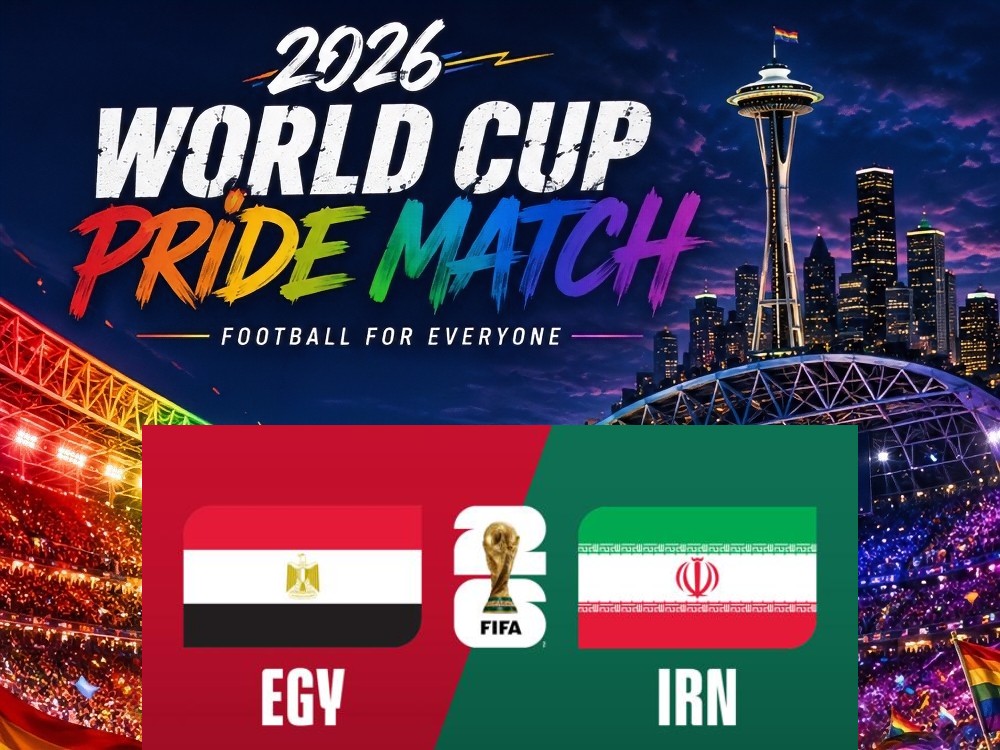
Iran and Egypt will face one another in a major Group G clash on Friday 26 June, in a match that has become one of the most politically charged fixtures of the 2026 FIFA World Cup.
The game, taking place at Lumen Field in Seattle, has been designated by the local Seattle World Cup host committee as the tournament’s first-ever Pride Match. That designation was decided before the participating countries were drawn.
When the draw later placed Iran and Egypt into the fixture, the match immediately drew attention. Both countries have poor records on LGBTQ+ rights, with Iran criminalising homosexuality and Egypt using vague morality and indecency laws to target LGBTQ+ people and expressions of Pride.
Despite months of complaints from Iran, Egypt and anti-LGBTQ+ groups, Seattle organisers have remained firm that the Pride Match will go ahead.
Seattle’s local organising committee has the ability to create host-city designations and events outside the stadium, including the Pride Match. While the designation is not a FIFA initiative, it reflects Seattle’s wider Pride culture and commitment to LGBTQ+ inclusion.
FIFA’s World Cup fan guidance says small flags, banners and posters are allowed inside stadiums, provided they meet size and safety requirements.
“We anticipate a lot of rainbow flags in the stadium and T-shirts with rainbow flags on them,” Hedda McLendon, Seattle FWC26’s senior vice-president of legacy, told Outsports.
“Let’s welcome people to Seattle. It’s the World Cup. And let’s show them how we Pride. It’s not a day, it’s not a weekend here. It’s a month.”
Respecting Seattle’s local Pride culture
When Qatar hosted the 2022 FIFA World Cup, LGBTQ+ visitors and allies were repeatedly told to respect local culture, despite Qatar’s criminalisation of same-sex intimacy.
Seattle organisers and LGBTQ+ advocates are now making the opposite point: in Seattle, local culture embraces and celebrates LGBTQ+ communities.
For the Pride Match advisory committee, the moment carries significance beyond one fixture.
“What stands out over and over again is this responsibility to celebrate Pride for everyone,” said Jen Barnes, CEO and founder of Rough & Tumble, a Seattle pub centred on women’s sports.
“It’s an opportunity to bring Pride to people who can’t live being out. We want to bring visibility for them.
“For those fans, for those athletes, all over the world, they’re going to be celebrating with us. When you have billions of people watching that same moment together, and knowing as we sit in the stands together what we’ve done, it is so beautiful to uplift the community for the entire World Cup.”
The Seattle Pride Match initiative includes local artists, businesses and community organisations, with organisers aiming to create visibility across the city as well as around the stadium.
“We are the only city that’s celebrating a Pride Match as part of this World Cup,” Barnes said. “I feel the joy of celebrating the LGBTQ community around the world is on our shoulders.”
Iran and Egypt both chasing knockout qualification
Beyond the politics, the match itself could be a fascinating contest.
Belgium entered Group G as the favourite, but both Iran and Egypt managed to draw with the European side. At the same time Iran and Egypt play in Seattle, Belgium will face New Zealand.
If Belgium beats New Zealand, the All Whites will be eliminated, while Iran and Egypt would join Belgium in the knockout stage. However, because the matches are played simultaneously, neither Iran nor Egypt can rely on that result while they are on the pitch.
A win in the Pride Match would guarantee progression for either side.
That means two countries whose governments have objected to LGBTQ+ visibility will be fighting for their World Cup future in a match surrounded by rainbow flags, Pride events and queer celebration.
Whether they like it or not, Iran and Egypt’s knockout hopes now run through Seattle’s Pride Match.