








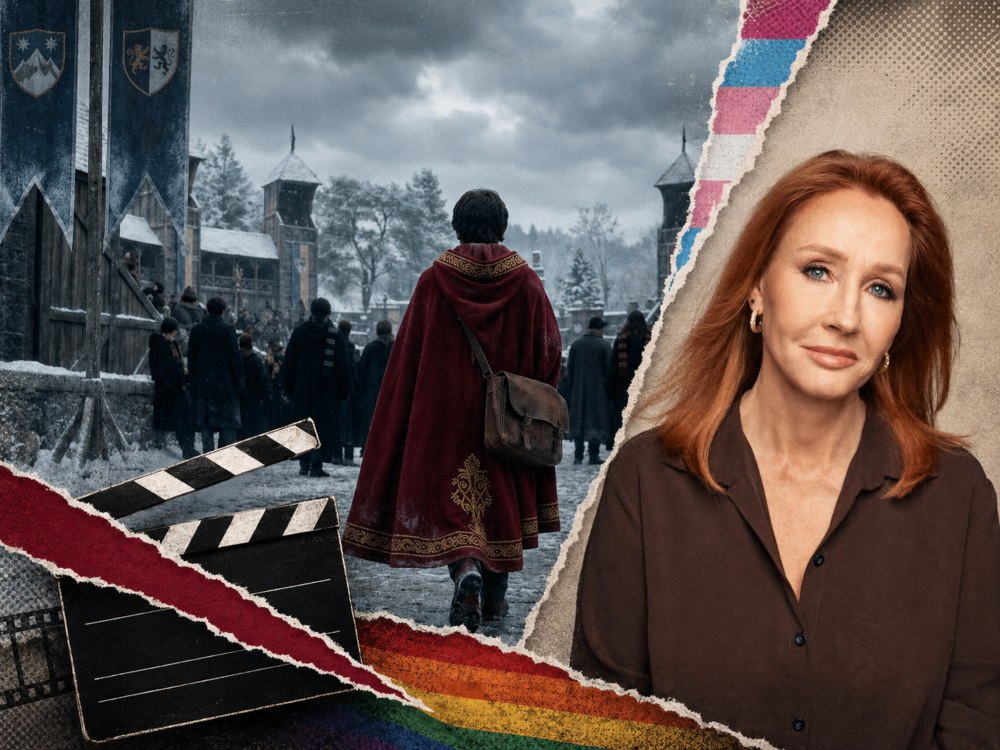
Two queer directors have revealed they turned down opportunities to work on HBO’s upcoming Harry Potter television series, citing J.K. Rowling’s record on transgender issues.
Canadian writer-director Ally Pankiw, whose credits include Black Mirror, The Great and I Used to Be Funny, shared a screenshot of an exchange with her representative in which she was asked whether Harry Potter was a “hard no”.
Her response was emphatic.
“Absolutely f***ing not!” Pankiw replied, later writing that it was “this easy to say ‘no’ to funding transphobia”.
Fellow queer director Kate Herron, known for Loki, Doctor Who and The Last of Us, then revealed in the comments that she had also been approached.
“They’ve asked me twice and I’ve had to explain my answer is never gonna change from a ‘no’,” Herron wrote.
Pankiw has previously spoken publicly about being a queer filmmaker and how her identity influences her approach to storytelling. Herron has likewise publicly identified as queer.
Directors draw a line over Rowling’s involvement
Their decisions come amid an ongoing divide within the entertainment industry over whether to participate in new Harry Potter projects while Rowling remains closely involved with the franchise.
Rowling is an executive producer on HBO’s television adaptation, meaning she remains directly connected to the new series. The production also features John Lithgow as Albus Dumbledore, Paapa Essiedu as Severus Snape, Nick Frost as Rubeus Hagrid and Bel Powley as Petunia Dursley.
Several actors attached to the production have expressed positions supportive of trans people despite accepting roles in the series.
Powley has said she “strongly” disagrees with Rowling’s views on gender and believes trans people deserve safety, dignity, respect and acceptance. Essiedu has also supported an industry open letter advocating for transgender, non-binary and intersex people.
For Pankiw and Herron, however, declining the work represents a different approach: refusing professional involvement altogether.
Rowling continues to fund sex-based rights cases
The directors’ concerns also extend beyond Rowling’s public commentary.
Rowling has established the J.K. Rowling Women’s Fund, a private fund that financially supports legal action aimed at strengthening what it describes as women’s and girls’ “sex-based rights”. Its stated priorities include cases involving single-sex spaces, employment disputes and challenges to policies it considers inconsistent with the UK Equality Act.
The fund says it prioritises strategic legal cases intended to establish precedents and enforce the interpretation of sex-based rights following the 2025 UK Supreme Court judgment in For Women Scotland v The Scottish Ministers.
Rowling also donated £70,000 to For Women Scotland, the organisation that brought the case eventually decided by the Supreme Court.
In April 2025, the Supreme Court unanimously ruled that the terms “woman”, “man” and “sex” in the Equality Act 2010 refer to biological sex. The judgment means a trans woman with a Gender Recognition Certificate is not considered a “woman” for the purposes of sex-based provisions in that Act.
Importantly, the Court also stated that its ruling does not remove anti-discrimination protections from transgender people. Gender reassignment remains a protected characteristic under the Equality Act, and trans people may also rely on other provisions covering discrimination and harassment.
The judgment has nevertheless been viewed by many LGBTQ+ organisations and trans advocates as a significant setback because of its implications for access to some single-sex services and spaces.
A growing ethical question around Harry Potter
The disagreement surrounding HBO’s Harry Potter adaptation reflects a broader question for LGBTQ+ audiences, performers and creatives: whether participating in or financially supporting the franchise can be separated from Rowling’s political and legal activism.
There is no single response within the industry.
Some actors have chosen to join the series while publicly distancing themselves from Rowling’s positions. Pankiw and Herron have instead decided that declining the work is the clearest expression of their support for trans communities.
For queer and trans audiences in Aotearoa and elsewhere, their refusals are notable because they show that debate around Harry Potter is no longer limited to what audiences choose to watch or buy. It is also influencing decisions made by people working behind the camera.
Pankiw’s message, at least, could hardly have been clearer: for her, saying no was not complicated.