








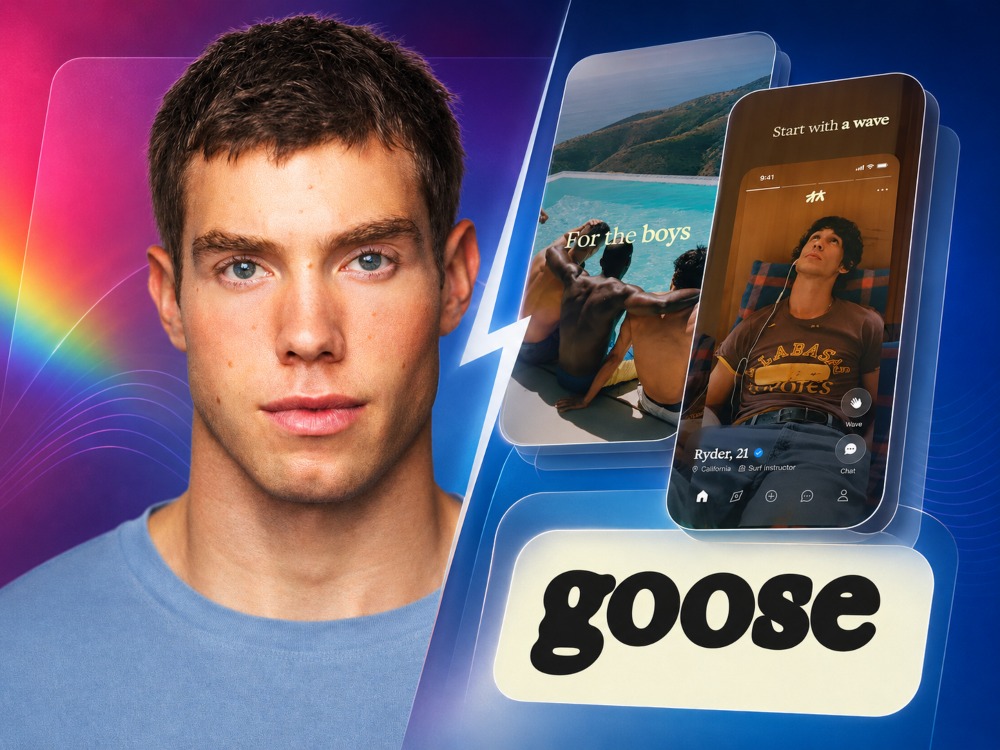
Derek Chadwick has stepped away from Goose, the gay dating app he co-founded as an alternative to platforms such as Grindr and Scruff, saying the company’s direction no longer aligns with his original vision.
The actor, model and entrepreneur announced his departure on Instagram, confirming he is no longer involved with Goose “in any capacity”.
The exit comes less than two months after the app launched and follows a turbulent debut that included scrutiny over its marketing practices and privacy terms.
For Chadwick, however, the explanation for leaving was straightforward: he could no longer fully stand behind where the company was heading.
“Where I landed is that my vision for where this should go and the direction the company is going aren’t the same thing anymore,” he wrote.
“When my name and my face are on something, I want to be able to stand behind all of it, fully. As that stopped being true, staying didn’t feel right.”
Chadwick Says He Still Wishes Goose Well
Despite stepping away entirely, Chadwick made clear there was no blanket condemnation of the people still working on the platform.
“Although I’m no longer involved with Goose in any capacity, I wish the team the best — there are great people over there working incredibly hard to make Goose special,” he wrote.
He also thanked the gay men who joined during the app’s opening weeks, particularly those who contacted him to say they had made genuine connections through the platform.
According to Chadwick, tens of thousands of people signed up within the first few weeks.
“That was always the whole point for me, and it still is,” he said.
His statement also hinted that his departure from Goose will not mark the end of his attempts to create projects for gay men.
“I’m not done building for us,” he wrote.
“More soon.”
What Is Goose?
Goose launched in June 2026 with Chadwick and former BeReal growth and community manager David Aliagas among its founders.
The platform positioned itself as a different kind of gay social and dating app, placing greater emphasis on connections through shared interests, places, friends and real-world experiences.
Rather than traditional matches, Goose uses a feature called Waves.
Users can wave at somebody they are interested in connecting with, and when both people wave, a conversation opens.
The concept was pitched as a lower-pressure alternative to the more transactional experience some gay men associate with dating apps.
That proposition clearly appealed to part of the community.
But the app’s launch was quickly overshadowed by questions about how it was being promoted.
Goose Faced Questions Over Alleged AI Accounts
In July, a WIRED investigation examined a network of Instagram accounts that appeared to be promoting Goose directly to gay men.
Several of those accounts showed signs of being inauthentic, including recently created profiles, unusual follower patterns and repeated promotional messages.
Some profile images were also assessed by AI-detection tools as likely to have been artificially generated.
WIRED spoke to gay men who said they initially believed they were interacting with real people before being encouraged to sign up for Goose.
The investigation also identified an account linked to co-founder David Aliagas advertising paid “ambassador” roles involving secondary Instagram accounts.
Goose denied that its marketing was intended to deceive potential users.
It is important to note that Chadwick has not said the controversy contributed to his departure, and his statement did not specifically mention the AI-profile allegations.
His explanation remained focused on a broader disagreement over the company’s direction.
Privacy Terms Also Drew Criticism
Goose also faced criticism soon after launch over an earlier version of its terms and conditions.
A section called the Member Content License and Waiver granted the company broad rights involving material uploaded to the service, including a user’s name, image, voice and likeness.
The wording attracted particular concern because it also referred to disappearing content.
For a dating app serving gay men — some of whom may live in countries, families or workplaces where being openly LGBTQ+ carries genuine risk — control over personal images and identity is especially sensitive.
Questions around privacy are therefore more than an abstract technology debate for queer dating platforms.
They can have direct implications for safety, outing, employment and personal relationships.
Goose subsequently amended the relevant section of its terms on 30 June, saying the changes reflected more standard language used across lifestyle and dating apps.
Trust Matters In Queer Dating Apps
The controversies surrounding Goose highlight a bigger challenge facing companies building technology specifically for LGBTQ+ communities.
Dating platforms require an unusually high level of trust.
People hand over photographs, locations, conversations, relationship preferences and deeply personal information — often while expecting those platforms to help them meet strangers safely.
For gay, bisexual and other queer men, those concerns can be amplified by the possibility of discrimination, outing or harassment.
An app presenting itself as a community-focused alternative therefore has to do more than simply offer different features.
Users also need confidence that the people they encounter are genuine and that their personal information is being handled responsibly.
That makes transparency particularly important when a company markets itself around authenticity and community.
What Comes Next For Derek Chadwick?
Chadwick has not yet revealed what he plans to build next.
But his final message suggests another queer-focused project may already be on his mind.
For someone whose face and profile played such a major role in Goose’s launch, leaving only weeks later represents a significant change for the young platform.
Whether Goose can continue building momentum without one of its most visible founders remains to be seen.
Chadwick, meanwhile, appears determined to continue creating something for the community — just not under the Goose banner.
“More soon,” he promised.