










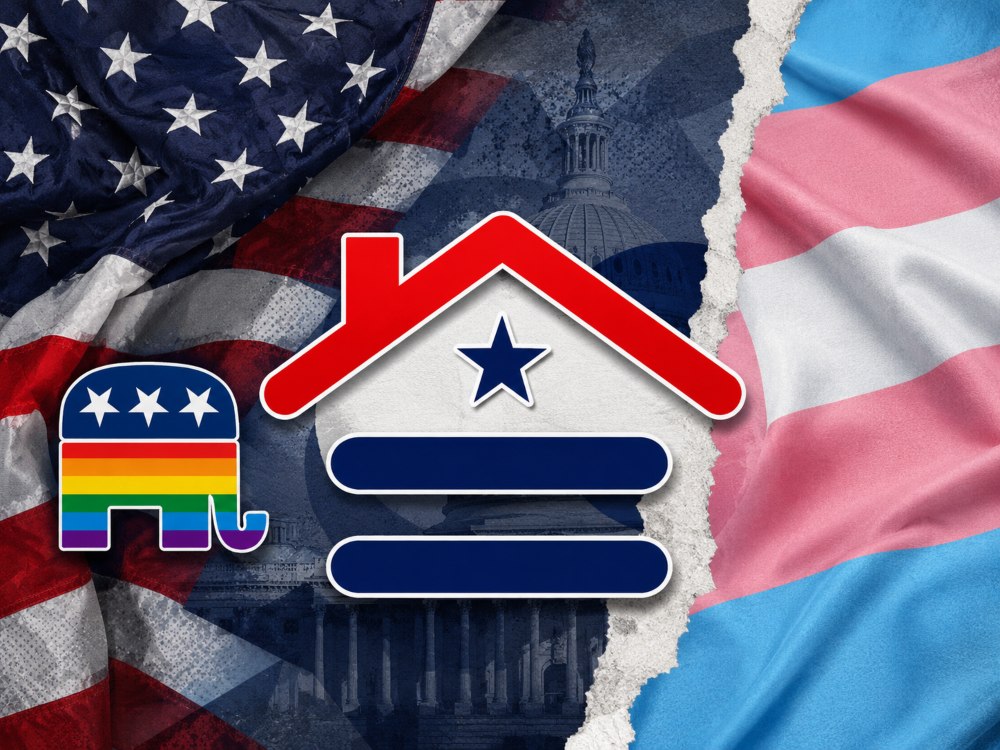
The Log Cabin Republicans have formally dropped transgender advocacy from their national mission, declaring themselves an “LGB advocacy organisation” after more than a decade of including trans people within their stated work.
National president Ross Hemminger announced the shift on 20 August, saying the conservative LGBTQ+ organisation will now concentrate specifically on sexual orientation and conservative political priorities.
Transgender people will still be permitted to join the organisation, but trans rights will no longer form part of its national advocacy focus.
The decision represents a significant break from the position adopted by the Log Cabin Republicans in 2015, when its board formally added transgender people to its mission.
At the time, the organisation argued that adults should be free to live as they choose without unnecessary government interference.
Now, Hemminger says the organisation believes the modern transgender rights movement has moved away from that principle.
Log Cabin Republicans Declare Themselves An ‘LGB Advocacy Organisation’
In announcing the decision, Hemminger said the board had held significant discussions with members before changing course.
The organisation would now “concentrate specifically on issues of sexual orientation and conservative values”, he said.
“In other words, we are an LGB advocacy organisation.”
Hemminger argued that the move represented a return to the organisation’s roots rather than a rejection of individual transgender conservatives.
Membership, he said, would remain open to all conservatives, and local chapters could continue operating in ways that reflected their membership.
However, the practical result is unmistakable: transgender equality is no longer something the national organisation considers part of its core advocacy mission.
Hemminger Targets Trans Young People, Sport And Healthcare
Hemminger justified the decision with a series of sweeping claims about transgender activism, particularly involving young people.
He argued that trans advocacy had become overwhelmingly focused on minors, schools, sport and gender-affirming healthcare.
He also claimed that advocates support medical treatment for young people “often without the knowledge or consent of the parents” and described such treatment as largely irreversible.
Those claims require significant context.
Gender-affirming care for young people is not a single treatment and does not automatically mean medical intervention.
It can include psychological support, changes in name or presentation and, for some adolescents following clinical assessment, puberty blockers or hormone therapy.
Major US medical organisations have supported access to individualised gender-affirming care when provided according to established clinical standards.
Guidance from the Endocrine Society recommends multidisciplinary assessment for adolescents considering medical treatment, informed consent, ongoing monitoring and family involvement.
For patients under 18, its clinical guidelines contemplate parental or guardian consent for hormone treatment.
Some effects of hormone therapy can be irreversible, while puberty suppression is intended to pause pubertal development while treatment decisions are considered.
That is considerably more nuanced than the picture presented in Hemminger’s announcement.
Trans Advocacy Extends Far Beyond Healthcare For Minors
Hemminger’s suggestion that the transgender rights movement has “ceased focusing on adults” also overlooks many of the major trans-rights battles currently unfolding across the United States.
Transgender adults have faced disputes over passports and other identity documents, military service, healthcare coverage, employment protections, bathroom access and recognition by federal agencies.
The Trump administration has introduced multiple policies affecting transgender adults as well as young people.
Transgender service members, federal workers and adults seeking to update identification documents have all been affected by recent policy changes.
So while debates involving young people have become particularly prominent in US politics, they represent only one part of the wider transgender rights landscape.
Human Rights Campaign Condemns The Split
The Human Rights Campaign has strongly criticised the Log Cabin Republicans’ decision, arguing that separating lesbian, gay and bisexual rights from transgender equality weakens the wider LGBTQ+ movement.
HRC spokesperson Delphine Luneau said attempts to split the community were exactly what opponents of LGBTQ+ equality wanted.
“Sacrificing one part of a community in the false hope that it will somehow protect the rest of it has never worked throughout history,” she said.
Luneau argued that freedoms enjoyed by lesbian, gay, bisexual and transgender people are interconnected.
Her criticism reflects a long-running debate within LGBTQ+ politics.
Some campaigners argue that lesbian, gay and bisexual rights can be politically separated from questions involving gender identity.
Others point out that many of the legal arguments historically used against gay and lesbian people — including claims about protecting children, preserving traditional values or restricting public visibility — are now regularly directed towards transgender communities.
An Organisation With Deep Republican Ties
The Log Cabin Republicans were founded to give gay conservatives a voice within the Republican Party.
Over decades, the organisation campaigned on issues including marriage equality, military service and anti-discrimination protections while trying to convince Republican politicians that conservative politics and gay rights were compatible.
Its relationship with Donald Trump has become increasingly close.
Former First Lady Melania Trump hosted a major Log Cabin Republicans fundraiser in 2024, while Donald Trump addressed the organisation at an event in 2022.
The group has frequently defended Trump against criticism from other LGBTQ+ organisations, arguing that conservative gay people should not automatically be expected to support Democratic candidates.
That positioning has increasingly put it at odds with major LGBTQ+ rights organisations, particularly as Republican lawmakers have pursued restrictions affecting transgender people.
Its Record On Trans Rights Was Already Complicated
The 2026 announcement formalises a shift that had been developing for years.
Log Cabin Republicans once criticised efforts to roll back protections for transgender students.
But more recently, the organisation supported Florida legislation restricting classroom discussion of sexual orientation and gender identity, opposed gender-affirming healthcare for minors and criticised policies intended to protect some transgender young people estranged from their families.
The decision to become explicitly “LGB” therefore does not arrive entirely out of nowhere.
What is different now is that the separation has become official organisational policy.
Can LGB Rights Be Separated From Trans Rights?
For LGBTQ+ communities, the decision raises a much larger question about solidarity.
Lesbian, gay, bisexual and transgender people do not have identical experiences.
Sexual orientation and gender identity are different.
There are legitimate debates within rainbow communities about policy, language and priorities.
But LGBTQ+ history is also full of overlapping struggles.
Trans people participated in early queer liberation movements.
Gay and lesbian people have stood alongside trans communities in battles over healthcare, employment and public recognition.
Bisexual people have similarly fought against being erased from both heterosexual and gay spaces.
Many people also belong to more than one part of the acronym — someone can be transgender and gay, lesbian or bisexual at the same time.
Trying to draw a clean political boundary between the “LGB” and the “T” therefore becomes considerably harder when looking at the people themselves.
A Familiar Divide-And-Conquer Debate
Supporters of the Log Cabin Republicans’ new direction will likely argue that narrowing its mission allows the organisation to focus on areas where it believes conservative consensus is possible.
Critics see something more troubling.
They argue that an organisation established to fight discrimination against one part of the queer community is now distancing itself from another minority facing intense political pressure.
For LGBTQ+ communities in Aotearoa New Zealand, the development may feel familiar to wider international debates attempting to separate sexuality from gender diversity.
Those debates deserve factual scrutiny rather than slogans.
Claims about transgender healthcare, schools and sport should be assessed against evidence and actual policy — not used as shorthand for whether transgender people deserve equality.
Log Cabin Republicans remain free to decide what causes they advocate for.
But the organisation’s new position leaves little ambiguity about where it now draws the line.
After formally adding the “T” in 2015, it has chosen to remove transgender rights from its national mission.
And at a time when trans people are facing some of the fiercest political battles in the United States, that choice is unlikely to go unnoticed.