









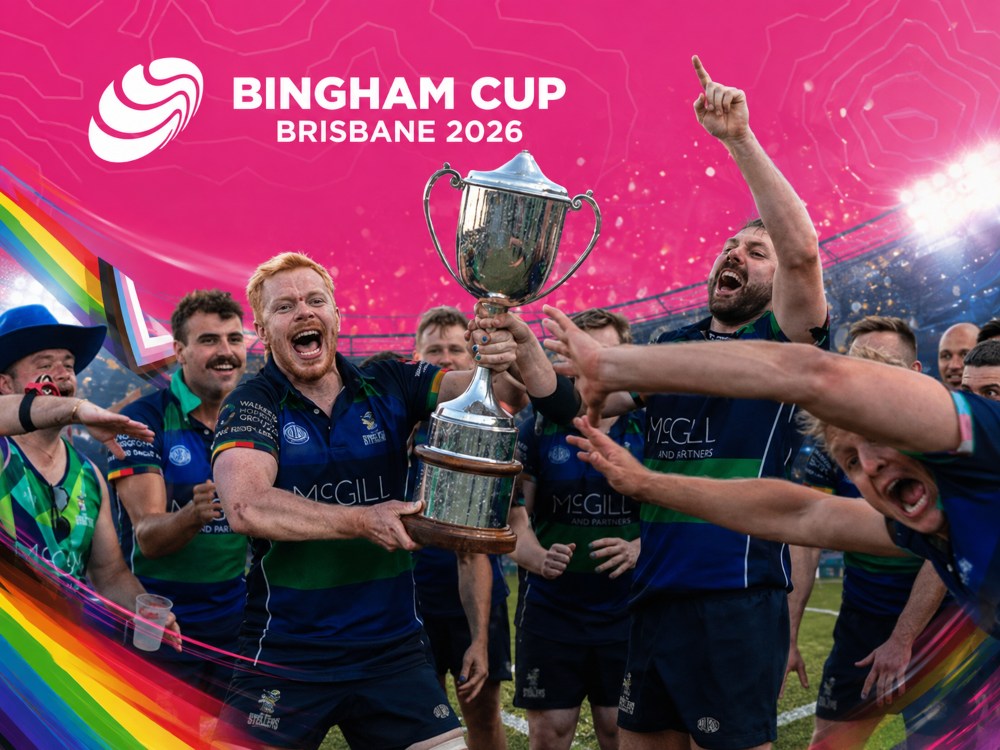
London’s Kings Cross Steelers have been crowned 2026 Bingham Cup champions, defeating the Sydney Convicts 12–5 in a hard-fought final in Brisbane.
The victory gives the Steelers their second Bingham Cup title in four years, following their triumph in Ottawa in 2022.
For Sydney, the result marks a second consecutive appearance in the tournament’s top-tier final. The Convicts also reached the decider in Rome in 2024, where they were beaten by Paris side Les Gaillards.
But after four days of fiercely competitive LGBTQ+-inclusive rugby in Brisbane, 2026 belonged to the Steelers.
And while there was plenty of pride, friendship and celebration surrounding the tournament, nobody appeared to have forgotten that there was also a trophy to win.
Steelers Complete An Impressive Tournament
The Kings Cross Steelers arrived in Brisbane in formidable form.
They finished the pool stage at the top of their group after scoring 158 points without conceding a single point.
The knockout rounds proved considerably tighter.
In the semi-final, the Steelers edged tournament hosts Brisbane Hustlers 8–5 to secure their place in Sunday’s decider.
There they faced the Sydney Convicts, historically the most successful team in Bingham Cup competition.
The final lived up to the occasion, but the London side ultimately prevailed 12–5 to take the trophy back to the United Kingdom.
It was also a fitting result during the Steelers’ 30th anniversary season.
Founded in 1995, Kings Cross Steelers are widely recognised as the world’s first gay and inclusive rugby union club.
Sydney Convicts Remain A Bingham Cup Powerhouse
While Sydney missed out on the title, reaching another final reinforced the Convicts’ extraordinary record at the tournament.
The Australian club has won the Bingham Cup five times, making it the most successful team in the competition’s history.
In 2024, the Convicts reached the final in Rome before losing 27–7 to Les Gaillards.
Two years later, they were back in contention for the trophy on home soil.
For queer rugby in Australia, having both Sydney and host club Brisbane Hustlers competing deep into the tournament also demonstrated the strength of the country’s gay and inclusive rugby scene.
Ottawa Wolves Win The Amanda Mark Cup
The Bingham Cup was not the only international trophy decided in Brisbane.
The Ottawa Wolves claimed the Amanda Mark Cup, defeating Dublin’s Emerald Warriors 31–5 in the final.
It is the Canadian club’s second Amanda Mark Cup title, having previously lifted the trophy when Ottawa hosted the tournament in 2022.
The Amanda Mark Cup is the women’s and non-binary competition held alongside the Bingham Cup under International Gay Rugby.
Its development reflects the wider expansion of inclusive rugby beyond the men’s competition.
After making its full debut in Ottawa in 2022 and returning in Rome in 2024, the tournament continued to grow in Brisbane.
Four Days Of Rugby — And Something Much Bigger
Match play ran from 20 to 23 August as teams representing LGBTQ+-inclusive rugby clubs from around the world descended on Brisbane.
The wider festival stretched across more than a week, combining competition with ceremonies, parties and community events.
But for many players, the Bingham Cup has never simply been a rugby tournament.
It can also provide something queer people have historically struggled to find within some sporting environments: a place where they can compete seriously without hiding who they are.
Sydney Convicts fourth-team player James described Bingham as representing “passion, skill, love, verve, intensity, and triumph of the human spirit”.
“But most of all it represents a real community for those deprived of one but given one when they needed it most,” he said.
That sense of belonging is central to why players travel enormous distances to compete.
‘Part Of Something Bigger’
James’ teammate Connor arrived at the tournament with little rugby experience but finished it having helped the Convicts’ fourth team reach a semi-final.
He described the experience as “absolutely exhilarating”.
“Coming from a place of no experience yet making it to the semis with a legendary group of players — shoutout 4ths — and getting three tries in one game was probably one of the best moments of my life,” he said.
For Connor, the appeal went well beyond his own performance.
He said the tournament made him feel as though he was “part of something bigger”.
That captures much of what has made the Bingham Cup endure.
Players range from experienced competitors to people who discovered rugby through inclusive clubs because mainstream sporting spaces had never previously felt like somewhere they belonged.
Once they reach Bingham, however, inclusion does not mean lowering the competitive stakes.
People still want to win.
They just get to do it without leaving their identity at the changing-room door.
Who Was Mark Bingham?
The tournament is formally known as the Mark Kendall Bingham Memorial Tournament.
It honours Mark Bingham, an openly gay American rugby player who died aboard United Airlines Flight 93 during the September 11 terrorist attacks in 2001.
Bingham played rugby with the San Francisco Fog and helped establish the Gotham Knights in New York.
He was also one of the passengers believed to have participated in the revolt against the hijackers aboard Flight 93.
The aircraft ultimately crashed into a field near Shanksville, Pennsylvania, killing everyone aboard but preventing the hijackers from reaching their intended target in Washington, DC.
Bingham had been an outspoken example of someone who challenged stereotypes about gay men and masculinity.
After his death, the international inclusive rugby community chose to name its major tournament in his honour.
The first Bingham Cup was held in San Francisco in 2002.
A Tournament Built Around Belonging
More than two decades later, the Bingham Cup has become one of the biggest events in international LGBTQ+ sport.
Its significance is particularly visible in rugby, a sport that has traditionally projected strongly masculine ideas about who belongs on the field.
Gay and inclusive clubs have challenged that assumption simply by showing up, playing seriously and building communities around the game.
Those clubs also offer something difficult to measure on a scoreboard.
For someone who has spent years worrying about how teammates might react to their sexuality or gender identity, walking into a club where those questions do not have to come first can be transformative.
That is why Bingham can simultaneously be a serious international rugby tournament and a celebration of found family.
The two ideas are not contradictory.
Players can fight ferociously for possession for 80 minutes and then celebrate together afterwards.
The Bingham Cup Heads To Leeds In 2028
With Brisbane 2026 now complete, attention will eventually turn to the next edition.
Leeds Hunters have been confirmed as hosts of the 2028 Bingham Cup, bringing the tournament back to England.
It will be the third time the competition has been held there, following London in 2004 and Manchester in 2012.
For now, though, the trophy is heading slightly further south.
After four days of competition and one tense final, the Kings Cross Steelers are Bingham Cup champions once again.
Two titles in four years.
Thirty years after the club was founded.
And proof that inclusive rugby can deliver both community and seriously competitive sport.