








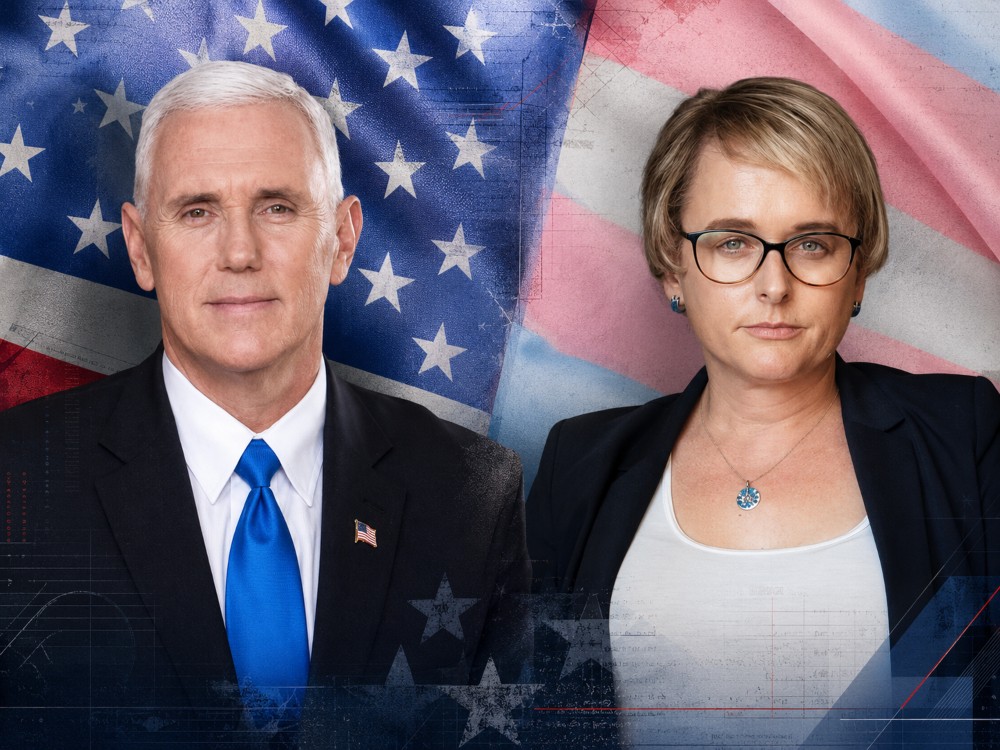

Former US Vice President Mike Pence says he was “heartened” to learn that transgender former CIA officer Julia Curlee remembers being treated with dignity and respect while serving as his daily intelligence briefer.
The comments reveal a striking contrast between Curlee’s personal experience working with Pence and his longstanding political record opposing LGBTQ+ rights.
Curlee, who spent nearly two decades working in US intelligence, recently spoke publicly about her career and her experiences serving multiple administrations.
She became the first known CIA officer to transition openly while continuing to serve at the agency and eventually rose to one of the most sensitive positions in American intelligence: delivering classified daily briefings to the vice president.
During Donald Trump’s first administration, that vice president was Pence.
Despite their very different backgrounds and political views, Curlee says Pence treated her with “profound respect and dignity”.
At one point, she even wrote: “No one has affirmed my gender identity quite like Mike Pence.”
Pence Says He Was ‘Heartened’ By Curlee’s Experience
Asked about Curlee during an interview with CNN, Pence said he appreciated hearing her positive account.
“My conservative values are fairly well-known,” he said.
But, he added, he and his wife believe their Christian faith also means treating other people with “decency and respect”.
“I was heartened to hear Julia reflect that that was the experience that took place in our office,” Pence said.
His comments followed Curlee describing one particularly memorable interaction involving her family.
After her assignment briefing Pence came to an end, Curlee says her family was invited to the White House.
During the visit, Pence reportedly told Curlee’s mother that she must be proud of her daughter.
For Curlee, who had spent years navigating life as a transgender woman inside some of the most powerful institutions in the United States, the moment clearly stayed with her.
An Unlikely Pairing
The relationship may surprise anyone familiar with Pence’s political career.
The former Indiana governor and vice president has spent decades aligning himself with conservative Christian politics and opposing significant LGBTQ+ rights reforms.
He opposed marriage equality and supported defining marriage as between a man and a woman.
During the first Trump administration, Pence was also part of an administration that moved to restrict transgender people from serving openly in the US military.
His political record has made him a deeply controversial figure for many LGBTQ+ Americans.
Curlee was well aware of that history while walking into his office to deliver some of the United States government’s most sensitive intelligence.
Yet she says her direct professional interactions with him were consistently respectful.
That distinction is at the centre of what makes her account so striking.
A politician can treat an individual trans person politely and respectfully while simultaneously supporting policies that LGBTQ+ advocates argue make life harder for transgender people as a group.
Both things can be true at once.
Curlee Became The CIA’s First Openly Transitioning Officer
Curlee joined the CIA in 2007.
She later transitioned while working at the agency, becoming the first officer known to have openly transitioned and continued serving.
Her career subsequently included work preparing and delivering the President’s Daily Brief, one of the most highly classified intelligence products produced by the US government.
She eventually became Pence’s regular briefer during Trump’s first term.
The role required Curlee to digest enormous amounts of intelligence and communicate the most important developments directly to one of the most powerful politicians in the country.
Her gender identity was not a secret to officials.
“Trump officials had known I was trans from day one,” Curlee has written.
For years, she continued to advance through the national security establishment.
Things Changed During Trump’s Second Term
After serving in national security roles during the Biden administration, Curlee remained at the White House when Trump returned to power.
But the environment for transgender federal employees changed rapidly.
Trump signed an executive order directing the federal government to recognise only two sexes, male and female, defined according to sex assigned at conception.
New policies followed affecting transgender federal workers, including restroom access, identity documents, discrimination protections and healthcare.
Curlee wrote that she was barred from using women’s bathrooms in federal facilities.
She also said insurance coverage for the estrogen she relied on was stripped away and that her passport documentation was changed to identify her as male.
Still, she continued working.
“Trump officials had known I was trans from day one,” she wrote.
“This hadn’t been an issue until it was public.”
Curlee Was Removed From Her White House Role
Curlee’s National Security Council assignment eventually ended abruptly.
Around the same period, far-right activist Laura Loomer publicly posted about a transgender “Biden holdover” working inside the Trump White House.
Curlee has not claimed that Loomer personally caused her removal, nor has she said she has evidence Trump ordered her dismissal because she is transgender.
She was never given an official explanation.
But the timing left her with difficult questions about why an identity that had long been known inside government suddenly appeared to become a problem.
After her White House assignment ended, Curlee returned to the CIA.
There, she watched as LGBTQ+ initiatives were dismantled and policies affecting transgender employees became increasingly restrictive.
She ultimately left the agency in 2026.
‘I Cannot In Good Conscience Advise LGBTQ Americans To Join The CIA’
Perhaps the most sobering part of Curlee’s account is what she now says about the institution where she spent much of her adult life.
“I cannot in good conscience advise LGBTQ Americans to join the CIA,” she wrote.
For someone who once saw intelligence work as a calling, she described writing that sentence as exceptionally painful.
Curlee argues that the problem goes beyond how transgender employees are treated.
She says the politicisation of federal institutions risks discouraging experienced professionals from telling political leaders difficult truths — one of the central responsibilities of intelligence agencies.
“Those who remain within an agency built to deliver hard truths are being muzzled,” she wrote.
Personal Respect Does Not Erase Political Consequences
Curlee’s experience with Pence presents an uncomfortable but important distinction.
She does not describe him as personally cruel.
Quite the opposite.
In her telling, Pence behaved professionally, treated her respectfully and recognised her as a woman in interactions that clearly meant something to her.
That deserves to be acknowledged.
But individual courtesy does not erase the impact of political policies.
For transgender people, being treated kindly by one politician in a room cannot substitute for legal protections affecting healthcare, employment, military service, identification and everyday life.
Pence himself effectively acknowledged the divide when he noted that his conservative views are well known while emphasising his belief in treating individuals respectfully.
For LGBTQ+ communities, Curlee’s story demonstrates why both levels matter.
Respect matters.
So do rights.
A transgender person should not need to be personally liked, respected or valued by someone in power before their dignity is protected.
Curlee’s Story Is Ultimately About Service
Despite everything that happened, Curlee’s account is not simply a story about Mike Pence or Donald Trump.
It is also about a transgender woman who spent almost two decades serving her country at some of the highest levels of national security.
She worked through multiple presidents.
She operated in war zones.
She handled some of America’s most sensitive intelligence.
And she briefed senior leaders regardless of whether their politics aligned with her identity.
Her experience challenges a political narrative that frequently presents transgender people as incompatible with public service or national security.
Curlee was not merely present in those institutions.
She was trusted with some of their most important work.
That is perhaps the most revealing part of the story.
Long before her identity became politically inconvenient, the US government already knew exactly who Julia Curlee was.
And it trusted her anyway.