








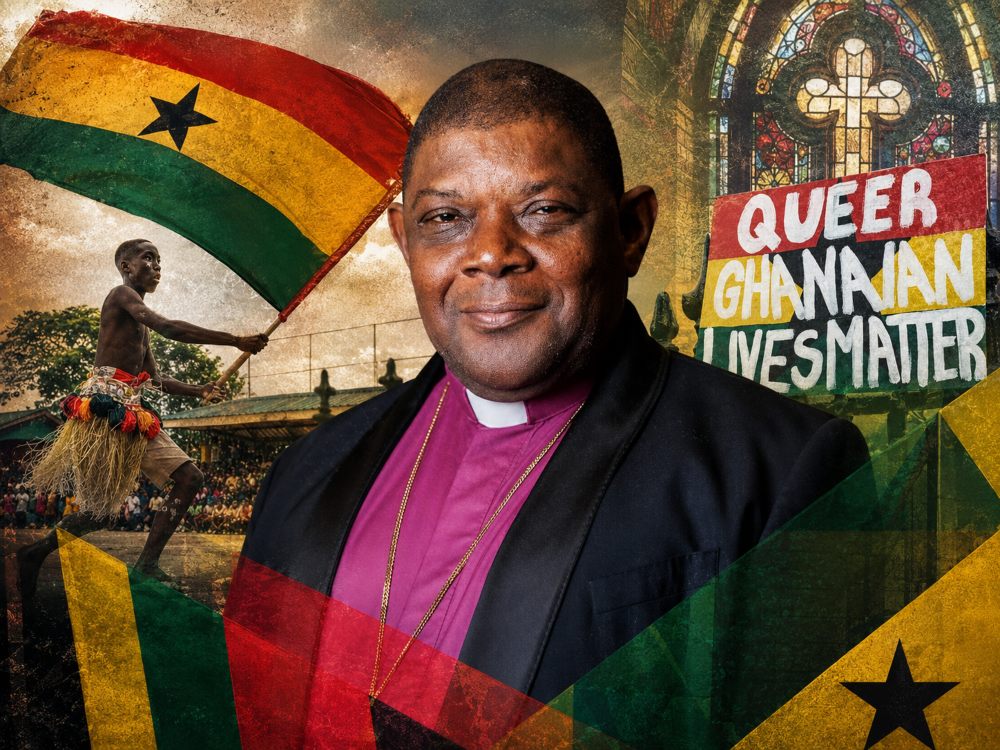
One of West Africa’s most senior Anglican leaders has spoken out against Ghana’s sweeping anti-LGBTQ+ bill, saying gay people should not be criminalised even as he maintains the Church’s traditional teaching on same-sex relationships.
Archbishop Cyril Kobina Ben-Smith, Primate of the Church of the Province of West Africa and Bishop of Asante-Mampong, made his position clear during a recent BBC interview.
“Our point in our province is very clear: we do not support the criminalisation of gay persons,” he said.
His intervention comes as Ghana awaits a decision from President John Dramani Mahama on one of the most severe pieces of anti-LGBTQ+ legislation proposed anywhere in Africa.
Parliament passed the Human Sexual Rights And Family Values Bill on 29 May 2026.
It has not yet become law.
‘They’ve Never Been A Problem’
Ben-Smith acknowledged that Ghana’s Anglican Church maintains a conservative theological position on sexuality and gender.
“We believe that God created male and female, so … we hold on to the traditional view,” he said.
But he drew a clear distinction between religious teaching and imprisoning people because of their sexuality.
“The whole concept of LGBT people, it’s not new here,” Ben-Smith said.
“They have lived in this country for a long time, and we’ve lived with them. They’ve never been a problem.”
He added that LGBTQ+ people remain “all children of God” and said that “God loves them”.
For an Anglican leader in a country where religious organisations have been among the strongest supporters of tougher anti-LGBTQ+ legislation, the comments represent an important public rejection of criminalisation.
They do not amount to endorsement of same-sex relationships or full LGBTQ+ equality.
But they challenge the argument that traditional Christian beliefs automatically require the state to punish queer people.
What Ghana’s Anti-LGBTQ+ Bill Would Do
The legislation awaiting presidential assent goes dramatically further than Ghana’s existing laws.
Consensual sex between men is already criminalised under a colonial-era provision dealing with so-called “unnatural carnal knowledge”.
The new bill would expand state control significantly.
It would criminalise people for identifying as lesbian, gay, bisexual, transgender, queer or other identities covered by the legislation.
Consensual same-sex sexual activity could carry prison sentences of up to three years.
Advocacy or the production and distribution of material considered to promote LGBTQ+ identities or relationships could lead to sentences of between five and 10 years.
Funding or sponsoring prohibited LGBTQ+ activities could also result in imprisonment.
LGBTQ+ organisations would effectively be unable to operate legally.
The bill also creates restrictions on information about sexuality and gender provided to children and young people.
For human-rights advocates, the result would be a legal framework that targets not only sexual behaviour but identity, speech, organising and support.
Citizens Could Be Required To Report Others
One of the bill’s most alarming provisions creates a duty to report suspected offences.
People who know of an alleged violation would be expected to report it to police or relevant community authorities.
Human Rights Watch has warned that the provision could encourage surveillance and denunciation between neighbours, relatives and community members.
In practice, LGBTQ+ advocates fear it could make people afraid to confide in others about their sexuality or gender identity.
A family member, friend or acquaintance could potentially be placed in the position of deciding whether to report them.
That risk could push already vulnerable people further underground.
Some Professional Exemptions Were Added
Before passing the bill, Parliament added several exemptions intended to protect certain legitimate professional activities.
Lawyers providing legal advice or representation to LGBTQ+ people are not supposed to be treated as promoting homosexuality simply for doing their jobs.
Journalists reporting on LGBTQ+ issues in the normal course of their work are similarly exempt.
Healthcare professionals providing medical, psychological or counselling services are also protected in specified circumstances.
Academic, scientific and medical publications can likewise fall outside the advocacy restrictions.
Those exemptions are significant.
However, human-rights organisations continue to argue that the broader legislation is so sweeping that it could still create fear among healthcare workers, journalists, researchers and advocates.
A law does not need to prosecute every professional for people to become nervous about how their work might be interpreted.
Human Rights Groups Warn Of Serious Consequences
Human Rights Watch has urged Ghana to abandon the bill, warning that it violates fundamental rights to privacy, dignity, freedom of expression and association.
The organisation has also raised concerns about the impact on healthcare.
Criminalising LGBTQ+ identities can discourage people from accessing HIV testing, sexual-health services, mental-health support or other medical treatment if they fear being identified or reported.
That can have consequences far beyond the LGBTQ+ community.
Effective HIV prevention depends on people being able to seek testing, treatment and information without fearing arrest.
Public-health organisations have repeatedly warned internationally that criminalisation can make marginalised communities harder to reach and undermine efforts to prevent transmission.
Ghana’s Existing Law Has Colonial Roots
Supporters of the bill frequently describe restrictions on homosexuality as necessary to preserve Ghanaian culture and family values.
But Ghana’s existing criminalisation of same-sex intimacy has roots in British colonial law.
The provision against “unnatural carnal knowledge” originates from a legal system imposed during colonial rule rather than an untouched pre-colonial legal tradition.
That history complicates claims that criminalisation is simply a defence against foreign cultural influence.
Modern anti-LGBTQ+ campaigns across parts of Africa have also received ideological and organisational support from conservative religious networks based overseas, including groups from the United States.
Arguments about sexuality in Ghana therefore sit within a far more complicated history of religion, colonialism, politics and international influence than slogans about “Western values” might suggest.
Religious Leaders Are Divided
Ben-Smith’s comments are particularly significant because religious leaders have played a major role in Ghana’s debate over the legislation.
Supporters of the bill have urged Mahama to sign it, presenting tougher restrictions as necessary to protect families and traditional values.
Reverend John Ntim Fordjour, one of the bill’s sponsors, has argued that the legislation makes Ghana’s existing laws “more robust, more encompassing and more stringent”.
Ben-Smith is offering a different Christian response.
His message is essentially that a church can maintain traditional theological beliefs without demanding imprisonment for people who live differently.
That distinction may seem limited from a full LGBTQ+ equality perspective, but in the context of a bill capable of criminalising identity itself, opposition to imprisonment matters.
The Decision Now Sits With President Mahama
President Mahama now faces pressure from both sides.
Religious and conservative groups want him to sign the bill.
LGBTQ+ advocates, human-rights organisations and international bodies are urging him not to.
A similar bill passed Parliament in 2024 under former president Nana Akufo-Addo but never became law amid constitutional litigation and procedural disputes.
The legislation was reintroduced after Mahama returned to the presidency and passed again in May 2026.
Until the president grants assent, however, the new provisions do not have the force of law.
For LGBTQ+ Ghanaians, that distinction is critical.
The bill could transform an already hostile legal environment into one where identity, advocacy and community support carry the threat of imprisonment.
Against that backdrop, Ben-Smith’s intervention offers a rare message from within Ghana’s religious establishment.
He may not support same-sex relationships.
But he is clear that LGBTQ+ people have always been part of Ghanaian society — and that being gay should not make someone a criminal.