









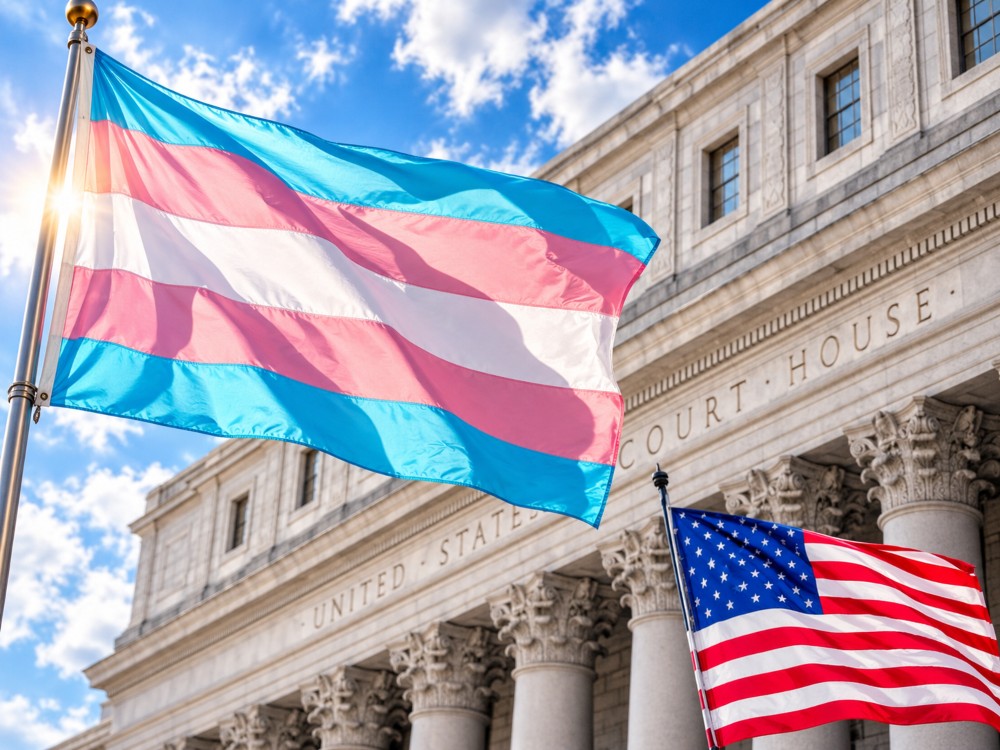
A US federal judge has ruled that a Christian-owned New Hampshire manufacturer cannot use religious-freedom arguments to have a transgender employee’s sex-discrimination claim dismissed, clearing the way for the case to proceed towards a jury trial.
A transgender machinist’s discrimination case against her employer will continue after a federal judge rejected the company’s attempt to rely on religious-freedom protections to defeat her remaining claim.
On 28 September, US District Judge Landya McCafferty denied Turbocam Inc’s bid for summary judgment on Lillian Bernier’s Title VII sex-discrimination claim.
Bernier, a transgender woman who has worked for Turbocam since 2019, alleges the New Hampshire manufacturer unlawfully discriminated against her by refusing to provide health insurance coverage for gender-affirming healthcare.
The ruling does not find Turbocam liable for discrimination. Instead, McCafferty concluded there are disputed factual issues that a jury could reasonably decide either way, meaning the Title VII claim cannot be resolved without a trial. She also denied Bernier’s own request for summary judgment in her favour.
Company argued religious beliefs protected its decision
Turbocam describes itself as a Christian business.
Its mission statement says the company exists to honour God, create wealth for employees and support Christian service, and says it holds itself accountable to “God’s law expressed in the Bible”.
The company argued that its religious beliefs should protect it from Bernier’s Title VII claim under the federal Religious Freedom Restoration Act, commonly known as RFRA, and the First Amendment’s Free Exercise Clause.
McCafferty rejected those arguments as grounds for ending the case.
On RFRA, the judge concluded that the law did not provide Turbocam with a defence in this private lawsuit because the federal government is not a party to the case.
“For all of these reasons, the court concludes as a matter of law that RFRA provides no defense to Turbocam against Bernier’s Title VII claim,” McCafferty wrote.
She also found that Turbocam’s Free Exercise argument did not entitle it to summary judgment, concluding that Title VII is a neutral law of general applicability.
Title VII of the US Civil Rights Act prohibits employers from discriminating against employees because of characteristics including sex. In its landmark 2020 Bostock v Clayton County ruling, the US Supreme Court held that discrimination against an employee for being gay or transgender falls within Title VII’s prohibition on sex discrimination.
Judge says jury could consider owner’s treatment of Bernier
McCafferty’s ruling points to evidence surrounding the attitudes of Turbocam owner and president Marian Noronha, who has ultimate authority over the company health plan.
During his deposition, Noronha repeatedly referred to Bernier using male pronouns.
The judgment records that when Bernier’s lawyers explained that she uses female pronouns and asked that he address her accordingly, Noronha continued referring to her as male.
Noronha also testified that he did not regard Bernier as a woman.
McCafferty concluded there was evidence from which a jury could find that Turbocam’s owner held “personal animus” towards Bernier because she is transgender.
However, other evidence could support Turbocam’s position.
The court noted that the company accommodated Bernier’s name change, generally used her requested pronouns, addressed another employee’s misgendering of her after she complained, and promoted her twice.
Because evidence exists on both sides, McCafferty said a reasonable jury could find either for Bernier or Turbocam on the Title VII claim.
What happened to Bernier’s healthcare coverage?
Bernier began working for Turbocam in June 2019 and began publicly transitioning in 2020.
At the time she began hormone therapy, Turbocam’s existing employee health plan covered transgender health services.
From January 2021, however, the company moved to a self-funded health plan. Under that arrangement, Turbocam had authority over what the plan covered, which treatments it excluded and whether individual exceptions could be granted.
The new plan excluded treatment for gender dysphoria.
The court record says Turbocam refused both to change that exclusion and to grant Bernier an individual exception that would cover surgery she was seeking.
McCafferty noted that the company’s refusal was not based on concerns about the cost, safety or effectiveness of Bernier’s requested treatment.
Bernier alleges that denying coverage because she sought gender-affirming healthcare amounted to discrimination because of sex.
Turbocam disputes that characterisation and argues that employees were offered the same health plan regardless of whether they were male or female.
The judge found that argument alone could not dispose of the Title VII claim, citing Supreme Court precedent that an employment policy can still constitute sex discrimination even when formally applied to everyone.
Disability claim dismissed
Bernier did not succeed on every part of her case.
McCafferty granted Turbocam summary judgment on Bernier’s claim under the Americans with Disabilities Act.
The judge concluded that, under the specific legal theory before the court, Bernier’s gender dysphoria fell within an exclusion in the ADA’s statutory definition of disability for certain gender identity disorders not resulting from physical impairments.
Bernier’s earlier claims under New Hampshire anti-discrimination law and the Affordable Care Act had already been voluntarily dismissed, meaning her Title VII claim is now the sole claim remaining for trial.
The court ordered the parties to propose a new schedule and consult with court staff about a trial date.
The case will therefore turn on whether a jury concludes Turbocam unlawfully discriminated against Bernier because of sex when it denied coverage for her gender-affirming healthcare.