








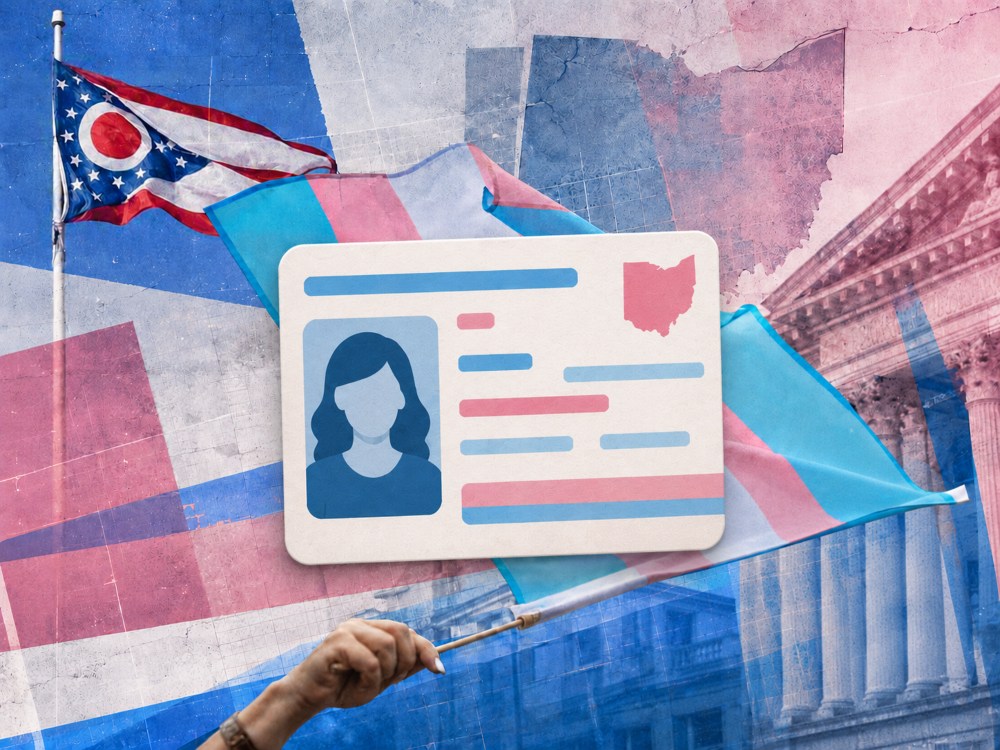

Ohio has abruptly ended a longstanding process that allowed transgender people to update the gender marker on their driver’s licence or state identification card without first changing other identity documents.
The Ohio Bureau of Motor Vehicles is no longer accepting its previous gender-change process, which allowed people to submit a professionally certified form requesting an updated marker.
Instead, the BMV says the sex listed on an Ohio driver’s licence or state ID must now correspond with the information on an accepted underlying document such as a birth certificate or passport.
The change took effect without a transition period, prompting LGBTQ+ advocates to accuse the state of deliberately making everyday life more difficult for transgender Ohioans.
For trans people whose birth certificates cannot easily be amended, the new policy could create a significant barrier to obtaining identification that reflects who they are.
A Sudden Change With No Transition Period
Until now, transgender Ohioans could request a gender-marker change directly through the BMV using a dedicated form.
That route has now been discontinued.
LGBTQ+ organisations Equality Ohio and TransOhio said the shift happened without advance public warning and immediately affected people attempting to update their documents.
Equality Ohio executive director Dwayne Steward strongly criticised the decision.
“Changing a policy this consequential overnight, without warning or transparency, is not an accident — it is a choice,” he said.
Steward described the move as an intentional attempt to make life harder for transgender people and also raised concerns about its potential impact on voting.
“We noticed. We are paying attention. And we will not stop fighting until every Ohioan has true lived and legal equality,” he said.
Why Birth Certificates Can Create Another Barrier
Requiring a driver’s licence to follow a birth certificate may sound like a simple administrative change.
For transgender people, it often is not.
The ability to amend an Ohio birth certificate has been the subject of years of litigation, and the process is not uniform across the state.
Some county probate courts have allowed transgender people to obtain corrections to the sex marker on their birth records, while others have taken a different approach.
That can leave access dependent on where someone lives and how a particular court interprets state law.
As a result, a trans person may be unable to easily change their birth certificate even if every other aspect of their daily life reflects their gender.
The new BMV approach therefore risks turning one difficult bureaucratic process into a prerequisite for another.
Ohio Law Now Rejects Gender Identity As A Basis For Sex Classification
The policy shift follows language already written into Ohio law establishing the state’s official approach to sex and gender.
Under the statute, Ohio recognises two sexes — male and female — and states that they are not changeable.
The legislation also contains a definition of “gender identity” that explicitly rejects it as a basis for legal sex classification.
That language is highly contested.
Major medical and psychological organisations distinguish gender identity from biological characteristics and recognise that transgender identities are a real part of human diversity.
Ohio’s statutory definition instead embeds one particular political understanding of sex and gender into state law.
For transgender Ohioans, the consequences are increasingly practical rather than merely rhetorical.
That definition is now influencing the identification documents they use in everyday life.
Why Accurate Identification Matters
A driver’s licence or state ID is not something most people think about until they need it.
It can be required when starting a new job, opening a bank account, renting housing, collecting medication, entering some venues, travelling domestically or interacting with government agencies.
In states with voter identification requirements, it can also be important when casting a ballot.
For transgender people, an ID that does not correspond with their name, appearance or gender presentation can expose private information every time the document is shown.
A routine interaction can suddenly become a forced coming-out.
That can lead to confusion, intrusive questioning, embarrassment or, in some circumstances, harassment and discrimination.
This is why LGBTQ+ advocates generally view accurate identity documents as an issue of safety and privacy as well as legal recognition.
Equality Ohio Raises Voting Concerns
Equality Ohio has described the timing and manner of the BMV change as particularly concerning because identification rules can also affect voting.
Steward characterised the policy as an attempt at “voter suppression”.
Whether the change ultimately prevents particular voters from casting ballots will depend on how Ohio’s election and identification requirements interact in individual cases.
But advocates argue that creating additional document mismatches and administrative hurdles risks disproportionately affecting transgender people.
Even when someone remains legally entitled to vote, uncertainty over identification can itself discourage participation.
That concern is especially significant in an election year.
A Growing Patchwork Across The United States
Ohio is not alone in restricting gender-marker changes.
Across the United States, the ability of transgender people to update identity documents increasingly depends on where they live.
Some jurisdictions have historically allowed people to change markers through relatively simple administrative processes.
Others require court orders or additional documentation, while a growing number of Republican-led states have moved to restrict changes more substantially.
The result is an increasingly complicated patchwork.
A transgender person may have one gender marker on a federal document and another on a state record, or find that documents accepted in one jurisdiction cannot easily be amended in another.
For a community already facing significant political scrutiny, those inconsistencies can make ordinary bureaucratic tasks considerably more stressful.
More Than A Letter On A Card
Supporters of restrictive gender-marker policies often frame the issue as one of maintaining accurate government records.
For trans people, however, the consequences extend beyond an “M” or “F” printed on a piece of plastic.
Identity documents are repeatedly used to verify who a person is.
When a government requires those documents to display information that does not reflect how someone lives and is recognised in everyday life, it can increase the likelihood that their transgender status will be disclosed without their consent.
For LGBTQ+ communities in Aotearoa New Zealand, the Ohio decision is another example of how debates over trans rights in the United States are increasingly playing out through administrative systems as well as headline legislation.
The change may look technical.
For the people required to present that ID at work, at the bank, at the airport or potentially at the ballot box, it can be anything but.