








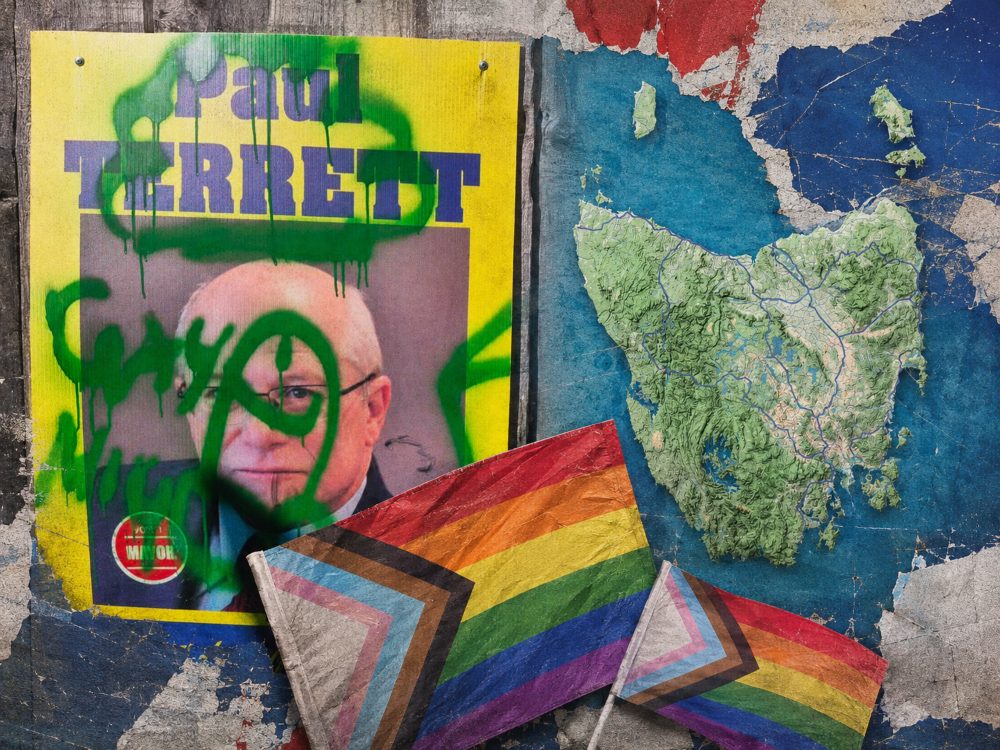

Campaign signs belonging to Tasmanian councillor Paul Terrett have been defaced with racist and homophobic slurs, prompting condemnation from LGBTQ+ advocates and renewed concern about hate targeting public figures.
Two signs promoting Terrett’s campaign for mayor of Northern Midlands Council were reportedly vandalised with anti-gay and racist language, along with crude drawings of genitalia.
The graffiti included deeply offensive slurs targeting both sexuality and race.
Equality Tasmania has condemned the vandalism, warning that attacks of this kind risk discouraging LGBTQ+ people from participating in public life.
“The anti-gay graffiti against Cr Terrett is a reminder that hate didn’t disappear with marriage equality,” Equality Tasmania spokesperson Rodney Croome said.
“This kind of graffiti will discourage LGBTQA+ people from standing for public office, which will be a loss for the whole community.”
Equality Tasmania Calls For Community Leaders To Speak Out
Croome urged political and community leaders to publicly condemn the attack.
“I urge community leaders to speak out against this attack to send a message hate is no longer acceptable,” he said.
He also called on Northern Midlands Council to develop an LGBTQIA+ inclusion plan similar to initiatives introduced by other Tasmanian councils.
Terrett has served as a Northern Midlands councillor since being elected in 2022 and is now campaigning for the mayoralty.
The vandalised signs have been reported to Tasmania Police.
Police are also investigating several graffiti incidents reported across the Northern Midlands during the same weekend, with the damage believed to have occurred overnight between 15 and 16 August.
There is currently no suggestion publicly identifying who was responsible for the vandalism.
Hate Does Not Disappear With Legal Equality
Tasmania’s LGBTQ+ rights record has undergone an extraordinary transformation over the past several decades.
The state was once the last Australian jurisdiction to decriminalise consensual sex between men, finally removing its laws in 1997 after years of activism and legal challenges.
Since then, Tasmania has frequently moved from being one of Australia’s least progressive jurisdictions on LGBTQ+ rights to one of its more proactive.
It became the first Australian state to establish a financial redress scheme for people affected by historical convictions under former laws criminalising homosexuality.
Tasmania has also played a leading role in initiatives designed to improve LGBTQ+ inclusion within tourism and other sectors.
But legal progress does not automatically remove prejudice.
Croome’s response to the vandalism reflects a concern shared by many rainbow advocates: LGBTQ+ equality on paper does not mean homophobia has disappeared from everyday life.
Graffiti may be dismissed by some as simple vandalism, but when it targets a person using slurs connected to sexuality or race, the message reaches beyond the damaged sign.
It tells members of those communities that their identities can still be used as weapons against them.
Public Office Should Be Open To Everyone
The attack also raises questions about who feels safe entering politics.
Local councils are often the most immediate form of government, dealing directly with neighbourhoods and communities.
Candidates already put themselves in a highly visible position by standing for office.
For LGBTQ+ candidates and others from minority communities, that visibility can also expose them to abuse focused not on their policies or performance, but on who they are.
That can have a chilling effect well beyond the individual being targeted.
If queer people see LGBTQ+ candidates subjected to slurs or harassment, some may reasonably wonder whether entering public life is worth exposing themselves and their families to the same treatment.
That is why Croome argues attacks such as this ultimately affect the wider community.
Representative democracy works best when people from a broad range of backgrounds feel able to participate.
Recent Anti-LGBTQ+ Vandalism Has Raised Concern
The incident in Tasmania follows other recent cases of homophobic vandalism targeting LGBTQ+ spaces around Australia.
Melbourne venues including The Laird and Eagle Leather have previously been targeted with anti-gay graffiti.
Such incidents sit alongside wider concerns about hostility directed at LGBTQ+ communities both online and offline.
Victoria is currently conducting a parliamentary inquiry into anti-LGBTIQA+ hate crimes following reports of targeted violence, harassment and abuse.
Evidence provided to the inquiry has highlighted the role online communities can play in spreading misogynistic, homophobic and transphobic rhetoric.
Researchers and community organisations have raised particular concerns about some online “manosphere” and extremist networks, where hostility towards women, LGBTQ+ people and racial minorities can overlap.
The inquiry has also heard disturbing accounts involving gay and bisexual men being targeted through dating apps, assaulted and, in some cases, threatened with being outed.
Racism And Homophobia Can Overlap
The vandalism of Terrett’s signs is notable because it reportedly combined racist and homophobic slurs.
That overlap is increasingly recognised by researchers studying hate and extremist movements.
Prejudice rarely exists neatly in separate boxes.
Individuals and groups promoting homophobia may also spread racism, misogyny, antisemitism or transphobia, with different forms of hostility reinforcing one another.
Victoria’s Commissioner for LGBTIQA+ Communities has warned that contemporary extremist and far-right networks can target multiple minority communities simultaneously.
That makes it important to respond to the vandalism not simply as an anti-gay incident or a racist one, but as an example of how hate can be directed across multiple identities at once.
Tasmania’s Progress Still Requires Protection
Tasmania’s transformation on LGBTQ+ rights is often held up as evidence of how quickly social attitudes and laws can change.
That progress deserves recognition.
But it also needs protecting.
Marriage equality, anti-discrimination protections and inclusive government policies do not mean every LGBTQ+ person feels safe or that prejudice has disappeared.
Visibility can still attract hostility.
The response cannot be to retreat from public life.
It must be to ensure that those targeted know their communities and institutions will stand behind them.
As Croome put it, hate did not vanish when marriage equality became law.
The challenge now is making sure incidents like this do not push LGBTQ+ people back out of the public spaces they fought so hard to enter.