










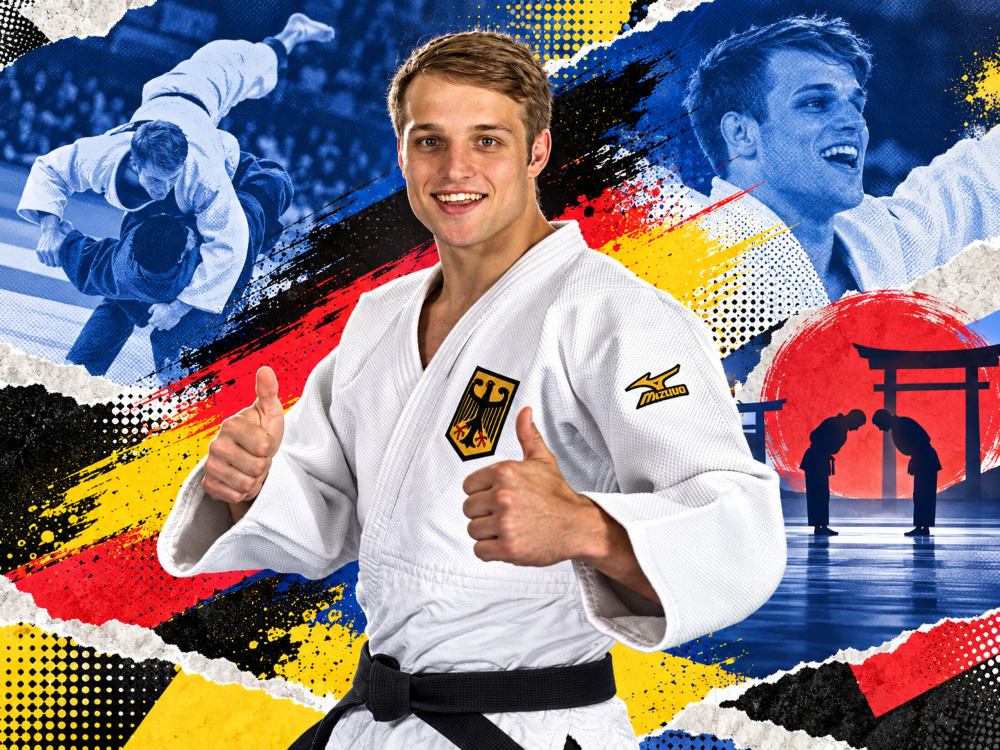

History-making gay Olympian Timo Cavelius is recovering from a double jaw fracture after being violently attacked by an opponent moments after winning a judo bout in Germany.
The 29-year-old German judoka was assaulted by Georgian competitor Akaki Japaridze following their Bundesliga match in Leipzig on 5 September.
Cavelius required surgery, with three metal plates inserted to stabilise his jaw.
The incident is being investigated by police, while German judo authorities have now imposed a lifetime Bundesliga ban on Japaridze.
There is currently no established evidence that Cavelius was attacked because he is gay, and Cavelius himself has declined to speculate about the motive.
What Happened In Leipzig?
Cavelius was competing for TSV Abensberg against Leipzig Judo Club when he faced Japaridze for the second time that day.
Japaridze had won their first bout, but Cavelius took the second.
After winning, Cavelius raised his fist in celebration towards his team.
Japaridze then attacked him, with the German Judo Federation saying Cavelius was struck repeatedly and continued to receive blows after falling to the ground before teammates intervened.
The federation described the incident as a serious physical assault and rejected attempts to portray it as a routine sporting confrontation.
Cavelius was taken to Leipzig University Hospital, where surgery was performed on his fractured jaw.
“My recovery is my priority now,” he later said.
“I’m glad that everything has gone according to plan so far, and I want to give my body the time it needs to heal completely.”
Lifetime Bundesliga Ban For Japaridze
Japaridze later posted a statement saying physical aggression was unacceptable and that he accepted responsibility for what happened.
However, he also claimed Cavelius had made an offensive gesture and behaved disrespectfully towards him.
Cavelius rejected that account.
“That celebration was for my own team and was an expression of joy at winning the bout,” he said.
He added that he had not verbally insulted Japaridze or physically attacked him, and said any offence taken from his celebration could not justify the violence that followed.
The German Judo Federation strongly backed Cavelius and criticised Japaridze’s explanation.
It said any attempt to minimise or defend the attack was incompatible with the values of judo.
On 22 September, Bundesliga authorities announced that Japaridze would be banned for life from being registered or competing in Germany’s Judo Bundesliga.
They also reversed the result of his earlier victory against Cavelius and amended the overall result of the team contest.
Assault Could Disrupt Olympic Campaign
The injuries come at a particularly damaging point in Cavelius’ sporting career.
He is attempting to qualify for the Los Angeles 2028 Olympic Games, having represented Germany at Paris 2024.
His enforced absence from competition could affect his world ranking, tournament seeding and ability to collect qualification points.
The German Judo Federation has said the consequences are especially severe because Cavelius is effectively paying a sporting price for being the victim of the attack.
For now, however, Cavelius says his focus is simply on healing.
A History-Making Gay Olympian
Cavelius made LGBTQ+ sporting history at Paris 2024 when he became the first openly gay male judoka to compete at an Olympic Games.
He had been open about being gay with people close to him and within his sport for several years before speaking publicly about his sexuality in 2020.
More recently, he has talked about how fears around coming out proved greater than the reaction he ultimately received from teammates.
His experience has made him an increasingly visible example of LGBTQ+ representation in elite men’s sport.
That visibility has inevitably prompted questions about whether his sexuality could have been connected to the Leipzig attack.
Cavelius has been careful not to make that claim.
“I cannot and do not want to judge whether Japaridze attacked me because of my sexuality,” he said.
There is currently no evidence establishing a discriminatory motive.
That distinction matters.
Cavelius’ significance as an openly gay Olympian is part of why the story resonates with LGBTQ+ audiences, but the assault should not be labelled homophobic without evidence to support that conclusion.
For now, the focus remains on his recovery — and whether the serious injuries will disrupt his path towards a second Olympic Games.