









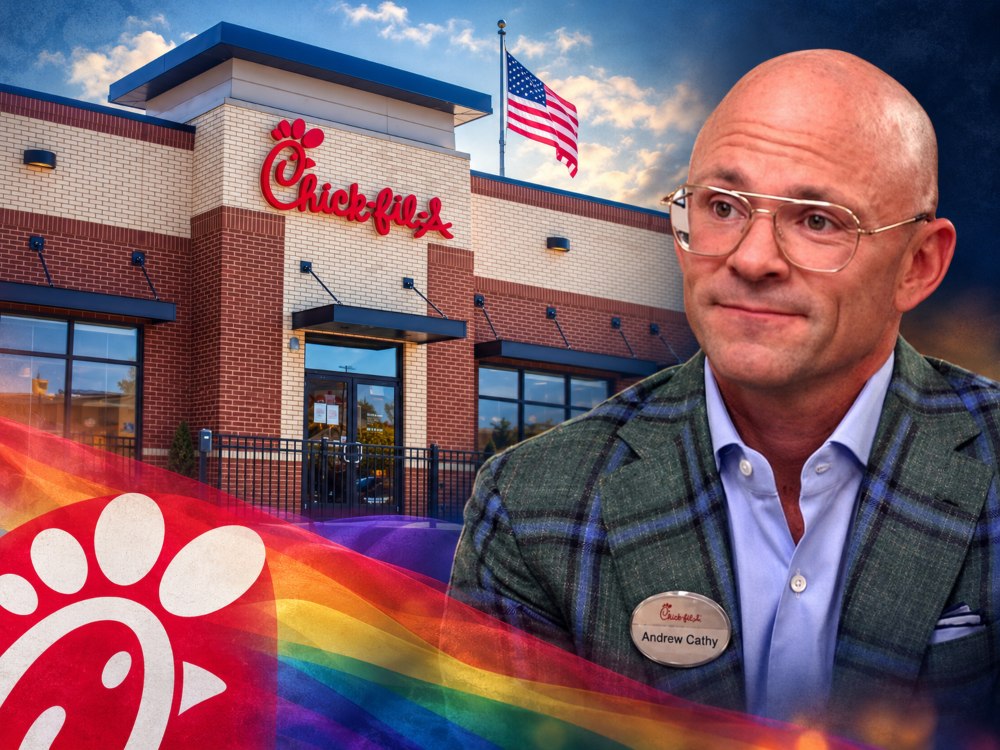
Chick-fil-A chief executive Andrew Cathy has declined to directly state whether the fast-food giant now supports LGBTQ+ equality, instead repeatedly emphasising hospitality and customer service when questioned about the company’s controversial history.
Chick-fil-A’s long-running relationship with LGBTQ+ controversy is back in the spotlight after chief executive Andrew Cathy was pressed on the company’s current position on equal rights.
Appearing on NBC’s Today, Cathy was questioned by presenter Craig Melvin about the backlash that has followed the company for more than a decade.
Asked what he would say to people who had boycotted Chick-fil-A because of its history, Cathy invited them to give the chain a try.
“For anybody that hasn’t tried us, we’d love for you to come try and have our great-tasting food and the hospitality that we’re known for,” he said.
When Melvin pushed further and asked about the company’s position on LGBTQ+ equal rights, Cathy again focused on service.
“We’re focused on hospitality, serving great-tasting food, and great service,” he said.
The answer confirmed that LGBTQ+ customers are welcome to eat at Chick-fil-A.
It did not answer the more specific question being put to him: whether the company’s leadership now supports LGBTQ+ equality or rejects the positions that helped create its reputation in the first place.
Why does Chick-fil-A have an anti-LGBTQ+ reputation?
The controversy dates back years and involves both statements from company leadership and charitable giving.
In 2012, Andrew Cathy’s father and then-CEO Dan Cathy publicly backed what he described as a biblical definition of the family, opposing same-sex marriage.
Those comments intensified scrutiny of donations made through organisations associated with Chick-fil-A and triggered boycotts, protests and highly publicised counter-campaigns supporting the company.
One major focus became the Fellowship of Christian Athletes.
Tax filings showed the Chick-fil-A Foundation donated US$1.65 million to the FCA in 2018, while the Atlanta branch of the Salvation Army received US$115,000.
The FCA maintains explicitly conservative Christian teachings around sexuality.
Its Christian Community Statement requires leaders to affirm its religious beliefs on sexual conduct and marriage, and those requirements have continued to feature in litigation involving the organisation as recently as 2026.
That history is a major reason LGBTQ+ campaigners have objected not simply to Chick-fil-A’s religious identity, but to where company-linked charitable money has previously gone.
What changed in 2019?
In November 2019, Chick-fil-A announced a major change to its charitable-giving strategy.
From 2020, the company said its giving would concentrate on education, homelessness and hunger, rather than continuing the previous funding arrangements that had drawn criticism.
Chick-fil-A’s own corporate reporting confirms that change in focus.
The shift meant the Fellowship of Christian Athletes and Salvation Army were no longer part of its announced funding programme.
At the time, however, company president Tim Tassopoulos said Chick-fil-A was not introducing a blanket policy excluding religious organisations from possible future funding.
So the 2019 move was a clear change in charitable priorities.
It was not an explicit declaration that the company supported marriage equality or LGBTQ+ rights more broadly.
That distinction is part of why the issue continues to follow Chick-fil-A.
The company’s giving looks different today
Chick-fil-A’s current corporate philanthropy is heavily focused on food insecurity, education and community programmes.
Its current material highlights initiatives including Shared Table, which redistributes surplus restaurant food, and its True Inspiration Awards, which provide grants to community organisations.
The company says more than 90% of its restaurants now participate in its food-recovery programme and that its hunger-relief initiatives have helped provide the equivalent of hundreds of millions of meals since 2020.
That represents a significant shift from the giving structure that fuelled much of the original LGBTQ+ backlash.
What remains less clear is whether there has been a corresponding shift in the company leadership’s stated position on LGBTQ+ equality.
Cathy’s Today interview did not provide one.
London opening brought the controversy back
The issue has become particularly visible again as Chick-fil-A expands internationally.
On 5 March 2026, LGBTQ+ rights campaigner Peter Tatchell led a demonstration outside the opening of the company’s first London restaurant in Kingston upon Thames.
Campaigners called on Chick-fil-A to publicly commit to not funding organisations that oppose LGBTQ+ equality.
The Peter Tatchell Foundation said it had repeatedly attempted to engage the company and seek assurances about future donations.
The organisation said it had been unable to obtain the commitment it wanted and therefore encouraged a consumer boycott.
That campaign is an advocacy position, rather than evidence that Chick-fil-A currently funds the same organisations it supported before 2019.
The criticism instead centres on the company’s history and its refusal, in campaigners’ view, to make an explicit commitment ruling out future support for organisations opposing LGBTQ+ rights.
Hospitality versus equality
Cathy became chief executive in 2021, succeeding his father as the third generation of the Cathy family to lead the company.
In his Today interview, he also defended Chick-fil-A’s long-standing practice of closing on Sundays, describing it as an opportunity for staff to rest, spend time with family and attend church if they choose.
Chick-fil-A’s Christian identity is not itself the core of the LGBTQ+ controversy.
The criticism has instead centred on documented donations and public statements opposing same-sex marriage.
That is what makes Cathy’s response notable.
Saying LGBTQ+ customers will receive food and hospitality answers one question: whether they can walk into a restaurant and expect to be served.
It does not answer another: whether the people leading the company support those customers having equal rights outside its doors.
For now, Chick-fil-A’s charitable priorities have clearly changed.
Its answer on LGBTQ+ equality remains much less explicit.